






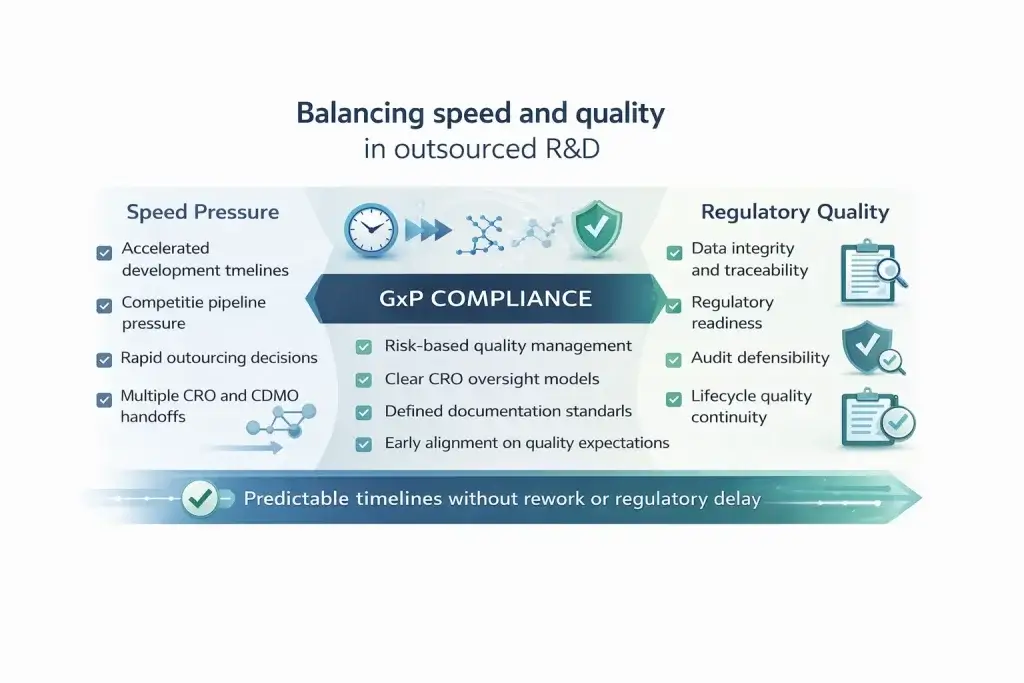
Outsourced research and development (R&D) has become central to how pharmaceutical and biotechnology companies manage innovation, scale, and cost. As pipelines expand and modalities become more complex, sponsors increasingly rely on external partners to deliver discovery, development, and manufacturing activities at pace. At the same time, regulatory expectations around GXP compliance continue to intensify. This creates a persistent tension: how to move fast without weakening quality systems, data integrity, or regulatory readiness.
In outsourced R&D, speed and quality are often treated as competing priorities. In practice, they are tightly connected. Delays, rework, and regulatory findings usually arise not from excessive quality controls but from gaps in planning, oversight, and execution. Balancing timelines while maintaining GXP compliance requires a disciplined approach to governance, risk, and partnership design across the R&D lifecycle.
Why speed pressure is rising in outsourced R&D
The pressure to accelerate development timelines is coming from several directions. Scientific competition is intense, particularly in oncology, immunology, and rare diseases. Investors expect earlier value inflection points, while payers and regulators demand stronger evidence of safety, efficacy, and manufacturing control. Outsourcing R&D allows sponsors to access specialized capabilities quickly, but it also introduces additional interfaces where timelines can slip.
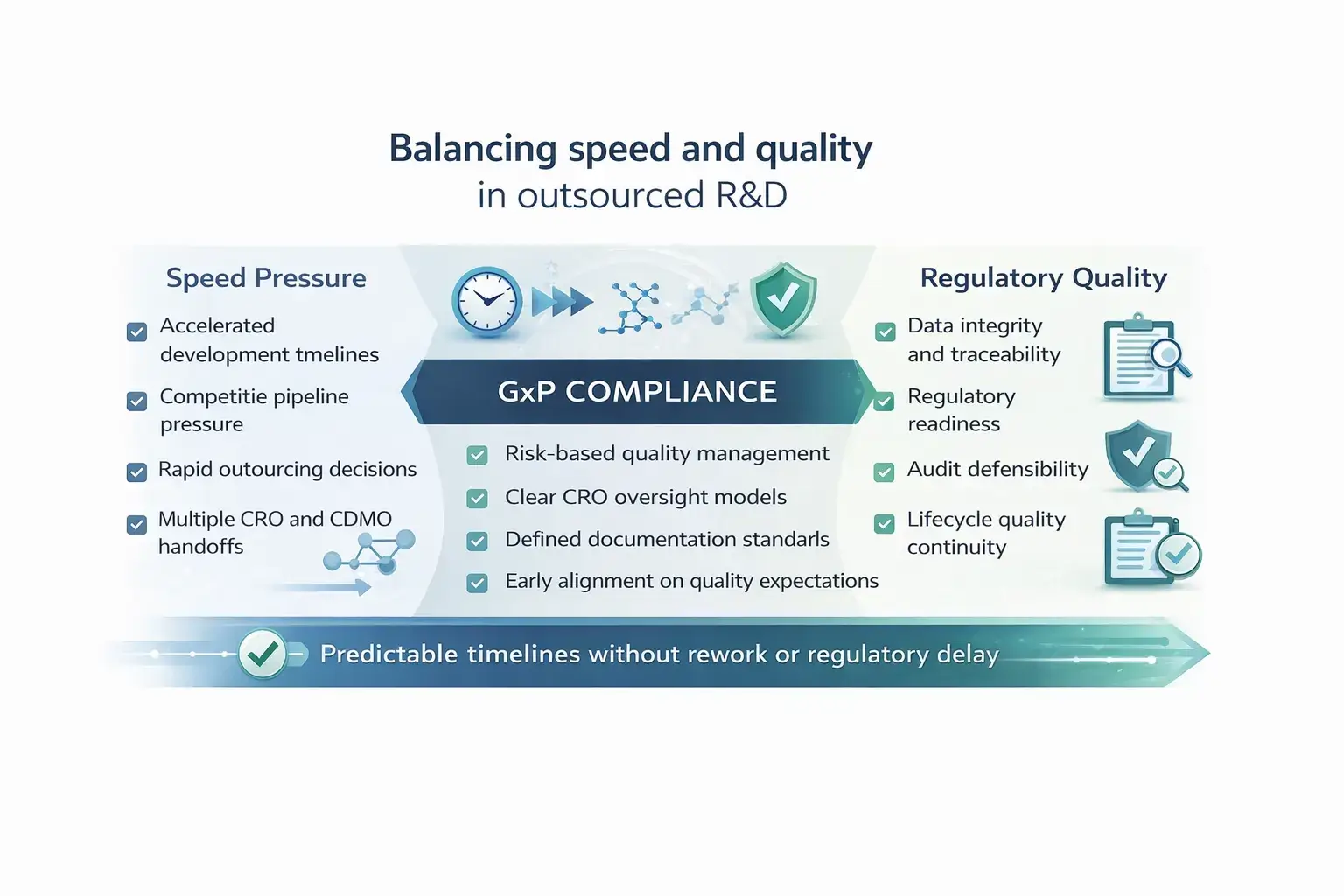
In contract research and development, speed is often interpreted as faster execution at the bench or plant floor. However, many delays occur upstream or downstream of execution. Ambiguous scopes, late changes in strategy, incomplete transfer packages, and unclear quality expectations slow programs far more than experimental work itself. These issues become amplified when activities are distributed across multiple CROs or CDMOs, increasing the need for structured CRO oversight.
GXP compliance as a driver of predictable timelines
There is a common misconception that GXP compliance slows programs down. In reality, strong compliance frameworks reduce uncertainty and prevent downstream disruption. When quality systems are clearly defined and consistently applied, teams spend less time resolving deviations, repeating studies, or defending data during audits.
Early integration of GXP compliance into outsourcing decisions helps align expectations between sponsor and partner. This includes clarity on data ownership, documentation standards, change control, and deviation management. When these elements are agreed upon upfront, development teams can make faster decisions with confidence that outputs will withstand regulatory scrutiny.
In outsourced settings, compliance should not be viewed as a checklist applied at the end of a study or campaign. It must be embedded into daily operations, from protocol design and method validation to tech transfer and scale-up. This approach supports both speed and quality by reducing the likelihood of late-stage surprises.
Risk-based quality management in external partnerships
A key enabler of balanced timelines is risk-based quality management. Not all activities carry the same regulatory or patient risk, and treating them uniformly often leads to inefficiency. A risk-based approach focuses attention and resources on critical process parameters, data criticality, and decision-making points that directly impact product quality and patient safety.
In outsourcing R&D, this means jointly identifying high-risk activities early and designing controls proportionate to that risk. For example, early discovery assays may require flexibility and rapid iteration, while later-stage bioanalytical or stability studies demand stricter controls and documentation. Aligning on this distinction allows partners to move quickly where appropriate, without compromising GXP compliance where it matters most.
Risk-based quality management also improves communication between sponsors and service providers. Clear escalation pathways and predefined acceptance criteria reduce delays caused by uncertainty or over-review. Over time, this builds mutual trust and operational efficiency.
Designing effective CRO oversight without slowing execution
Effective CRO oversight is essential in outsourced R&D, but excessive or poorly structured oversight can become a bottleneck. The goal is not to duplicate the CRO’s quality systems, but to ensure alignment, visibility, and accountability.
Successful oversight models are built around transparency rather than control. Regular data reviews, shared dashboards, and joint governance forums allow issues to be identified early, when they are easier to resolve. Oversight should focus on trends and systemic risks, not individual data points, unless there is a clear signal of concern.
Importantly, oversight expectations should evolve with the program phase. Early development benefits from frequent scientific interaction, while later stages require tighter control over documentation, validation, and change management. Adapting oversight intensity to program maturity supports both speed and quality.
Managing interfaces across the outsourced R&D continuum
Outsourcing R&D rarely involves a single partner or a single activity. Discovery, development, and manufacturing are increasingly interconnected, and decisions made at one stage affect timelines at the next. Fragmentation across vendors is a common source of delay, particularly during transitions.
Integrated CRDMO management services help reduce friction at these interfaces. When development and manufacturing considerations are addressed early, rework during scale-up or validation can be minimized. Similarly, early alignment between analytical development and regulatory strategy reduces the risk of late method changes.
From a sponsor perspective, this requires a holistic view of the outsourcing landscape. Rather than optimizing each activity in isolation, timelines improve when decisions are made with the full lifecycle in mind. This systems-level thinking is especially important as molecules become more complex and regulatory expectations increase.
Data integrity and digital readiness as accelerators
Digital systems play an increasingly important role in balancing speed and quality. Electronic data capture, centralized document management, and integrated quality platforms improve traceability and reduce manual effort. When implemented well, they support GXP compliance while enabling faster data review and decision making.
However, digital tools alone are not sufficient. Processes and people must be aligned to use them effectively. Clear data standards, defined roles, and training across sponsor and partner teams are critical. Without this alignment, digitalization can introduce new delays rather than removing existing ones.
In outsourced R&D, shared digital environments also improve collaboration and oversight. Real-time access to data and documentation allows sponsors to engage proactively, rather than reacting after milestones are missed.
Building long-term outsourcing relationships for speed and quality
Balancing speed and quality is easier in long-term partnerships than in transactional engagements. Over time, partners develop a deeper understanding of sponsor expectations, decision-making styles, and risk tolerance. This reduces onboarding time, improves communication, and supports consistent GXP compliance across programs.
Long-term relationships also allow continuous improvement initiatives to take root. Lessons learned from one program can be applied to the next, gradually improving timelines without compromising quality. This is particularly valuable in platforms or modalities where sponsors expect to run multiple programs over several years.
In this context, outsourcing R&D becomes less about cost arbitrage and more about capability extension. The most effective partnerships are those where speed is achieved through alignment, not pressure.
Conclusion
In outsourced R&D, speed and quality are not opposing forces. When GXP compliance, risk-based quality management, and effective CRO oversight are built into the partnership from the start, timelines become more predictable and resilient. Delays are reduced not by cutting corners, but by removing ambiguity, strengthening interfaces, and focusing effort where risk is highest.
As development programs grow in complexity, sponsors and service providers must move beyond simplistic trade-offs between speed and quality. A structured, lifecycle-oriented approach to outsourcing R&D enables faster progress while maintaining the standards required for regulatory success and patient safety.