






Bispecific Antibodies in Clinical Development: Translating Molecular Innovation into Reliable Clinical Evidence
Home » Resources ▸ View Points » Bispecific Antibodies in Clinical Development: Translating Molecular Innovation into Reliable Clinical Evidence
Bispecific antibodies have moved from experimental constructs to central pillars of modern biologics pipelines, particularly in oncology and clinical development, where they represent one of the most promising therapeutic classes of the last decade (Choi et al., 2024; Zhou et al., 2022). By binding two targets simultaneously, these engineered molecules can redirect immune cells to tumors, block parallel signaling pathways, or modulate two immune checkpoints at once (Choi et al., 2024). The scientific rationale is powerful. Early clinical responses observed across multiple programs have reinforced enthusiasm across the industry (Choi et al., 2024; Zhou et al., 2022).
Yet as many sponsors have discovered, the complexity of bispecific antibodies does not end at molecular design. The true test begins when the molecule enters preclinical toxicology and clinical development. At that stage, the focus shifts from what the molecule can theoretically do to what can be reliably measured, reproduced, and defended under regulatory scrutiny. Pharmacokinetics must be characterized across extreme concentration ranges to ensure accurate estimation of exposure parameters such as Cmax, AUC, and half-life, which directly inform dose selection, safety margins, and regulatory decision-making (U.S. Food and Drug Administration, 2022). Immunogenicity must be detected even in the presence of high circulating drug levels to avoid false-negative anti-drug antibody results that could obscure true immune responses and distort interpretation of safety and efficacy data (Myler et al., 2021; U.S. Food and Drug Administration, 2019). Assays must remain stable over long clinical timelines and across thousands of samples to maintain data consistency, reproducibility, and regulatory credibility throughout the duration of large, submission-supportive clinical programs (U.S. Food and Drug Administration, 2022).
The transition from molecular innovation to robust clinical evidence depends on bioanalytical precision. The experience from two recent development programs—one involving a bispecific nanobody and another focused on a half-life extended bispecific antibody in oncology—illustrates how early analytical challenges can threaten timelines and how methodical optimization can restore confidence (Syngene International Limited, n.d.-a, n.d.-b).
This viewpoint examines bispecific antibodies from a development perspective, highlighting the scientific nuances that shape bioanalytical strategy and explaining why assay design is often the decisive factor between program acceleration and delay.
Bispecific antibody design and analytical implications
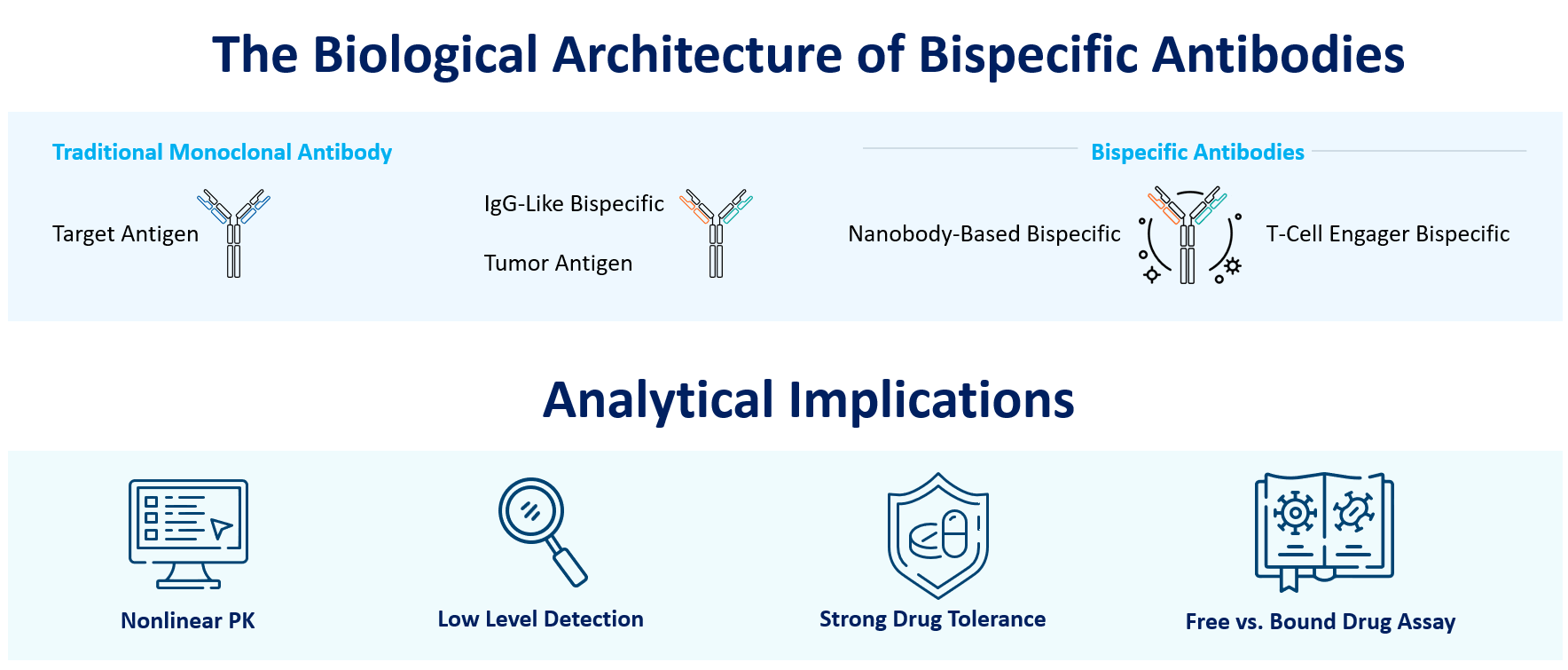
Traditional monoclonal antibodies bind a single antigen. Their pharmacokinetic behavior, immunogenicity profile, and assay formats are relatively well characterized after decades of development experience. Bispecific antibodies, however, introduce structural and functional diversity that directly affects analytical strategy (Choi et al., 2024; Datta-Mannan et al., 2021).
Some bispecific constructs are IgG-like molecules engineered with dual-binding domains. Others are smaller fragments, such as nanobody-based formats, that offer improved tissue penetration but often clear more rapidly. T-cell–engaging bispecifics typically bind CD3 on T cells and a tumor-associated antigen on malignant cells, physically bridging immune effector cells to their targets (Choi et al., 2024; Zhou et al., 2022).
This dual engagement changes pharmacology in several ways. Clearance may be influenced by both targets. Target-mediated drug disposition can become more pronounced. Soluble antigen may interfere with quantification. Exposure–response relationships can be nonlinear. Half-life extension technologies, including Fc engineering or albumin-binding strategies, may further modify distribution and elimination kinetics (Choi et al., 2024; Datta-Mannan et al., 2021; Schropp et al., 2019).
Each of these biological features introduces analytical consequences. A molecule with rapid distribution and deep terminal elimination requires an assay that remains sensitive at very low concentrations. A half-life extended molecule with prolonged systemic exposure demands strong drug tolerance in immunogenicity assays. A T-cell engager operating in complex immune environments requires highly selective detection to distinguish free drug from target-bound complexes (Myler et al., 2021; Schropp et al., 2019; U.S. Food and Drug Administration, 2019, 2022; Zhou et al., 2022).
In bispecific development, the analytical framework must evolve alongside molecular design.
Dynamic range challenges in pharmacokinetic assays during clinical development
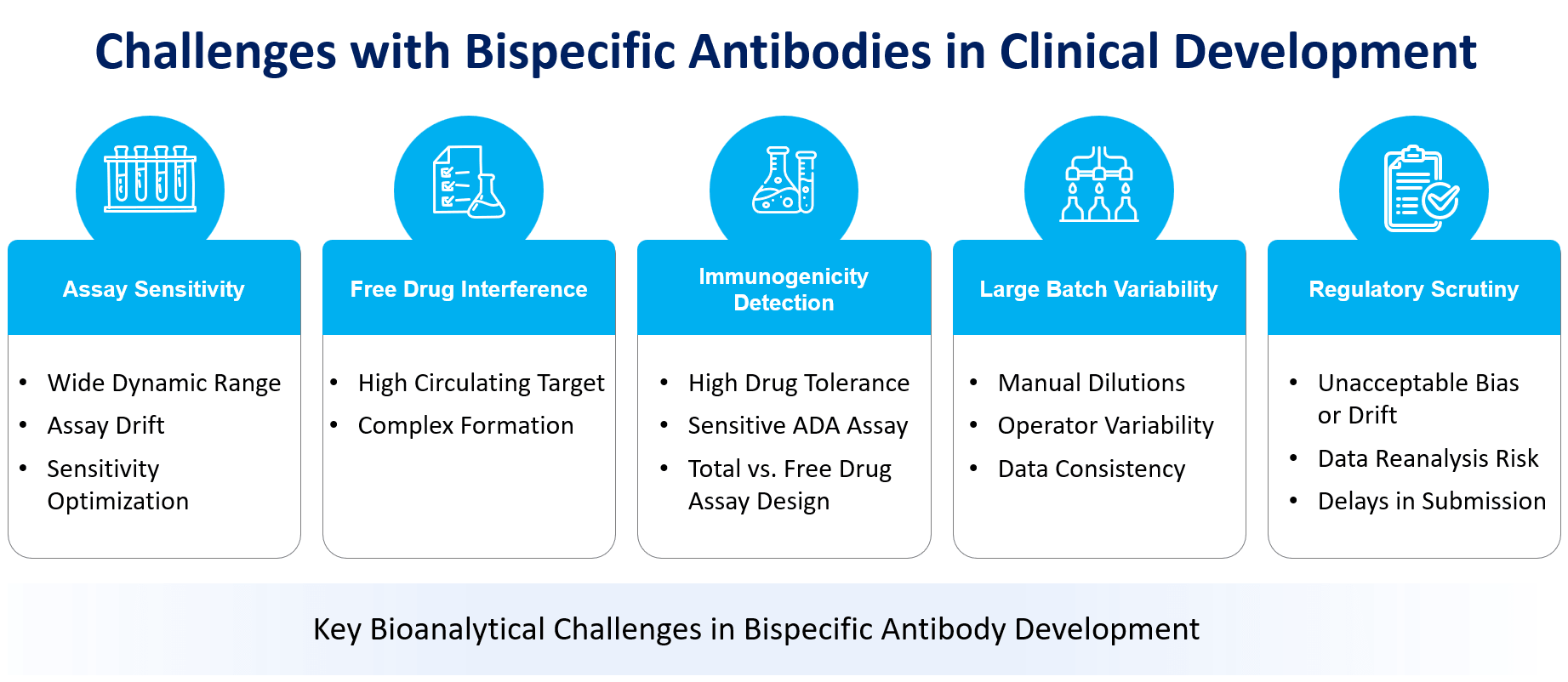
One of the earliest and most common analytical challenges in bispecific programs is dynamic range. A pharmacokinetic assay must quantify drug concentrations spanning several orders of magnitude within a single study. Early post-dose samples may show very high concentrations, while terminal-phase samples may fall close to the lower limit of detection (U.S. Food and Drug Administration, 2022).
In a clinical program involving a novel bispecific nanobody, this issue became immediately apparent. The transferred ligand-binding assay could not reliably measure the lowest expected concentrations. At the same time, high peak concentrations strained the upper limit of quantification. Plate drift and positional variability compounded the issue, and spike-recovery results showed systemic negative bias (Syngene International Limited, n.d.-a).
If left unresolved, such issues can distort exposure estimates. Underestimation of terminal-phase concentrations affects half-life calculations. Inaccurate Cmax values influence safety margin assessment. Inconsistent recovery across plates increases repeat analysis rates, consuming time and precious clinical samples (U.S. Food and Drug Administration, 2022).
A structured optimization strategy was implemented to address these limitations. The calibration curve was redesigned to extend the quantifiable range from 1.00 to 1000 ng/mL. Reagent concentrations were reclaiberated to stabilize signal generation across the entire plate. Well-loading sequences and mixing steps were standardized to minimize temporal drift (Syngene International Limited, n.d.-a).
The impact of these refinements was substantial. Spike-recovery bias narrowed to within acceptable limits, and low-concentration samples down to approximately 1.43 ng/mL could be reliably detected. Across the clinical study, repeat rates dropped to around one percent, reflecting a stable and reproducible method (Syngene International Limited, n.d.-a).
What might appear as technical fine-tuning had broader implications. With reliable concentration–time profiles, clinical teams could estimate Cmax, AUC, and elimination parameters with confidence. Dose-selection decisions became more defensible. Regulatory discussions were supported by internally consistent exposure data. The integrity of the pharmacokinetic dataset directly influenced the program’s forward trajectory (U.S. Food and Drug Administration, 2022).
Free drug versus total drug: specificity in complex matrices
In bispecific antibody programs—particularly those involving immune cell engagement—the distinction between free drug and target-bound drug becomes analytically significant. One arm of the molecule may bind a soluble antigen present in plasma. If an assay cannot distinguish between free and bound forms, measured concentrations may not accurately reflect pharmacologically active drug (Schropp et al., 2019; Zhou et al., 2022).
This challenge intensifies in oncology programs where tumor-associated antigens may circulate in measurable amounts. Without careful validation, soluble target interference can suppress or artificially inflate signal. Assay specificity must therefore be demonstrated under realistic matrix conditions, including the presence of soluble antigen at clinically relevant concentrations (U.S. Food and Drug Administration, 2022).
The half-life extended bispecific antibody developed for small-cell lung cancer illustrates this complexity. The pharmacokinetic assay was required to function directly in serum without applying a fixed minimum required dilution. The method transferred to an MSD platform achieved sensitivity down to approximately 0.4 ng/mL while maintaining specificity even in the presence of soluble target (Syngene International Limited, n.d.-b).
Such specificity studies are more than regulatory formalities. They ensure that the measured analyte corresponds to the biologically relevant form of the molecule. Accurate free drug quantification underpins exposure–response modeling and informs safety and efficacy interpretation (U.S. Food and Drug Administration, 2022).
Anti-drug antibodies under high circulating drug conditions
Immunogenicity assessment is an inherent requirement in biologics development. Anti-drug antibodies (ADA) can alter pharmacokinetics, reduce efficacy, and occasionally contribute to safety events. In bispecific antibodies, particularly T-cell engagers, immunogenicity risk must be closely monitored (U.S. Food and Drug Administration, 2014; Zhou et al., 2022).
However, long half-life constructs introduce a technical paradox. High circulating drug levels can mask ADA detection in bridging assays, producing false-negative results. Drug tolerance studies therefore become essential components of assWay validation (Myler et al., 2021; U.S. Food and Drug Administration, 2019).
In the oncology program involving the half-life extended bispecific antibody, a bridging ligand-binding assay on the MSD platform achieved sensitivity below 5 ng/mL. Importantly, the assay demonstrated ADA detection across a wide concentration range, from approximately 12 ng/mL to 10,000 ng/mL, even in the presence of at least 10 µg/mL circulating drug (Syngene International Limited, n.d.-b).
This degree of drug tolerance is critical for interpreting immunogenicity incidence accurately. Without it, ADA rates may be underestimated, and subsequent exposure–immunogenicity correlations may be misleading. Robust drug tolerance validation provides a clearer understanding of true immunogenicity patterns over extended dosing intervals (Myler et al., 2021; U.S. Food and Drug Administration, 2019).
Controlling variability in large clinical programs
As development advances into later phases, sample volumes increase substantially. Late-stage oncology studies may generate thousands of serum samples over extended timelines. Even a well-validated assay can exhibit variability if calibrators and controls are prepared manually across multiple batches (U.S. Food and Drug Administration, 2022).
Operator-dependent variability, lot-to-lot inconsistencies, and cumulative drift can subtly influence long-term trends. For submission-supportive programs, where regulators review exposure and immunogenicity data across entire trial durations, such variability becomes a serious concern.
To mitigate this risk, automation of calibrator and control preparation was implemented using a Tecan liquid-handling platform. Bulk preparation procedures were standardized, reducing operator burden and improving reproducibility across runs. Automation also enhanced traceability and documentation, supporting audit readiness (Syngene International Limited, n.d.-b).
Operational discipline in assay execution is often as important as scientific design. A sensitive assay that cannot maintain consistency over time provides limited value. Conversely, a well-controlled workflow ensures that data generated months apart remain comparable and defensible.
Regulatory expectations in bispecific antibody clinical development
Regulatory authorities have become increasingly attentive to bioanalytical robustness in complex biologics. Reviewers evaluate sensitivity, specificity, precision, accuracy, stability, selectivity, dilution integrity, and drug tolerance in detail. For bispecific antibodies, where pharmacology may be novel, clarity in exposure characterization is essential (U.S. Food and Drug Administration, 2022).
Inadequate validation can lead to information requests, bridging study requirements, or demands for reanalysis. Such outcomes delay development and consume resources. Early anticipation of regulatory expectations allows sponsors to design assays that align with submission requirements from the outset.
A comprehensive bioanalytical strategy therefore serves not only scientific objectives but also regulatory positioning. By demonstrating control over assay performance variables, sponsors strengthen the credibility of their clinical data packages.
Integrating pharmacokinetics and anti-drug antibodies strategy
Pharmacokinetics and immunogenicity are not independent domains in bispecific antibody programs. ADA formation can alter drug clearance, reduce systemic exposure, and modify pharmacodynamic responses. Conversely, high exposure levels may mask ADA detection if drug tolerance is insufficient (Myler et al., 2021; U.S. Food and Drug Administration, 2014, 2019; Zhou et al., 2022).
An integrated strategy considers sampling schedules, assay formats, and data interpretation frameworks holistically. Exposure data are reviewed alongside ADA incidence. Trends in clearance are evaluated in the context of immunogenicity status. Statistical models incorporate both parameters to clarify exposure–response relationships (U.S. Food and Drug Administration, 2014; Zhou et al., 2022).
Such integration supports more nuanced clinical decision-making. Rather than viewing PK and ADA as separate reporting streams, they are interpreted as interconnected components of the molecule’s in vivo behavior (U.S. Food and Drug Administration, 2014; Zhou et al., 2022).
Scaling analytical frameworks for next-generation multispecifics
The field of multispecific biologics continues to evolve. Trispecific antibodies, conditionally activated constructs, and tumor microenvironment–selective formats are entering development. Each additional functional domain increases analytical complexity (Choi et al., 2024; Zhou et al., 2022).
Future programs may require multiplexed detection platforms capable of quantifying multiple analytes simultaneously. Hybrid ligand-binding and mass spectrometry approaches may be needed to distinguish closely related molecular species. Advanced PK–PD modeling will likely become standard practice to interpret complex exposure patterns (Schropp et al., 2019; U.S. Food and Drug Administration, 2022).
Sponsors who establish flexible, scalable bioanalytical infrastructure today will be better positioned to manage these emerging challenges. Analytical agility is becoming a competitive advantage in the biologics landscape (U.S. Food and Drug Administration, 2022).
Lessons from recent bispecific antibody development programs
The bispecific nanobody program and the half-life extended oncology program provide complementary insights into development strategy. The nanobody case emphasized dynamic range extension and bias reduction to capture both peak and terminal concentrations reliably. The oncology program highlighted the importance of high sensitivity, drug-tolerant immunogenicity detection, and automation for large-scale consistency (Syngene International Limited, n.d.-a, n.d.-b).
Together, these experiences reinforce a central principle: measurement precision determines translational success. Molecular design may drive innovation, but assay stability determines whether innovation translates into regulatory-ready evidence (Syngene International Limited, n.d.-a, n.d.-b).
Programs that anticipate analytical complexity early tend to move more efficiently through clinical phases. Those that address assay limitations reactively often encounter avoidable delays (Syngene International Limited, n.d.-a, n.d.-b).
Conclusion: measurement as the foundation of innovation
Bispecific antibodies represent one of the most transformative modalities in modern biologics. Their ability to engage dual targets opens new therapeutic possibilities, particularly in oncology. However, with innovation comes analytical responsibility.
Reliable pharmacokinetic characterization requires wide dynamic range, high sensitivity, and strict control of bias and drift. Immunogenicity assessment demands drug-tolerant detection and integrated interpretation alongside exposure data. Operational scalability requires automation and standardized workflows. Regulatory expectations require comprehensive validation and documentation.
The development experiences described here demonstrate that bioanalytical rigor is not a peripheral function but a central pillar of success. When assay design evolves in parallel with molecular engineering, bispecific antibodies progress through clinical development with stronger data packages and greater confidence.
In complex biologics programs, scientific ambition must be matched by measurement excellence. Only when both elements are aligned can molecular innovation fully realize its therapeutic potential.
References
- Choi, S. M., Lee, J.-H., Ko, S., Hong, S.-S., & Jin, H.-E. (2024). Mechanism of action and pharmacokinetics of approved bispecific antibodies. Biomolecules & Therapeutics, 32(6), 708–722. https://doi.org/10.4062/biomolther.2024.146
- Datta-Mannan, A., Brown, R., Key, S., Cain, P., & Feng, Y. (2021). Pharmacokinetic developability and disposition profiles of bispecific antibodies: A case study with two molecules. Antibodies, 11(1), Article 2. https://doi.org/10.3390/antib11010002
- Myler, H., Pedras-Vasconcelos, J., Phillips, K., Hottenstein, C. S., Chamberlain, P., Devanarayan, V., Gleason, C., Goodman, J., Hock, M. B., Kaliyaperumal, A., Karnes, H. T., Kaur, S., Kelley, M., Liu, S., Michaut, M., Mire-Sluis, A., Rup, B., Sikkema, D., Tourdot, S., … Shankar, G. (2021). Anti-drug antibody validation testing and reporting harmonization. The AAPS Journal, 24, Article 4. https://doi.org/10.1208/s12248-021-00649-y
- Schropp, J., Khot, A., Shah, D. K., & Koch, G. (2019). Target-mediated drug disposition model for bispecific antibodies: Properties, approximation, and optimal dosing strategy. CPT: Pharmacometrics & Systems Pharmacology, 8(3), 177–187. https://doi.org/10.1002/psp4.12369
- Syngene International Limited. (n.d.-a). Bioanalysis for a fit-for-purpose PK assay for a novel bispecific nanobody [Case study].
- Syngene International Limited. (n.d.-b). Pharmacokinetics-focused bioanalysis for a half-life extended bispecific antibody in oncology [Case study].
- S. Food and Drug Administration. (2014). Immunogenicity assessment for therapeutic protein products: Guidance for industry. https://www.fda.gov/regulatory-information/search-fda-guidance-documents/immunogenicity-assessment-therapeutic-protein-products
- S. Food and Drug Administration. (2019). Immunogenicity testing of therapeutic protein products: Developing and validating assays for anti-drug antibody detection: Guidance for industry. https://www.fda.gov/regulatory-information/search-fda-guidance-documents/immunogenicity-testing-therapeutic-protein-products-developing-and-validating-assays-anti-drug
- S. Food and Drug Administration. (2022). M10 bioanalytical method validation and study sample analysis: Guidance for industry. https://www.fda.gov/media/162903/download
- Zhou, Y., Penny, H. L., Kroenke, M. A., Bautista, B., Hainline, K., Chea, L. S., Parnes, J., & Mytych, D. T. (2022). Immunogenicity assessment of bispecific antibody-based immunotherapy in oncology. Journal for ImmunoTherapy of Cancer, 10(4), Article e004225. https://doi.org/10.1136/jitc-2021-004225