





From Throughput to Decisions: Redefining DMPK Efficiency Through Integrated Automation
Home » Whitepapers » From Throughput to Decisions: Redefining DMPK Efficiency Through Integrated Automation
Executive Summary
DMPK solutions are becoming central to faster discovery decisions because drug metabolism and pharmacokinetics (DMPK) studies guide compound progression by informing solubility, permeability, metabolic stability, and drug–drug interaction risk. However, advances in compound generation have outpaced traditional DMPK services capacity, creating a structural bottleneck in the Design–Make–Test–Analyze (DMTA) cycle.
Conventional DMPK workflows continue to rely on manual liquid handling, sequential LC–MS/MS analysis, and fragmented data management systems, limiting throughput and operational efficiency. As a result, the timely integration of DMPK data into compound design and optimization processes is often constrained, reducing its impact on real-time decision-making.
The value of DMPK automation lies not in increasing analytical volume, but in Enabling timely, dependable, and decision relevant scientific insight.
This work presents an integrated DMPK automation framework connecting experimental execution, analytical workflows, and data processing. In the first case study, automation increased scientist productivity from 24 to 45 compounds per day while improving right-first-time performance from 89% to 96%. In the second case study, implementation of a dual-injector with automatic column regeneration in the LC-MS/MS workflow increased analytical throughput from ~37 to ~71 samples per hour through improved instrument utilization.
Evaluation across nine DMPK assays demonstrated high agreement for robust endpoints, alongside assay-dependent variability in more complex systems. These results highlight that automation must be assessed not only by throughput gains, but by its ability to preserve decision quality.
Why DMPK Services Need Automation In Discovery
DMPK occupies a significant role in drug discovery by linking compound synthesis to progression decisions. Despite promising biological activity, compounds often fail due to poor pharmacokinetic or physicochemical properties. As a result, DMPK data is critical for determining whether compounds are advanced, optimized, or discontinued.
These evaluations occur iteratively within the DMTA cycle and rely heavily on rapid feedback. The value of DMPK data is determined not only by its accuracy and quality but also by the speed with which it is generated and delivered. Data produced outside the critical compound design window often has limited influence on decision-making, whereas timely, actionable insights can directly support compound optimization, accelerate design iterations, and improve overall efficiency within the drug discovery process.
DMPK automation is a strategic enabler of decision velocity, transforming data generation into timely insight that drives efficient compound optimization.
Modern discovery programs generate large volumes of compounds, each producing multiple analytical samples. This significantly amplifies workload and creates a growing mismatch between compound generation and DMPK evaluation capacity.
In this context, the limiting factor in drug discovery is no longer compound generation, but the ability to rapidly convert experimental data into actionable insight. Delays in DMPK data disrupt the DMTA cycle, weaken feedback loops, and reduce the effectiveness of compound prioritization.
Automation addresses this challenge by improving consistency in experimental execution, increasing analytical utilization, and enabling faster data processing. More importantly, it ensures that DMPK results are delivered within the active decision window.
Challenges In Conventional Workflows Across The DMTA Cycle
DMPK workflows involve multiple interconnected stages, including experimental preparation, assay execution, analytical measurement, and data processing. While well established, their conventional implementation introduces inefficiencies that limit throughput and delay decision-making.
Manual execution of assays constrains scalability and introduces variability, particularly in time dependent assays. At the analytical level, conventional LC–MS/MS workflows operate sequentially, resulting in underutilization of instrumentation due to non productive phases such as equilibration and washing. As sample volumes increase, these inefficiencies lead to longer turnaround times.
Data processing introduces an additional bottleneck. Fragmented workflows that rely on manual data transfer increase the risk of errors and delay reporting, even after analysis is complete.
The core limitation of conventional DMPK workflows is not individual inefficiency, but the lack of integration across experimental, analytical, and data systems, leading to delayed and reduced decision impact.
These challenges are amplified by sample complexity. Each compound generates multiple analytical samples across time points, concentrations, matrices, and replicates, significantly increasing workload beyond compound count alone.
Importantly, these limitations are interconnected. Improving one stage often shifts bottlenecks to another rather than resolving the underlying issue, reflecting a lack of workflow integration.
As a result, delays in DMPK data delivery reduce the effectiveness of the DMTA cycle and limit the impact of DMPK on compound optimization.
Integrated DMPK Solutions For Experimental, Analytical, And Data Workflows
Addressing the limitations of conventional DMPK workflows requires more than incremental improvements at individual stages. Effective automation must be implemented as an integrated framework, where experimental execution, analytical measurement, and data processing operate as a coordinated system.
At the experimental level, automation standardizes liquid handling and ensures precise control over critical steps such as compound transfer, incubation, and sampling. This reduces variability, improves reproducibility, and minimizes the need for repeat experiments, thereby increasing effective capacity.
At the analytical level, automation enhances LC–MS/MS efficiency by maximizing instrument utilization. Dual injection and column regeneration workflows enable parallel chromatographic operations, reducing non productive run time and significantly increasing throughput without additional instrumentation.
The effectiveness of DMPK automation depends not on optimizing individual steps, but on integrating experimental, analytical, and data workflows into a unified system that delivers timely and reliable decisions.
At the data level, automation enables rapid transformation of analytical outputs into decision relevant parameters while maintaining traceability. Automated data pipelines reduce manual intervention, minimize errors, and accelerate reporting timelines.
The key enabler of this framework is workflow integration. Improvements in individual components deliver limited benefit unless they are aligned across the entire system. Integrated automation ensures that gains in experimental and analytical throughput are matched by efficient data processing, eliminating bottlenecks and enabling seamless data flow.
This approach shifts DMPK workflows from a sequence of independent activities to a connected, end to end process focused on delivering decision ready outputs.
Case Study 1: Experimental Automation of Liver Microsomal Stability Assays
Liver microsomal stability assays are a key component of early DMPK screening, providing critical insight into metabolic clearance. However, manual execution of these assays is operationally demanding and sensitive to timing variability, limiting throughput and reproducibility.
Automation of this workflow was implemented using a liquid handling system designed to standardize key experimental steps, including reagent addition, incubation, sampling, and quenching. This ensured precise timing control and minimized variability associated with manual handling.
Comparative evaluation using control compounds confirmed that automation maintained analytical consistency within established assay ranges.
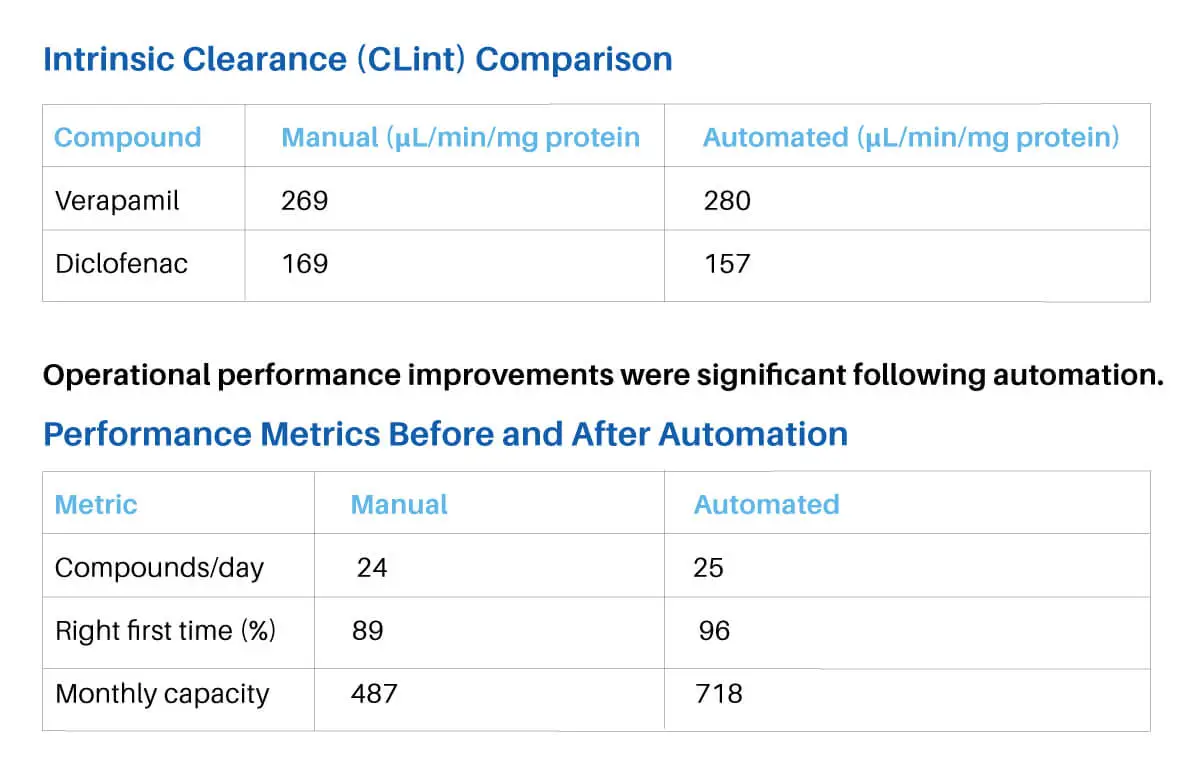
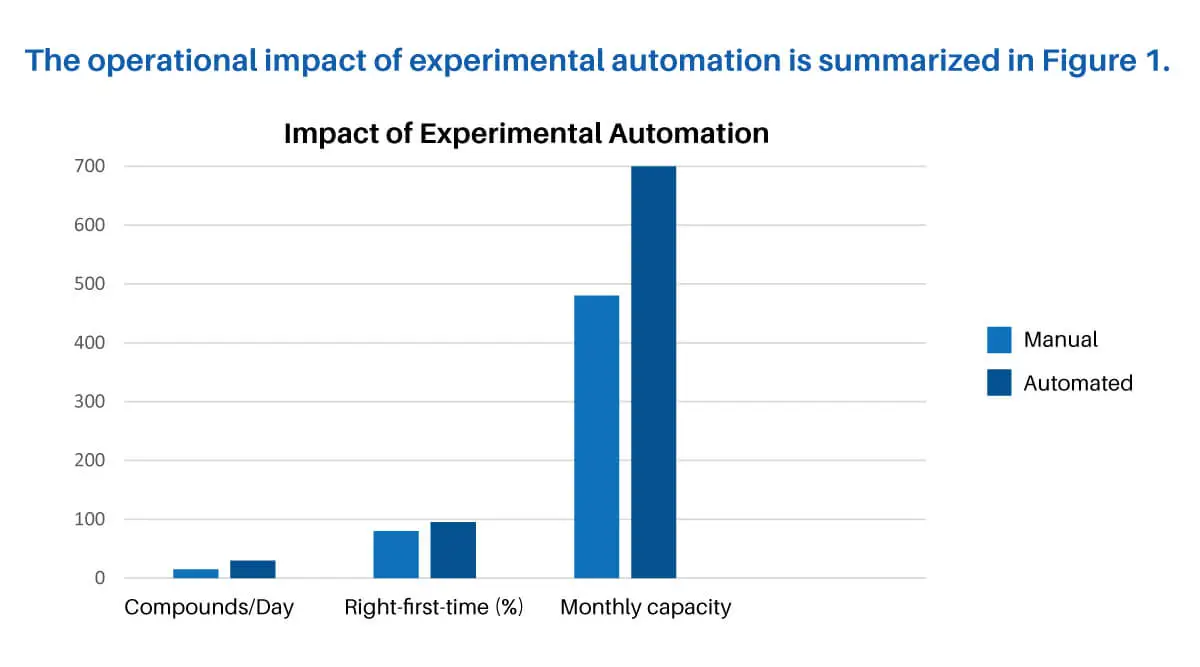
Scientific productivity increased by ~87%, while improved right first time performance reduced the need for repeat experiments. This resulted in a substantial increase in effective capacity, even though overall throughput remained partially constrained by downstream analytical capacity.
Importantly, automation improved not only throughput but also reproducibility and consistency. Reduced experimental variability enhances confidence in generated data and supports more reliable downstream decision-making.
From a workflow perspective, these improvements enable metabolic stability data to be delivered within the active DMTA cycle, increasing its value for compound optimization.
The primary impact of experimental automation lies not only in increasing throughput, but in improving reproducibility and effective capacity, enabling more reliable and timely decision-making.
Case Study 2: Analytical Automation Using Dual Injector with automatic column regeneration approach in LC–MS/MS Workflow
While experimental automation increases sample processing capacity, its impact is limited unless analytical workflows are equally optimized. Conventional LC–MS MS methods operate sequentially, where each injection is followed by separation, column washing, and equilibration. During these non productive phases, the mass spectrometer remains underutilized, restricting overall throughput.
To address this limitation, A Dual Injector column regeneration (DICR) workflow was implemented. This approach enables parallel chromatographic operation, allowing one column to perform active analysis while the second undergoes regeneration. By overlapping these steps, the system minimizes idle time and maximizes instrument utilization.
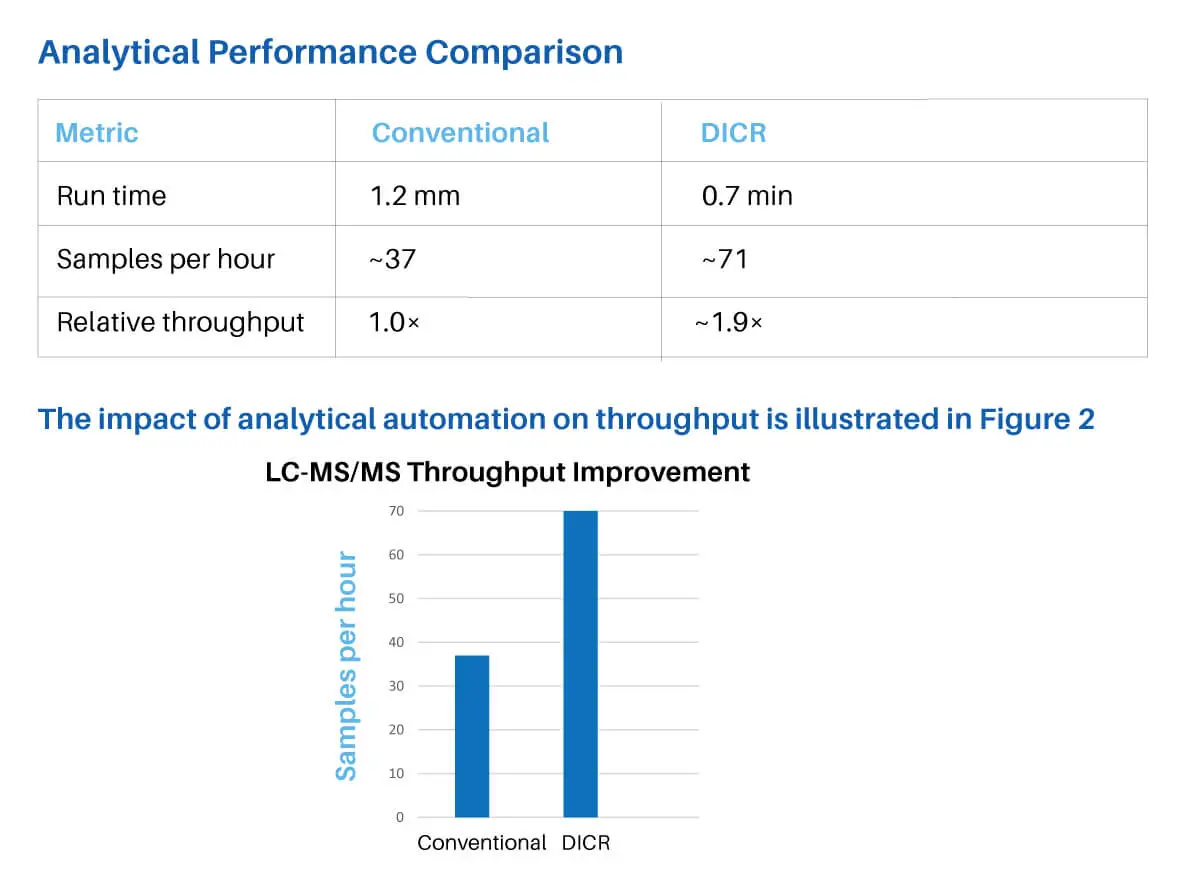
Implementation of the DICR workflow resulted in an approximate two fold increase in throughput, primarily driven by improved instrument utilization rather than reduction in chromatographic run time alone. This highlights that analytical efficiency is determined not just by method speed, but by how effectively instrument time is used.
From a workflow perspective, analytical automation ensures that increased sample generation from experimental systems does not create downstream bottlenecks. This alignment is essential for maintaining continuous workflow efficiency and supporting timely data delivery.
Assay Comparability and Workflow Validation
The implementation of an accelerated analytical workflow requires careful evaluation to ensure that increased throughput does not compromise scientific validity. While improvements in efficiency are important, their value ultimately depends on the reliability of data used for compound classification and decision making.
The primary advantage of analytical automation lies not in faster chromatography alone, but in maximizing instrument utilization to deliver higher throughput without compromising data quality.
To assess this, the dual injection LC–MS/MS workflow was evaluated across nine early discovery DMPK assays, representing key physicochemical, metabolic, and permeability endpoints. These assays play a central role in compound prioritization and include solubility, plasma protein binding, microsomal stability, permeability models, hepatocyte stability, CYP inhibition, and lipophilicity.
The assay-wise agreement profile is summarized in Figure 3. The figure shows the percentage agreement in category classification between the conventional and accelerated LC-MS/MS workflows across the evaluated DMPK assays
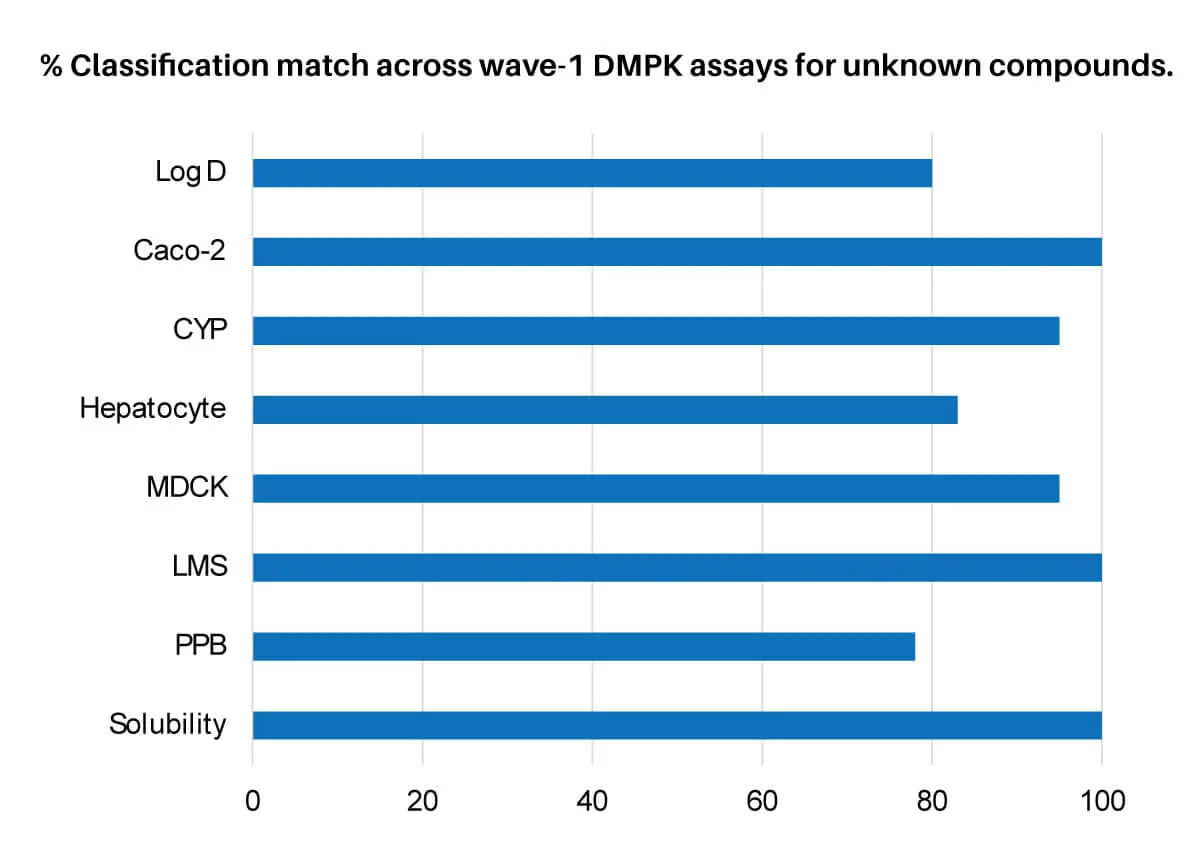
The results show strong classification agreement for thermodynamic solubility, microsomal stability, Caco-2 permeability, and cell solubility, with MDCK permeability and CYP inhibition also showing high agreement. Lower agreement in plasma protein binding, hepatocyte stability, and Log D indicates that accelerated LC–MS/MS performance should not be judged only by an overall agreement value.
Some discrepancies may arise when results sit close to decision thresholds, while larger numerical differences require root-cause analysis before the automated workflow can be considered comparable for that assay. Overall, the data support the use of the accelerated workflow for high-throughput DMPK screening, provided that comparability is assessed assay by assay and exceptions are reviewed for their impact on compound classification.
Performance of Robust and Sensitive DMPK Assays
The key outcome of this analysis is that automation success is assay-dependent and must be evaluated based on its impact on decision reliability rather than overall agreement alone.
Evaluation across multiple DMPK assays revealed a clear distinction between robust endpoints and analytically sensitive systems. This differentiation is critical for understanding where automation can be applied with high confidence and where additional validation is required.
Assays such as thermodynamic solubility, liver microsomal stability, and permeability models (Caco 2 and MDCK) demonstrated consistently high classification agreement. These endpoints are characterized by well controlled experimental conditions and stable analytical signals, making them relatively insensitive to variations introduced by accelerated workflows. As a result, they are ideally suited for high throughput automation.
In contrast, assays including plasma protein binding, hepatocyte stability, and Log D exhibited moderate agreement. These systems incorporate additional biological complexity and are more sensitive to factors such as matrix interactions, compound partitioning, and variability in cellular or enzymatic processes. In such cases, even small differences in analytical measurements can lead to changes in classification outcomes, particularly near decision thresholds.
This distinction highlights that assay performance under automated conditions is not uniform but intrinsically dependent on assay characteristics. Robust assays primarily benefit from increased efficiency with minimal impact on interpretation, whereas sensitive assays require careful validation, stricter controls, and targeted review of discrepancies.
From a practical perspective, this enables a tiered automation strategy, where high confidence assays are scaled for throughput, while sensitive assays are managed with additional scientific oversight.
The key implication is that DMPK automation should be applied selectively, with assay-specific strategies to ensure that gains in throughput do not compromise decision reliability.
Comparative Interpretation and Impact on Decision-Making
The evaluation of automated DMPK workflows demonstrates that improvements in throughput must be interpreted in the context of decision reliability and scientific relevance. While several assays show high classification agreement, others exhibit variability, highlighting that automation performance is inherently assay dependent.
As shown in Figure 3, robust assays consistently maintain classification outcomes under accelerated analytical conditions. In these systems, analytical variation has minimal impact on interpretation, enabling confident integration into high throughput workflows. In contrast, sensitive assays display greater variability, particularly near classification thresholds. In these cases, even small numerical differences can influence compound categorization, potentially affecting prioritization decisions. This highlights the importance of distinguishing between numerical variation and decision impact.
From a decision-making perspective, discrepancies observed across workflows can be broadly categorized into two types. The first involves threshold effects, where minor differences result in classification changes. The second involves larger deviations, which may indicate underlying issues in experimental or analytical performance. While threshold-related changes may require confirmatory evaluation, larger discrepancies necessitate systematic investigation.
These observations emphasize that overall agreement metrics alone are insufficient to establish analytical equivalence. A workflow may demonstrate high average concordance while still producing individual discrepancies that influence key decisions.
To address this, automated DMPK workflows must adopt a decision-centric evaluation framework, incorporating assay-specific acceptance criteria, monitoring of values relative to decision thresholds, and targeted review of outliers. Such an approach ensures that improvements in throughput do not come at the cost of increased misclassification risk.
From a broader perspective, the success of automation is defined not by the number of samples processed, but by the ability to deliver accurate, timely, and decision relevant data that can be effectively integrated into the DMTA cycle.
The key outcome is that DMPK automation must be evaluated based on its impact on decision quality, where maintaining reliable classification is more critical than achieving.
Data Automation and Exception Led Review
As experimental and analytical throughput increases, data processing becomes a critical determinant of overall workflow efficiency. Without automation at this stage, gains achieved in upstream processes can be negated by delays in data handling, interpretation, and reporting.
Traditional workflows often rely on fragmented systems involving manual transfer of data between instrument software, spreadsheets, and reporting tools. This introduces inefficiencies, increases the risk of transcription errors, and delays the generation of decision relevant outputs.
Data automation addresses these limitations by enabling a connected and traceable pipeline that links raw analytical data to final reported results. Automated processing workflows support consistent peak integration, calibration, and parameter calculation, ensuring uniform application of analytical rules across datasets. This not only improves efficiency but also enhances data consistency and traceability.
A key component of this approach is exception led review, where scientific attention is focused on results that deviate from expected behaviour. Automated systems flag potential issues such as abnormal internal standard response, retention time shifts, or values near classification thresholds. This allows routine data to be processed rapidly, while ensuring that critical cases receive detailed evaluation.
From a workflow perspective, this targeted approach significantly reduces manual workload while maintaining data quality. Scientists can focus on interpretation and decision-making rather than repetitive data processing tasks.
Importantly, data automation ensures that increased analytical throughput translates into timely delivery of decision ready outputs, maintaining alignment with the DMTA cycle.
The key value of data automation lies in transforming large data volumes into structured, reliable, and decision ready outputs through standardized processing and focused scientific review.
Protecting Data Quality While Increasing Throughput
While automation enables substantial gains in experimental and analytical throughput, it also introduces the risk of propagating systematic errors across large datasets. As a result, maintaining data quality becomes a critical requirement in automated DMPK workflows.
At the experimental level, consistency in liquid handling, incubation timing, and sample tracking is essential. Automated systems reduce variability but require proper calibration and monitoring to ensure precision. Small deviations in time dependent assays can lead to significant changes in measured outcomes.
At the analytical level, maintaining LC–MS/MS performance is equally important. System suitability parameters such as retention time stability, peak quality, signal intensity, and carryover must be continuously monitored. In dual column workflows, consistent performance across both analytical paths is critical to ensure data comparability.
Data processing workflows also require strict control. Automated pipelines must apply consistent integration, calibration, and classification rules, while maintaining full traceability of results. Any manual intervention or deviation from standard processing should be documented to ensure transparency and reproducibility.
A key aspect of quality assurance is the definition of predefined acceptance criteria and repeat conditions. These criteria ensure that failed or borderline results are handled consistently, reducing subjectivity in decision-making. Additionally, monitoring of historical trends and control data enables early detection of performance drift.
Importantly, quality assurance in automated workflows is not a one-time validation exercise but requires continuous monitoring to ensure sustained performance at increased throughput.
The key requirement in automated DMPK workflows is not only to increase speed, but to ensure that data quality, consistency, and traceability are maintained at scale.
Implementation Strategy and Prioritization of DMPK Automation
Successful implementation of DMPK automation requires a structured and phased approach, rather than direct large scale deployment. Given the diversity of DMPK assays, not all workflows are equally suited for immediate automation, making prioritization critical.
The first step involves identifying workflows that are high volume, repetitive, and standardized, such as microsomal stability and solubility assays. These assays offer the greatest return on automation by delivering immediate improvements in throughput and reproducibility with minimal complexity.
Equally important is the level of method maturity. Assays with well established protocols and defined performance criteria are more suitable for automation, as they provide a stable foundation for system standardization. In contrast, assays that are still under development or require compound specific customization should be automated at a later stage.
Implementation should follow a phased model, beginning with workflow mapping and baseline performance assessment. Key metrics such as compounds processed per day, right first time rates, and turnaround time should be defined to evaluate the impact of automation.
This is followed by comparative validation, where automated workflows are benchmarked against established methods to ensure consistency and identify any discrepancies. A period of parallel operation, where manual and automated workflows run simultaneously, allows for refinement and ensures reliable performance before full scale implementation.
From a system perspective, automation should be introduced as an integrated solution, ensuring alignment across experimental, analytical, and data workflows. Improvements in one stage must be matched by capacity in others to avoid shifting bottlenecks.
Finally, automation should be treated as an evolving capability, supported by continuous performance monitoring and incremental improvements. This approach ensures long term sustainability and adaptability as workflow requirements change.
The key to successful DMPK automation lies in phased implementation, assay prioritization, and system-wide integration, ensuring that efficiency gains translate into sustained improvements in decision-making capability.
Conclusion and Future Direction
The increasing gap between compound generation and DMPK evaluation capacity represents a critical limitation in modern drug discovery workflows. While advances in chemistry and biology have accelerated compound production, the ability to generate timely and reliable DMPK data has not progressed at the same pace. This imbalance directly impacts the efficiency of the Design–Make–Test–Analyze (DMTA) cycle, where the value of data depends not only on its accuracy but also on its availability within the active decision window.
The integrated automation approach described in this work demonstrates that significant improvements in throughput can be achieved across experimental and analytical workflows without compromising scientific validity. Experimental automation improved productivity and reproducibility, while analytical innovations such as dual injection LC–MS/MS workflows enhanced throughput through improved instrument utilization. Importantly, assay level evaluation confirms that automation performance is inherently assay dependent, reinforcing the need for careful validation and interpretation.
Beyond operational gains, the central outcome of this work is a shift in how DMPK automation is defined and evaluated. Traditional metrics such as samples processed per day provide only a partial view of performance. Instead, success must be measured by the ability to generate reliable, reproducible, and decision relevant data that can effectively guide compound progression.
The results highlight the importance of adopting a decision centric framework, where experimental execution, analytical measurement, and data processing are integrated into a unified system. This ensures that improvements in throughput translate into faster, more meaningful scientific insight, rather than simply increased analytical volume.
Looking forward, further advances in DMPK automation will depend on deeper system integration, including the implementation of connected data platforms, workflow orchestration tools, and predictive analytics. The development of more integrated environments, where data flows seamlessly between experimental and design stages, represents a key step toward more efficient and responsive discovery workflows.
At the same time, continued emphasis on assay specific validation, quality control, and data integrity will remain essential to ensure that increased throughput does not compromise decision reliability.
Ultimately, the value of DMPK automation lies not in processing more samples, but in enabling faster, more reliable, and decision driven scientific outcomes that accelerate drug discovery.