








Poor solubility may seem manageable during early process development, but it can become a serious challenge as the process moves toward optimization and scale-up. A reaction may reach good conversion in a small flask, but the same chemistry may later show slurry thickening, local supersaturation, oiling out, poor phase separation, or blocked transfer lines. Flow chemistry can help in selected cases because it gives tighter control over mixing, heat transfer, residence time, and when solids are allowed to form. Pressurized operation, controlled slurry processing, and integration with crystallization can also provide process options that are difficult to reproduce consistently in conventional batch systems.
For poorly soluble pharmaceutical intermediates, the value is better control over where, when, and how the compound remains dissolved, precipitates, or moves as a suspension. Continuous flow chemistry is most useful when poor solubility is linked to process control, not when the issue is simply low intrinsic solubility. The development strategy therefore needs to start with the behavior of the molecule and then identify the appropriate flow configuration, rather than treating flow as a default solution.
Why poor solubility becomes a process risk
Poorly soluble drug intermediates create risk because solubility is not a single number. It changes with solvent, temperature, concentration, salt form, impurity load, water content, and order of addition. A material may stay in solution during the reaction but crystallize during cooling. It may be filterable at one scale and form a dense, slow-draining cake at another.
Poor solubility can affect conversion, impurity rejection, yield, particle properties, and downstream handling. It can restrict reaction concentration, increase solvent volumes, and make the process less economical. If solubility is not understood early, teams often change solvents, temperatures, and workups without a clear reason for what is failing. Early process studies therefore need to establish not only whether a reaction works, but also how the material behaves during addition, reaction, cooling, concentration, isolation, and transfer.
Where flow chemistry can help
Better mixing before precipitation begins
In batch processing, local concentration gradients can form during reagent addition, quench, or antisolvent charging. These zones may create sudden supersaturation and uncontrolled precipitation. Once solids form in the wrong way, the process can become difficult to recover.
Flow chemistry can reduce this risk by improving mixing at defined points in the process. Reagents can be combined under controlled residence-time and temperature conditions, and the system can be designed so precipitation occurs only after the required transformation is complete. This is useful when poorly soluble pharmaceutical intermediates are formed rapidly or when the product has a narrow solubility window.
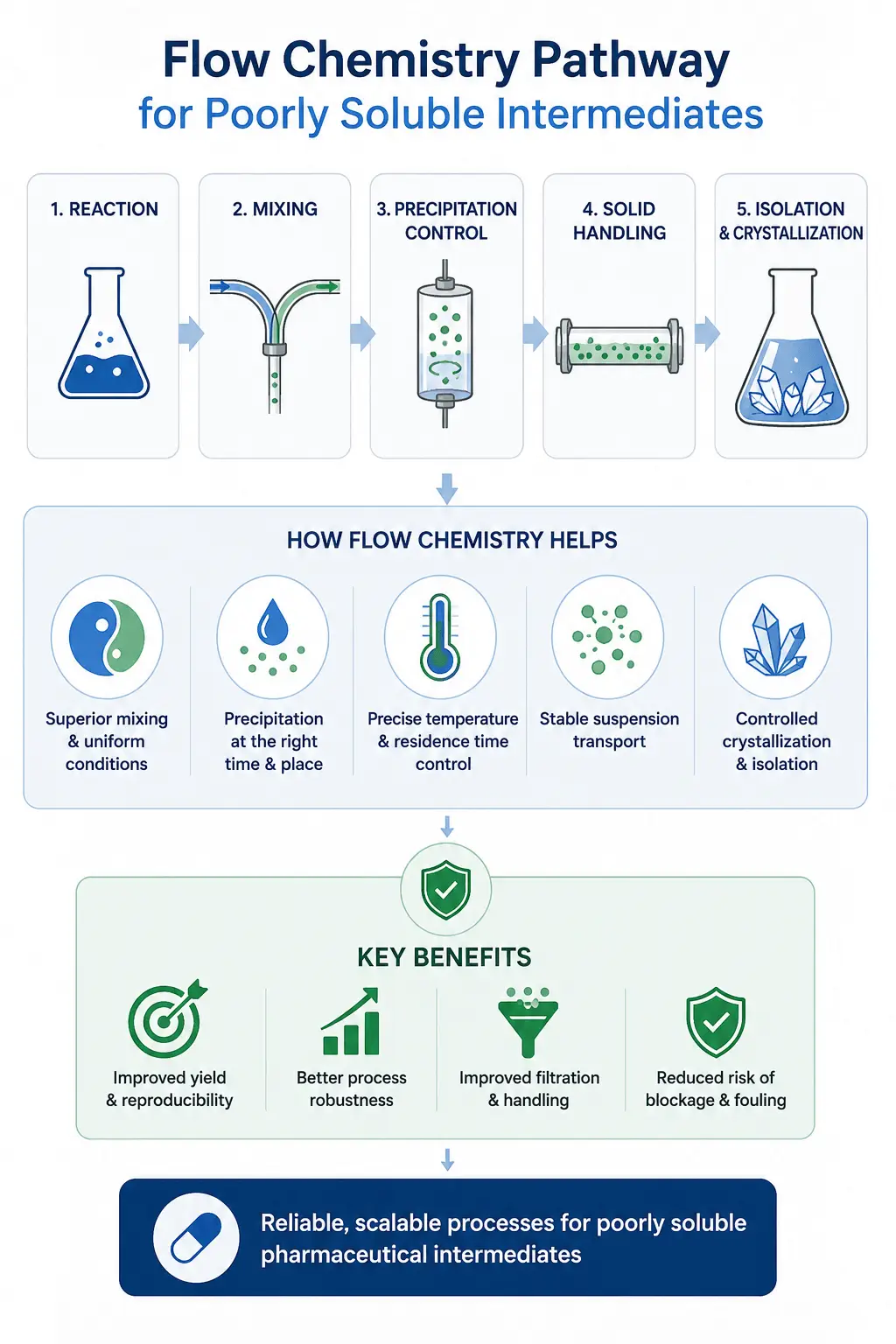
Figure 1. Flow chemistry pathway for controlling poorly soluble pharmaceutical intermediates during process development.
Using temperature and pressure to expand the process window
Some poorly soluble intermediates become considerably easier to process at elevated temperature. A pressurized flow reactor can allow operation above the normal boiling point of a solvent while keeping the reaction medium in the liquid phase. This can increase solubility and reaction rate and, in suitable cases, avoid the very dilute conditions that would otherwise be needed to keep the process manageable.
The combination of rapid heat transfer and defined residence time is important here. The material can be exposed to the required higher temperature for a controlled period and then rapidly cooled or quenched. This is particularly useful when improved solubility at higher temperature has to be balanced against thermal degradation or impurity formation.
Handling suspensions with caution
Suspension processing in flow is possible, but it should not be treated casually. Solids can settle, bridge, erode pump components, or foul narrow reactor channels. A slurry that moves easily at gram scale may become unreliable when the run time extends. For this reason, poorly soluble drug intermediates need a careful feed strategy. Options include higher-solubility precursor feeds, in situ generation of the low-solubility intermediate, particle-size control before feeding, or wider-bore systems that can tolerate solids. Where complete dissolution is neither practical nor necessary, controlled slurry processing can provide another route. The process then has to maintain sufficiently consistent contact among the solid, solvent, and reagents while controlling settling and blockage risk. Reactor geometry, solids loading, particle characteristics, pumping strategy, and run duration all become part of process development.
Using segmented and telescoped flow where appropriate
Segmented flow provides another option when precipitation or crystal formation is part of the process. Dividing the process stream into controlled liquid segments can improve mixing behavior and help limit uncontrolled solids deposition on reactor surfaces. Such configurations can be useful for selected precipitation and crystallization operations, although their suitability depends strongly on the physical properties of the system.
Poor solubility may also make isolation of an intermediate unnecessarily difficult. In these cases, telescoped flow processing can allow an intermediate to be generated and taken directly into the next transformation without isolation. This approach can reduce filtration and transfer steps, material losses, and exposure of a difficult intermediate to conditions under which it may precipitate or become hard to handle.
Crystallization process development is central
For poorly soluble pharmaceutical intermediates, crystallization is not just the final isolation step. It is part of the control strategy. Good crystallization process development helps determine whether the material can be isolated reproducibly, whether impurities are rejected, whether the solid form is acceptable, and whether filtration and drying are practical.
The mistake is to treat crystallization only as a clean-up operation after the reaction is fixed. In reality, the reaction and crystallization are often linked. The solvent system chosen for conversion may affect nucleation. The impurity profile may change crystal habit. The cooling rate may influence filterability.
Flow chemistry can support crystallization process development by providing a consistent reaction output stream. When concentration, temperature, and impurity levels are stable, the crystallization step becomes easier to design. Continuous antisolvent addition, controlled cooling, and seeded crystallization may then be evaluated more rationally. Continuous crystallization configurations, including tubular or segmented systems where appropriate, can provide further control over temperature, mixing, residence time, supersaturation, and particle formation. The objective is not to make every isolation continuous. It is to understand and control solid formation well enough to obtain reproducible material with suitable filtration and downstream handling characteristics.
Analytical and physical property data matter early
Poor solubility cannot be managed with HPLC data alone. Solubility curves, metastable zone width, particle size distribution, slurry stability, filtration behavior, solid form, and impurity partitioning all matter.
For flow chemistry, this information becomes even more important. A small change in particle behavior can affect pressure, residence time, and reproducibility. Monitoring pressure trends, solids formation, heat balance, and composition can reveal problems before the process fails visibly. These data also help determine whether the right solution is a homogeneous flow process, a slurry-capable system, a precipitation or crystallization operation, telescoping, or simply a better-designed batch process.
Connecting process chemistry with formulation needs
Poor solubility does not necessarily end when synthesis is complete. If the final drug substance also has poor aqueous solubility, particle size, crystal form, and dissolution behavior can influence formulation development and, ultimately, drug exposure. This makes some of the decisions taken during process development relevant further downstream.
Continuous approaches can extend into particle generation. Controlled precipitation and related continuous particle-forming processes can produce smaller or more consistent particles for selected poorly soluble compounds. This creates an opportunity to connect process understanding with early formulation assessment rather than treating synthesis and formulation as completely separate problems. The distinction is important, however: flow chemistry does not itself solve poor bioavailability. It can provide better-controlled material and process options for subsequent formulation development.
What CMC teams should watch for
CMC teams should not assume that a solubility problem is only a formulation issue or only a solvent-screening exercise. In process development, poor solubility can affect the entire route, from reaction concentration to isolation and technology transfer. Warning signs include repeated solvent changes, inconsistent filtration, unexplained yield loss, slurry thickening, oiling out, line fouling, or sensitivity to cooling rate and addition order.
Flow chemistry should be considered when poor solubility is linked to mixing, residence time, temperature exposure, precipitation control, or the need to generate a difficult intermediate only when it is ready to be consumed or isolated. It should not be chosen simply because the compound is insoluble. The better question is whether flow provides stronger control over the events causing the process to fail. That assessment should also consider whether pressurized high-temperature processing, slurry handling, telescoping, or controlled crystallization offers a practical advantage over the corresponding batch operation.
An integrated development perspective
At Syngene, the process challenge is approached across reaction development, flow processing, solid handling, crystallization, analytical characterization, and scale-up rather than as a stand-alone reactor problem. For poorly soluble pharmaceutical intermediates, this allows the choice of flow configuration to be based on the actual limitation of the chemistry, whether that is mixing, temperature, solids transport, precipitation, isolation, or the need to telescope a difficult intermediate.
A solvent change may solve conversion but damage isolation. A better crystallization may improve purity but reduce recovery. A slurry feed may simplify chemistry but increase mechanical risk. Similarly, high-temperature processing may improve solubility and kinetics but still require careful control of thermal degradation. These trade-offs need to be understood together.
For this reason, flow chemistry should be evaluated as part of the wider development plan, not as a separate technology experiment. When poor solubility affects reaction performance, impurity control, or isolation robustness, early assessment can prevent expensive late-stage rework. The aim is to identify a workable process window early, generate meaningful data with limited development material, and select a process that remains controllable as the program moves toward scale-up and formulation readiness.