


Pharma 4.0 is changing the way Quality Control is planned, executed, and reviewed across modern biopharma operations. In India, this shift is becoming more important as QC labs support global submissions, faster tech transfer, and increasingly complex products across biologics, small molecules, and emerging modalities. The older model of fragmented testing, paper-heavy review, and delayed exception handling is no longer enough. Future-ready labs are moving toward digital Quality Control, stronger system integration, and tighter control over people, data, and process flow within a one-CDMO operating model. That direction is also being reinforced by market movement. India’s laboratory automation market reached about USD 109.5 million in 2025 and is projected to grow to USD 210.7 million by 2034, while the global Laboratory Information Management System (LIMS) market was estimated at USD 2.08 billion in 2025 and is projected to reach USD 3.48 billion by 2033. That growth says something simple: digital lab infrastructure is no longer a side investment. It is becoming core operating infrastructure.
Why QC is becoming a strategic function in pharma 4.0
In a conventional setup, Quality Control was often treated as the last checkpoint. Samples arrived, analysts performed the tests, supervisors reviewed the records, and Quality teams decided the release status. That structure still has value, but it is too slow for current development and manufacturing cycles. In a Pharma 4.0 environment, QC becomes part of a connected decision system in which instruments, analysts, reviewers, laboratory information systems, audit trails, and manufacturing records work in a more coordinated manner. The goal is not just speed. The real value lies in better visibility, earlier detection of drift, and fewer surprises close to batch release.
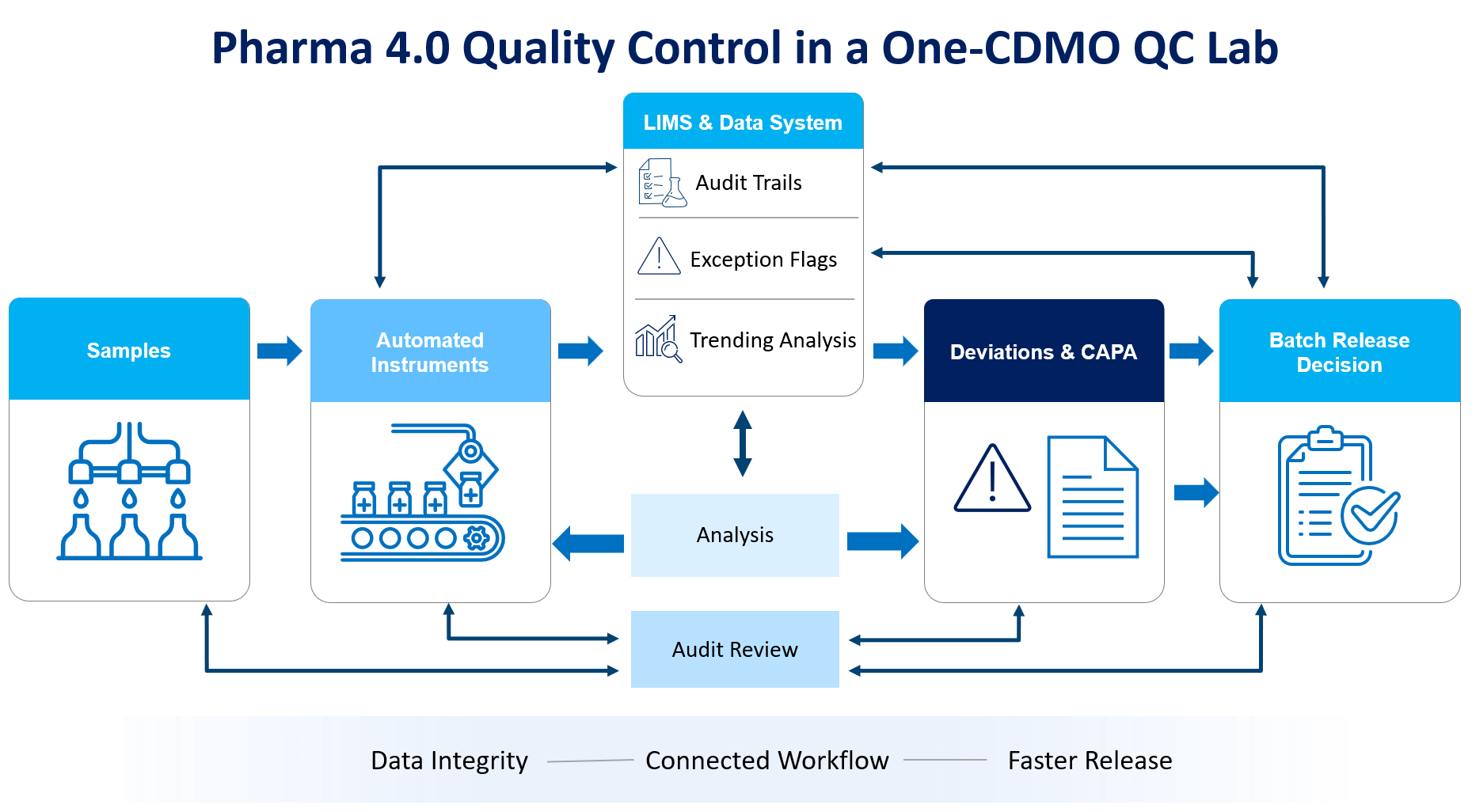
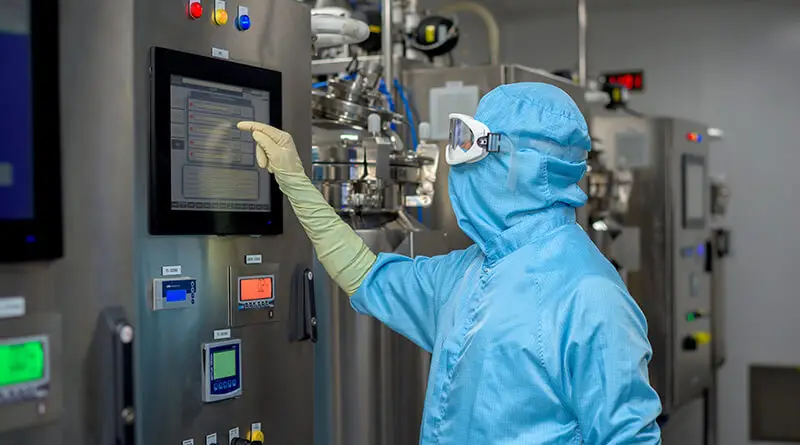
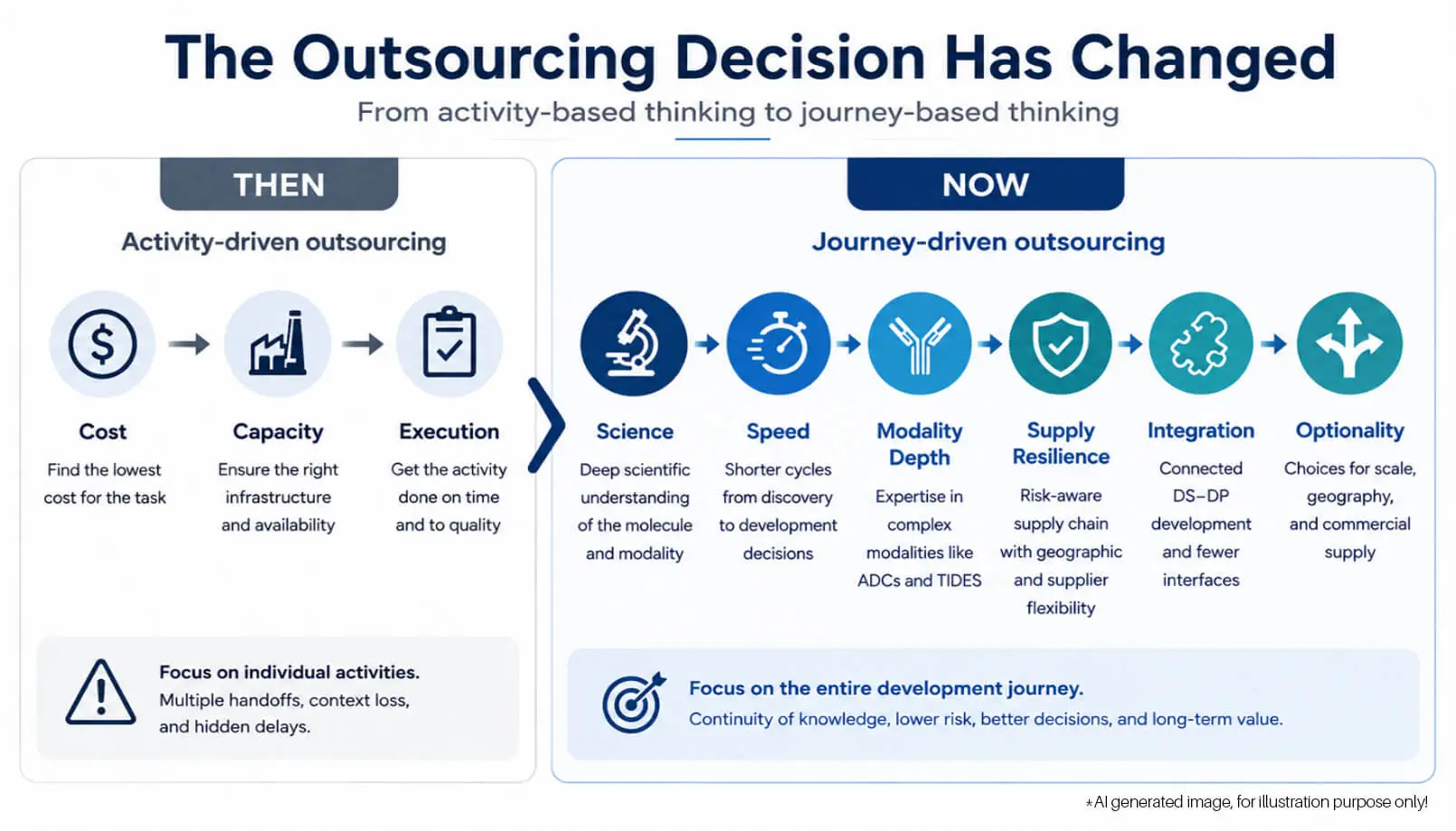
Figure 1. Pharma 4.0 digital quality control workflow in a one-CDMO QC lab
This matters in India because the country is no longer viewed only as a cost-efficient execution base. It is now supporting advanced analytical programs, global supply demands, accelerated timelines, and products that require much tighter control strategies. That means pharma Quality systems must handle both scale and scrutiny. They also need to function smoothly across development, method transfer, validation, stability, microbiology, environmental monitoring, and batch release. It sounds simple when written like this, but in practice, it gets messy very fast unless the lab architecture is designed for integration from the start. That is one reason Pharma 4.0 has gained such traction in the CDMO space. Syngene’s own Pharma 4.0 white paper frames this shift around transparency, data integrity, and real-time access to manufacturing information, which are now becoming basic client expectations rather than future-state ambitions.
Digital Quality Control is becoming central to pharmaceutical QC testing
Digital Quality Control is not simply about replacing paper with screens. It is about making the entire testing environment more traceable, review-ready, and decision-ready. In the Quality systems the pharmaceutical industry now depends on, data must remain consistent with ALCOA+ principles. That is to say, data must remain attributable, consistent, and easy to review across its full lifecycle.
In practical terms, that means QC lab automation cannot sit by itself. Automated sample handling, instrument integration, electronic records, audit trails, reviewer workflows, exception flags, and trending tools need to connect with the broader Quality framework. When that happens properly, pharmaceutical QC testing becomes more consistent and less exposed to manual transcription errors, undocumented interventions, and slow investigations. It also reduces the familiar delay between analysis, review, and action. That delay still affects many labs, often more than people admit. Syngene has already been moving in this direction across its scientific operations. In FY25, the company reported progress on its digital roadmap through upgrades to Electronic Lab Notebooks (ELN), LIMS, and related clinical applications, with a full digital transition targeted by FY26. The stated aim was real-time monitoring, lower documentation burden, and more integrated operations, all of which sit very close to the needs of future-ready QC.
How QC lab automation is changing lab execution
Automation in QC is moving beyond autosamplers and basic laboratory robotics. It now includes digital scheduling, guided workflows, e-signature pathways, deviation triggers, automated calculations, environmental data capture, and instrument-to-system data transfer with fewer manual touches. In a one-CDMO model, this matters because method transfer, comparability, and lot-release expectations must stay aligned across sites, teams, and timelines.
The benefit is not only higher throughput. Effective automation makes review easier because the system can enforce sequence, completeness, access control, and version discipline. It can also support quicker escalation when a result trends toward failure or when an assay starts behaving oddly. In that sense, QC lab automation is doing operational work, but it is also supporting governance. That is where its value becomes much more visible. At Syngene, automation is already visible in adjacent lab environments. A recent case study on automation-driven optimization of liver microsomal stability assays shows how automated workflows are being used to improve precision, throughput, and turnaround in scientific testing. QC has its own regulatory demands, of course, but the operating logic is similar: reduce manual friction, improve consistency, and make data easier to trust.
Where biometrics fits into pharma quality systems
Biometrics may appear to be only a security feature, but in future-ready labs it works more like a trust layer. In high-compliance environments, user identity matters at every stage, from log-in and role-based access to electronic signatures, controlled approvals, and access to restricted instruments or data zones. As Pharma 4.0 brings systems closer together, security and traceability become even more important.
For QC labs in India serving regulated markets, biometric authentication can strengthen digital quality control by eliminating shared credentials, improving user accountability, and supporting cleaner audit trails. It is not a cure-all. Weak procedures remain weak even with better hardware. Still, when biometrics is combined with validated computerized systems and disciplined SOP design, it can make pharma quality systems more defensible during audits and more reliable in routine use. Syngene already uses access-controlled laboratory environments in parts of its operations. Its central laboratory infrastructure, for example, is access-controlled and supported by alarm systems and wireless data logging, alongside 21 CFR Part 11-compliant Watson LIMS. That does not make biometrics universal across all QC settings, but it does show the company’s direction of travel toward controlled, data-secure lab environments.
Why VR is entering the QC discussion
Virtual Reality (VR) may seem unusual in a lab-quality discussion, yet its role is becoming easier to understand. QC failures do not arise only from methods or instruments. They also come from training gaps, inconsistent responses to deviations, and poor understanding of process-critical steps. Immersive training environments can help teams practice gowning flows, contamination-control steps, instrument response, exception handling, and analyst decision points before mistakes happen in the lab.
In a one-CDMO approach, VR can be particularly useful during onboarding, site-to-site harmonization, and transfer-related training. It allows the same scenario to be repeated across teams, which is often difficult in live environments. That consistency can quietly improve the Quality systems the pharmaceutical industry relies on, especially when timelines are tight and analyst readiness cannot be left to informal learning. This point becomes more relevant as Syngene expands its integrated manufacturing capabilities. The company’s annual report notes continued investments in automation, digitization, and the integration of manufacturing systems into operations. Once operations become more connected, training has to become more structured too. That is where simulation-led learning, including VR-based approaches, starts to make practical sense rather than sounding experimental.
The one-CDMO QC model in India
The strongest argument for future-ready QC labs is not technology on its own. It is integration. When analytical characterization, method transfer, in-process testing, finished-product testing, environmental monitoring, microbiology, stability, and release activities are managed within one connected operating framework, decision-making becomes clearer and handover risk comes down.
That is the one-CDMO advantage. Instead of building Quality through multiple disconnected vendors, sponsors can work within a structure where data continuity, review pathways, and technical accountability are better aligned. In India, this model is becoming more relevant as clients expect both cost discipline and global-Quality execution. Pharma 4.0 will push that expectation further. Syngene’s current setup already reflects much of this integrated QC logic. Here, raw material testing, in-process testing, finished-product testing, environmental and water-quality monitoring, microbiological testing, lot-release testing, and stability testing are carried out in-house under global GMP standards. Syngene combines more than 27 years of analytical development experience, and in biologics, an integrated development and manufacturing infrastructure that includes India’s only GLP viral testing facility for batch-release and viral-clearance testing. These signals show that the one-CDMO QC model is already being built around connected analytical and quality systems rather than around isolated testing blocks.
What future-ready really means
A future-ready QC lab is not just more digital but more connected, more controlled, and more usable under pressure. It combines automation with review discipline, biometrics with accountability, and VR with training consistency. It supports digital quality control not as a side initiative, but as part of the operating model itself. Most importantly, it places QC where it belongs, at the center of modern pharma quality systems rather than at the very end of them. That is where Pharma 4.0 is moving, and the labs that adapt early will shape the next standard for quality in Indian biopharma. In that setting, Syngene’s ongoing digitization, in-house GMP quality infrastructure, controlled lab systems, and integrated development-to-manufacturing model make this theme especially relevant for India. The bigger message is clear enough: future-ready QC will be defined less by isolated equipment upgrades and more by how well data, people, systems, and decisions are connected across the full quality lifecycle.