






A manufacturing model shaped by a different supply chain resilience challenge
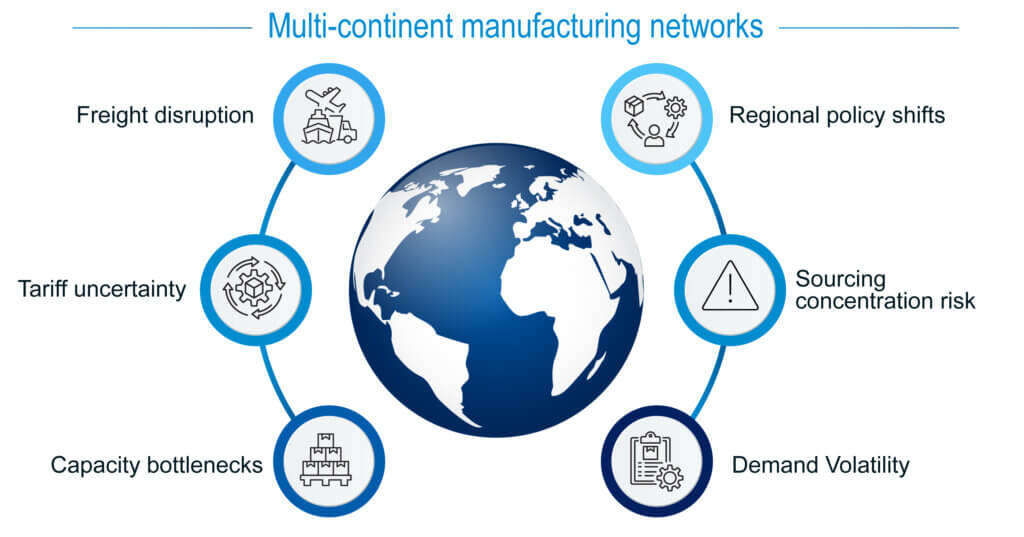
As of 2026, supply chain resilience has become a central concern in biopharma manufacturing decisions. The operating environment is very different from the one many companies took for granted before the disruptions that became impossible to ignore from 2019 onward. Long-standing assumptions around freight predictability, trade stability, sourcing continuity, and regional access have become less reliable. A biologics development or manufacturing program may begin with a clear sourcing plan, but face delays from freight disruption, policy shifts, tariff uncertainty, regional trade measures, or capacity bottlenecks. In that setting, it is entirely reasonable for customers to ask a direct question: how can manufacturing stay dependable when external conditions do not?
One strong answer is multi-continent manufacturing. The case for this model is becoming stronger as outsourcing expands and as sponsors look for greater flexibility in how they scale programs. According to the 2025 BCG-IPSO report, India’s CRDMO sector is currently valued at about USD 3-3.5 billion, representing roughly 2-3% of the worldwide CRDMO market, and could grow to USD 22-25 billion by 2035. The same report places the global CRDMO market at about USD 140-145 billion. Seen against the size of the global market, India’s projected growth reads more realistically.
Why the biologics outsourcing market is increasing the need for multi-continent manufacturing
The logic is straightforward. A multi-continent manufacturing network can reduce dependence on any one geography, create options when trade conditions change, improve business continuity planning, and place some capacity closer to major customer markets. It can also help sponsors respond faster when product demand, supply requirements, or market priorities shift. The value here is resilience. Customers do not necessarily care about geography for its own sake. They care about supply assurance, delivery continuity, and reduced exposure to concentration risk. In practical terms, that is supply chain resilience.
These are no longer theoretical advantages. Deloitte’s 2025 life sciences outlook found that 37% of life sciences executives identified resilient and adaptable supply chains as a top organizational priority for 2025. ZS also reported that more than 85% of biopharma executives surveyed planned to invest in data, AI, and digital tools in 2025 to strengthen supply chain resilience. Tariff discussions have added another layer to the argument. CSIS noted in 2025 that tariffs on branded, generic, and biosimilar finished products could have wide-ranging implications for healthcare, product availability, and consumers in the United States. The same analysis cited a Yale Budget Lab projection that a 25% ad valorem tariff could raise medication costs by around USD 600 per household per year in the U.S. Even when a specific product is not directly affected, tariff uncertainty changes how companies think about risk concentration, supply continuity, and manufacturing location strategy.
Why India matters in biologics manufacturing networks
India’s role in this model should not be reduced to cost efficiency alone. Cost remains one advantage, but it is only one part of the picture. The 2025 BCG-IPSO report also points to India’s growing relevance in global pharmaceutical realignment and its expanding role in biologics and next-generation modalities.
India also offers advantages that go beyond cost. It has a large scientific and technical talent base, a deep pharmaceutical manufacturing ecosystem, and extensive experience serving regulated markets. Bain notes that India has more than 10,000 manufacturing facilities, over 3,000 pharma companies, and 650 US-FDA-compliant pharma plants, the largest number outside the U.S. India also supplies one in five generic drugs sold globally, which reflects not just scale, but long-standing export execution. At the same time, the 2025 BCG-IPSO report notes that Indian CRDMOs are building capacity in biologics, ADCs, gene therapies, and RNA therapeutics, while benefiting from broader supply-chain realignment and rising global interest in partner diversification. India’s strength, therefore, does not lie only in lower cost. It lies in offering global companies a credible mix of talent, manufacturing depth, regulated-market experience, and diversification value at a time when dependence on any single geography is itself a risk.
Why multiple facilities are valuable, but difficult to manage
At the same time, maintaining manufacturing across multiple continents is not simple. It is easy to say that a company has more than one facility. The real question is whether those facilities can function as one coordinated network.
This is where many organizations face difficulty. Different sites often develop their own documentation habits, operational rhythms, training patterns, data practices, and interpretations of process control. Small differences can grow into major issues during transfer, scale-up, or commercial execution. A process that performs smoothly at one site may encounter avoidable friction at another if the receiving team does not inherit the same technical understanding, analytical rigor, and quality discipline.
That is why the value of multi-continent manufacturing does not come from geography alone. It comes from alignment. What matters to customers is not the map by itself, but whether the network can deliver one standard of execution, one quality language, and one dependable supply experience. If that alignment is absent, multiple facilities can add complexity instead of reducing risk. In other words, supply chain resilience depends on operational harmony, not just on geographic spread.
Where tech transfer and regulatory readiness become critical
This is precisely why tech transfer matters so much. In a strong network, transfer is not treated as a document movement exercise. It is treated as a structured movement of knowledge, control, and execution readiness.
Good tech transfer starts with process clarity. The process must be described in a truly transferable way, including critical process parameters, critical quality attributes, acceptable operating ranges, scale-sensitive factors, in-process controls, and the reasoning behind each major step. If core process knowledge remains mostly with a few individuals, transfer risk rises sharply.
Analytical readiness is equally important. A receiving site must be able to test, trend, interpret, and release material with the same rigor as the sending site. Documentation must support that effort through aligned batch records, standard operating procedures, specifications, deviation history, and risk assessments. People and governance also matter. Cross-functional alignment across manufacturing, MSAT, process development, QC, QA, regulatory, and supply chain teams is often what determines whether a transfer stays on schedule and remains inspection-ready. That is where regulatory readiness becomes essential. It supports continuity across sites and strengthens supply chain resilience when programs move between regions. Syngene’s own published material on technology transfer in biologics manufacturing emphasizes structured, risk-based transfer and cross-functional integration as core enablers of successful execution.
How Syngene applies the multi-continent manufacturing model
A useful way to understand this multi-continent model is to look at how Syngene is framing its own network. Syngene’s published biologics positioning describes a global manufacturing offering designed to provide speed, flexibility, and confidence in scaling programs. The company states that its Maryland, U.S. facility expands Syngene’s total single-use bioreactor capacity to 50,000 liters, with 2,000 L and 4,000 L bioreactors, and supports its broader dual-site biologics manufacturing model across India and the United States. Syngene also highlights global tech transfer capability and regulatory support as part of that offering.
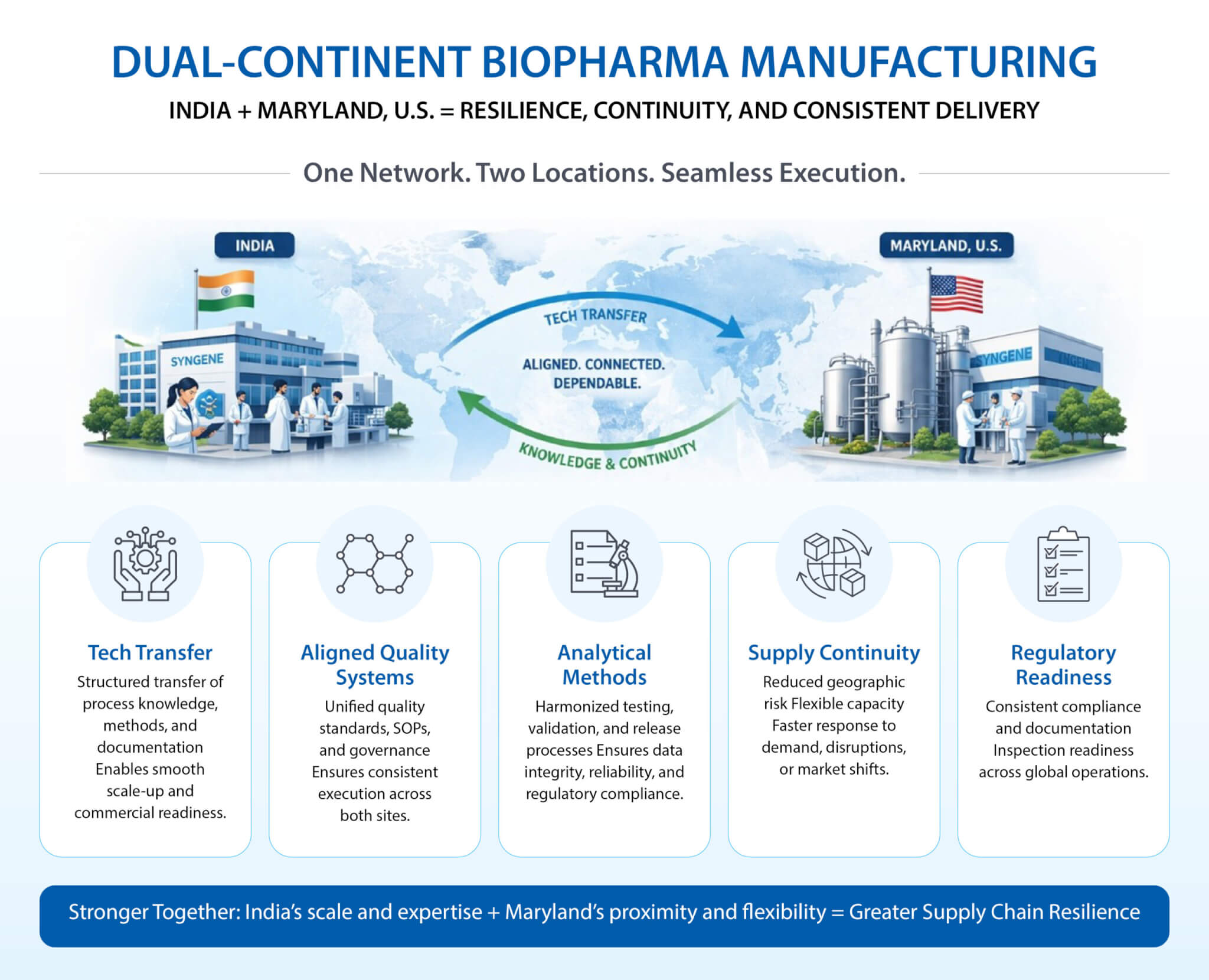
Figure 1. Dual-continent biopharma manufacturing model linking India and Maryland, U.S., through tech transfer, aligned quality systems, analytical methods, supply continuity, and regulatory readiness.
This matters because customers do not buy capacity in isolation. They buy confidence that a process can move, scale, and stay under control. Maryland also brings strategic value beyond the facility itself. According to the State of Maryland’s business announcement, the site strengthens Syngene’s biologics footprint in a major U.S. biotech region and is expected to enhance customer supply continuity by integrating with Syngene’s existing development and manufacturing network across India and North America. From a customer perspective, that creates a practical proposition. It combines India’s technical depth and execution scale with U.S.-side manufacturing presence, market proximity, and regional flexibility. It also supports a supply model that is better positioned to absorb policy shifts and operational disruption without forcing sponsors to manage fragmented oversight across multiple unrelated vendors.
The broader customer value
The commercial message is broader than transfer alone. It is about building a manufacturing network that can preserve quality, reduce concentration risk, and remain responsive when external conditions change. In a market where biologics demand is rising, outsourcing continues to expand, and supply chain resilience is now a strategic concern, multi-continent manufacturing becomes more relevant.
Seen in that light, the real advantage is not duplication for its own sake. It is the ability to connect sites across geographies in a disciplined way, so that scale, continuity, and control can move together.
A final view
Multi-continent manufacturing in biopharma is becoming more important because the market now values resilience alongside cost, proximity alongside scale, and flexibility alongside compliance. That shift is pushing companies to think beyond single-site models and toward more connected manufacturing networks.
When facilities across geographies operate with aligned standards, disciplined tech transfer, and shared quality expectations, a multi-continent model becomes a meaningful competitive advantage. Syngene’s India-Maryland, U.S. example shows how that story can be presented: not as a simple two-site footprint, but as a coordinated manufacturing network built for continuity, transfer readiness, and delivery confidence.