






The pharmaceutical industry is gradually shifting toward smarter and more adaptive manufacturing systems. Regulatory frameworks are evolving alongside this transition to support innovation in production and quality control. One of the most significant developments in this direction is the United States Food and Drug Administration’s Advanced Manufacturing Technology (AMT) program.
This shift is supported by industry adoption trends. According to recent FDA and industry communications, more than a dozen commercial products have been approved globally using continuous manufacturing platforms, while multiple additional applications incorporating advanced manufacturing technologies are under regulatory review.
At the heart of this transition lies process analytical technology (PAT), a framework that allows manufacturers to monitor and control production processes using real-time analytical data. By integrating advanced sensors, analytical instruments, and digital control systems, pharmaceutical companies can better understand manufacturing performance as it occurs. In parallel, industry surveys from organizations such as ISPE have indicated increasing adoption of PAT-driven monitoring systems, with a growing proportion of late-stage manufacturing processes incorporating real-time analytical controls.
The AMT initiative aims to encourage and de-risk the adoption of modern manufacturing approaches such as continuous production systems, integrated analytics, and automated process control. The program was launched in 2023, and is administered under the FDA’s Emerging Technology Program within the Center for Drug Evaluation and Research. For the biopharmaceutical ecosystem, including contract research development and manufacturing organizations, these changes are shaping how product quality, supply reliability, and regulatory collaboration evolve in the coming years.
The program also reflects a regulatory intent to reduce uncertainty associated with implementing novel manufacturing technologies rather than to provide accelerated product approvals.
Evolution of advanced manufacturing technologies in pharma
Pharmaceutical manufacturing has traditionally relied on batch-based processes followed by extensive laboratory testing to confirm product quality. This approach has supported regulatory compliance for decades. However, batch manufacturing can sometimes introduce inefficiencies, longer production cycles, and delays in product release.
Advanced manufacturing technologies represent a shift toward more integrated and data-driven production environments. These technologies combine automation, predictive analytics, advanced sensors, and digital control strategies to maintain consistent product quality throughout manufacturing.
Within this framework, PAT plays a central role. The concept was introduced by the FDA in its 2004 PAT guidance, which encouraged manufacturers to design and control processes through timely measurements of critical quality attributes and critical process parameters. PAT tools allow manufacturers to continuously monitor process conditions and product characteristics during production. Instead of relying solely on end-product testing, companies gain real-time insight into process performance, enabling faster decision making and improved control over variability.
For example, spectroscopy-based inline monitoring has been widely adopted in solid oral dosage manufacturing, enabling real-time blend uniformity assessment and reducing dependence on offline testing.
The FDA has consistently supported these innovations through multiple regulatory initiatives. The AMT program builds on earlier efforts by providing a structured pathway to support the development and implementation of modern manufacturing platforms. Recent regulatory updates suggest that the FDA continues to receive increasing numbers of submissions incorporating advanced manufacturing elements, reflecting gradual but steady industry adoption.
Understanding the FDA AMT designation
The FDA AMT designation was introduced to encourage the development and adoption of innovative pharmaceutical manufacturing technologies. The program is intended for manufacturing platforms that demonstrate the potential to improve product quality, enhance manufacturing reliability, or significantly modernize production processes.
Technologies eligible for AMT designation may include advanced control systems, continuous manufacturing platforms, novel analytical monitoring tools, and digitally integrated production systems. These technologies are often supported by robust analytical frameworks such as process analytical technology. Companies must submit a formal request for AMT designation, typically through existing regulatory pathways such as IND, NDA, BLA, or Type C meeting requests, supported by scientific evidence demonstrating a meaningful improvement over conventional manufacturing approaches.
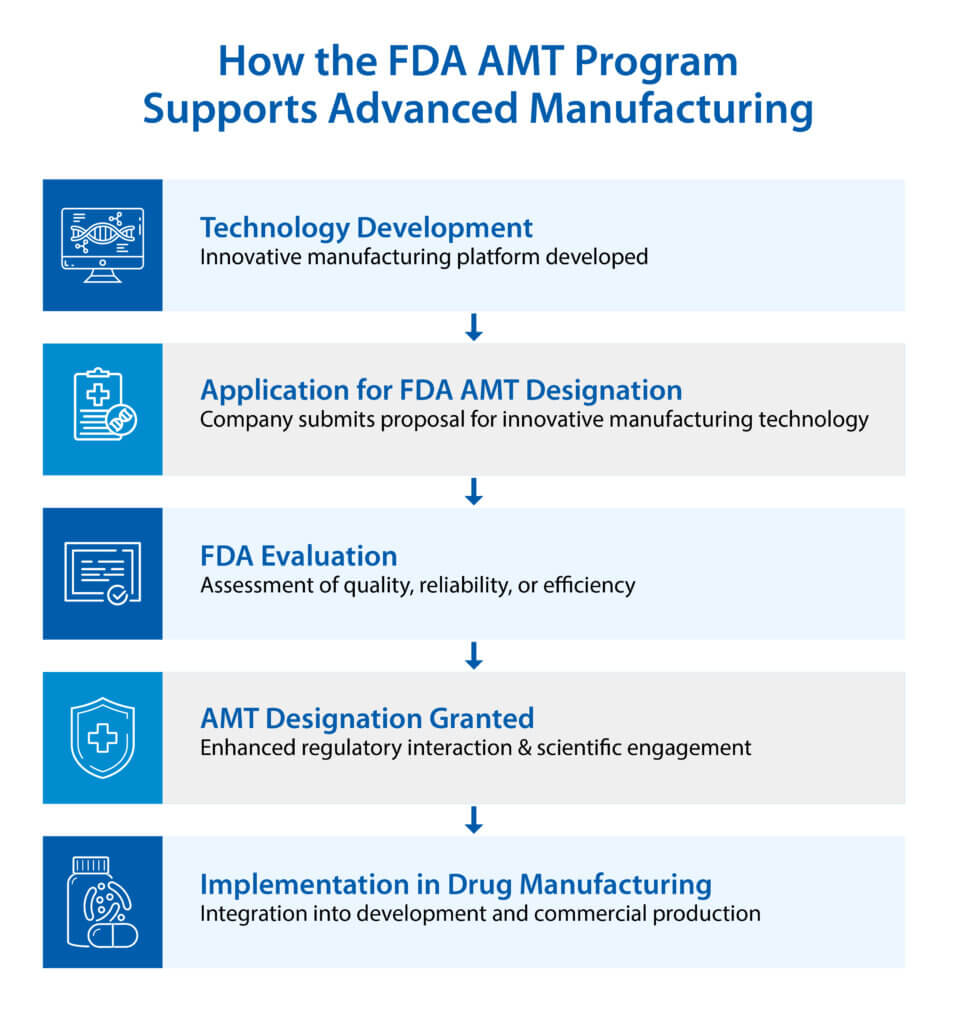
Figure 1. Overview of the FDA Advanced Manufacturing Technology (AMT) program pathway supporting the adoption of innovative pharmaceutical manufacturing technologies.
When a technology receives AMT designation, developers may benefit from enhanced interaction with the FDA during the development and review process. This interaction typically involves earlier scientific engagement with FDA reviewers, additional technical meetings such as Type C interactions, and more iterative dialogue during review of manufacturing strategies. These discussions focus on process validation, analytical monitoring approaches, and control strategies for novel manufacturing systems.
The purpose of this collaborative approach is not to accelerate approvals without scrutiny, but rather to facilitate the responsible adoption of technologies that strengthen pharmaceutical manufacturing. By supporting early engagement, the program helps developers align innovative manufacturing strategies with regulatory expectations. It is important to note that AMT designation does not approve a drug product, does not certify a manufacturing facility, does not replace GMP inspections, and does not guarantee accelerated regulatory timelines.
For drug developers and manufacturing partners, the AMT pathway provides an opportunity to introduce modern production technologies while maintaining regulatory confidence in product safety and quality. For organizations such as Syngene, this reinforces the need to integrate development, analytics, and manufacturing capabilities in a manner that supports early regulatory engagement and robust process understanding.
Process analytical technology as the backbone of modern manufacturing
Among the various tools shaping modern pharmaceutical manufacturing, PAT has become one of the most influential. PAT frameworks integrate analytical instruments directly into manufacturing processes, allowing continuous measurement of key attributes such as concentration, particle size distribution, and product purity. This capability fundamentally changes how product quality is managed. Instead of relying primarily on laboratory analysis after production is complete, manufacturers can observe quality-related parameters during manufacturing itself.
In advanced production environments, PAT tools are often connected to automated process-control systems. These systems analyze incoming data and adjust process parameters when necessary to maintain stable operating conditions. Such closed-loop control systems reduce variability and help prevent deviations before they affect product quality.
These capabilities are particularly valuable in the manufacturing of complex therapies, including biologics, where small changes in process conditions can influence critical product attributes. Real-time monitoring therefore enables a deeper understanding of the relationship between manufacturing variables and final product performance. In biologics manufacturing, for instance, real-time monitoring of parameters such as pH, dissolved oxygen, and metabolite levels is increasingly used to maintain consistent cell culture performance.
Within the AMT framework, the effective implementation of PAT is often a key component supporting advanced manufacturing proposals. Syngene’s analytical and bioanalytical infrastructure, combined with process development capabilities, supports the generation of such real-time process insights across development and manufacturing stages.
Continuous manufacturing pharma and the shift toward real-time quality
One of the most prominent examples of advanced manufacturing technologies is continuous manufacturing pharma production. In contrast to traditional batch processing, continuous manufacturing involves an uninterrupted flow of materials through interconnected processing steps.
This model offers several operational advantages. Continuous systems can reduce manufacturing footprint, improve production efficiency, and enable more consistent product quality. However, these benefits depend heavily on robust process monitoring and control systems.
Here again, PAT plays a critical enabling role. Continuous manufacturing relies on real-time measurements to maintain steady-state operation and detect deviations quickly. Without this analytical visibility, continuous processes would be significantly more difficult to control.
Industry experience suggests that continuous manufacturing can reduce production cycle times and variability, although implementation remains limited to specific product categories due to infrastructure and regulatory considerations.
Another closely related concept is real-time release testing, in which product quality can be verified using process data generated during manufacturing. Instead of waiting for laboratory test results after production, real-time process data may provide sufficient evidence that quality specifications are met.
Real-time release testing can shorten manufacturing timelines and improve supply chain responsiveness. It also aligns closely with regulatory objectives that emphasize building quality directly into manufacturing processes. Adoption of real-time release testing remains gradual, with regulatory acceptance depending on strong validation of analytical methods and process-control systems.
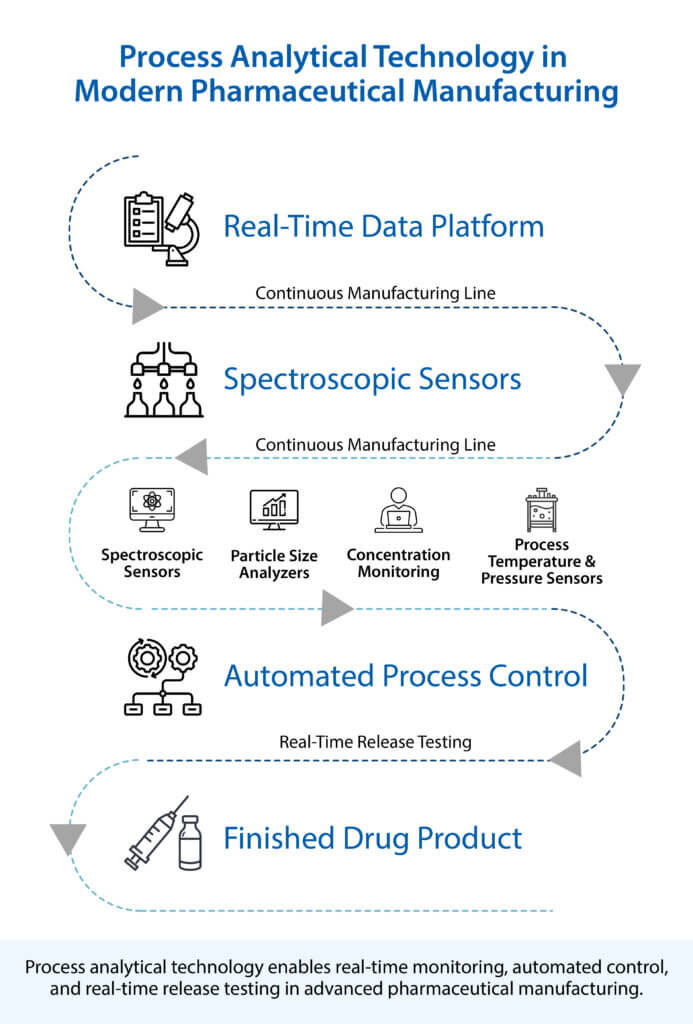
Figure 2. Role of process analytical technology in continuous pharmaceutical manufacturing, enabling real-time monitoring, automated process control, and real-time release testing.
Regulatory collaboration and implementation considerations
Although advanced manufacturing technologies offer clear advantages, their implementation requires careful planning and validation. Integrating new analytical systems, digital infrastructure, and control strategies often requires significant investment in equipment, training, and data management capabilities.
One important challenge involves the management and interpretation of large volumes of process data. Continuous monitoring systems generate extensive datasets that must be validated, securely stored, and interpreted in accordance with regulatory expectations.
The AMT program helps address these challenges by encouraging early engagement between manufacturers and regulators. Through these interactions, companies can discuss development strategies involving PAT, digital manufacturing platforms, and real-time monitoring approaches.
This early engagement is particularly useful in clarifying expectations around data integrity, model validation, and lifecycle management of analytical systems.
Such discussions are particularly useful when development programs involve novel manufacturing concepts or highly integrated analytical systems. Early regulatory dialogue can help clarify expectations related to process validation, data integrity, and quality assurance strategies.
This collaborative approach supports smoother technology adoption and reduces uncertainty during development and commercialization. Syngene’s integrated CRDMO model, combining discovery, development, analytical characterization, and manufacturing, supports such early-stage alignment with regulatory expectations.
Implications for the future of pharmaceutical manufacturing
The introduction of the AMT program reflects a broader transformation in pharmaceutical manufacturing. Production is increasingly viewed as a knowledge-driven activity supported by advanced analytics, automation, and digital process control.
Technologies such as PAT, continuous manufacturing pharma systems, and integrated data platforms are reshaping how pharmaceutical products are developed and produced. These systems enable deeper process understanding, faster development timelines, and more resilient manufacturing networks.
For the biopharmaceutical industry, the long-term implications extend beyond operational efficiency. Advanced production technologies can support faster technology transfer, improved scale-up strategies, and more flexible responses to evolving clinical and market demands. At the same time, adoption remains uneven across the industry, with high initial investment and regulatory readiness continuing to influence the pace of transition.
As regulatory frameworks continue to evolve, programs such as the FDA AMT designation are likely to play an important role in accelerating the adoption of these innovations. By promoting collaboration between regulators, technology developers, and manufacturing organizations, the AMT program supports the gradual modernization of pharmaceutical production.
In this evolving landscape, the integration of PAT will remain fundamental to achieving reliable, data-driven manufacturing performance across the pharmaceutical value chain.