






A promising drug substance (DS) does not automatically make a workable drug product (DP). CMC analytical development helps determine whether the DS can be formulated, processed, and tested to support the next stage. A formulation may be difficult to scale, a process step may alter a quality attribute, or an analytical method may be too variable to show whether a change matters. These problems often surface when teams prepare clinical material, transfer a process, or decide the next development stage.
For sponsor teams, the pressure is practical: keep the program moving while protecting product quality and avoiding rework. A decision-led CMC analytical development strategy connects DS properties to formulation and process performance, then links those results to the quality and function of the DP. Data must answer clear questions at the points where decisions are made.
This is more challenging when a portfolio includes proteins, antibody-drug conjugates (ADCs), oligonucleotides, mRNA products, and cell or gene therapies. These products differ in structure, manufacturing process, delivery system, and mechanism of action. A shared framework can help teams organize decisions across programs, but the analytical plan must fit each product.
Recent regulatory developments reinforce the need to connect analytical evidence to product and process decisions. In November 2026, FDA finalized its guidance on potency assurance for cell and gene therapies. ICH has also adopted a consolidated Q1 stability guideline; the final text is expected to be published in the coming weeks. In parallel, ICH is revising Q6A and Q6B through Q6(R1), with the stated aim of updating specification principles across product modalities. That revision remains in development.
Begin CMC analytical development with the decision the team needs to make
An analytical plan is useful only when it helps answer a development question. Before selecting methods, the team needs to be clear about the decision in front of it: Is the DS suitable for the planned formulation? Can an intermediate be held for a defined period? Does a change in processing affect a relevant product attribute? Is the DP sufficiently characterized to support the next stage?
Starting with these questions helps prevent two costly problems. The first is generating data that describe the material but do not resolve the decision. The second is discovering late that the available methods cannot detect a change the team now needs to understand.
For each CMC analytical development decision, teams should identify the relevant quality attributes, the process steps that could affect them, and the evidence needed to interpret a result. The attributes will vary by molecule. For a protein, aggregation or biological activity may be relevant to a formulation decision. For an oligonucleotide, sequence-related impurities or degradation may matter. The aim is not to test every possible attribute at every stage. It is to understand which measurements are needed, and why.
Release testing and broader characterization
This also helps distinguish release testing from characterization. Release tests determine whether a batch meets its approved or development-stage requirements. Broader characterization helps explain the product, investigate changes, and support process and formulation decisions. The International Council for Harmonisation (ICH) Q6B guideline provides a framework for specifications for biotechnological and biological products. ICH Q5E explains why routine specifications alone may not be sufficient to assess the impact of a manufacturing change.
Treat the DS-to-DP handoff as a series of connected decisions
The DS-to-DP transition is not a single transfer. It involves operations such as formulation, concentration, mixing, filtration, filling, freezing, thawing, and storage. Depending on the product, some of these steps may introduce conditions that affect product quality or function.
The analytical plan should therefore follow the process. Teams need to know what the DS looks like before a step, what it looks like after the step, and whether any observed change affects the next decision. For example, if a formulation screen changes a product’s physical properties, the team needs to know whether this affects processability, stability, or biological activity. If a hold time is being proposed, data should support that specific duration and condition.
Sampling only the final DP can make it difficult to locate where a change occurred. Sampling relevant intermediates can help distinguish a DS issue from a formulation or processing effect. That distinction matters because the corrective action will differ. A formulation change will not solve a problem caused by DS quality, and an upstream process adjustment may be unnecessary if the change arises during DP processing.
The product’s formal DS and DP boundaries can also differ across modalities and manufacturing strategies. The analytical plan should follow the actual process and control strategy rather than assume that every product has the same handoff point.
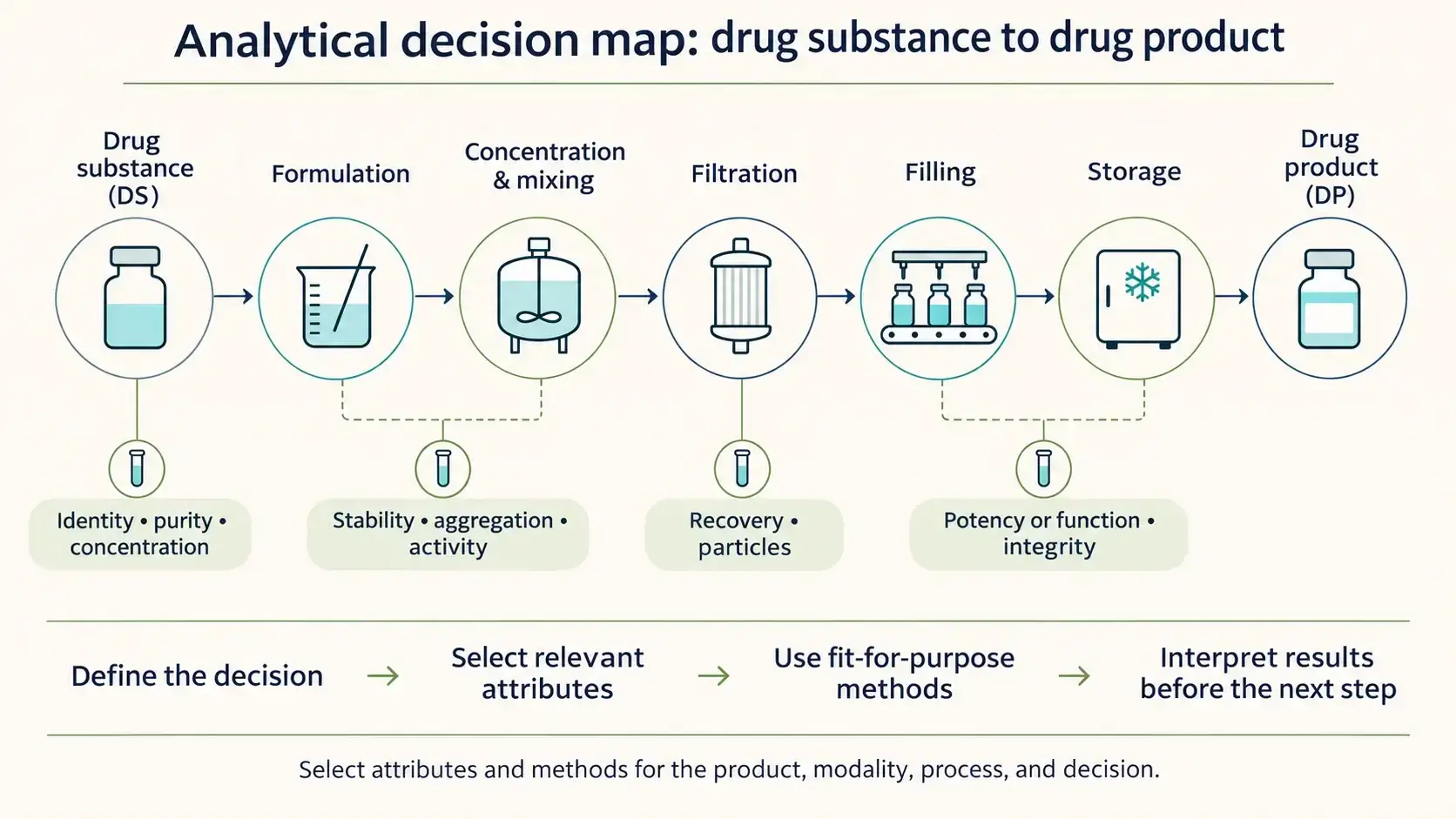
Figure 1. CMC analytical development checkpoints from drug substance to drug product.
Adapt analytical development to each modality
A modality-rich portfolio needs common decision principles, but CMC analytical development cannot rely on a universal assay panel.
For antibodies and other proteins, teams may need to understand whether the molecule retains relevant structural and functional properties during concentration, buffer exchange, filtration, filling, and storage. Depending on the product and decision, analysis may include identity, purity, aggregates, charge or size variants, concentration, and biological activity. The reason for each test should be clear: for example, whether it addresses formulation suitability, process control, product characterization, or release.
ADCs add a payload and linker to the antibody. Their analytical strategy may need to examine drug-to-antibody ratio (DAR) and its distribution, unconjugated antibody, free payload or drug-linker, conjugation-related attributes, aggregation, and functional activity. Average DAR alone may not describe the distribution of drug loading across the product. The team needs methods that reveal the attributes relevant to the process step and the decision being made. Reviews of ADC development emphasize the need to connect analytical and process development from antibody and drug-linker intermediates through DS and DP.
Oligonucleotides bring different analytical challenges. Chemical modifications, conjugation, and closely related sequence impurities can make separation and identification difficult. Chromatographic methods and mass spectrometry may provide complementary evidence because each method has different strengths and limits. The purpose is to build enough product understanding to detect meaningful changes, not to assume that one technique will resolve every impurity or quality question.
For mRNA products formulated in lipid nanoparticles (LNPs), the DS and DP raise distinct questions. The mRNA may need assessment for attributes such as identity, integrity, and purity, while the formulated product also calls for evaluation of relevant LNP properties and biological activity. The EMA’s draft guideline for mRNA vaccines addresses manufacturing, characterization, specifications, and analytical control for the active substance and finished product. Its scope is infectious-disease vaccines, so it should not be treated as a universal rulebook for every mRNA medicine.
Cell and gene therapy products need potency strategies suited to their mechanisms and manufacturing processes. FDA’s final 2026 guidance treats potency assurance as a broader control strategy involving process design, material controls, in-process testing, and release assays. This matters because a release assay alone may not detect every risk to product potency. The strategy must consider where potency can be affected during manufacturing and how those risks will be controlled and measured.
Use methods that can detect changes and explain their relevance
A method may produce precise results and still be unsuitable for a particular decision. It may not distinguish the product from a related impurity, detect a low-level change, or reflect the property the team is trying to control. Method selection should therefore consider what a procedure can measure, how reliably it measures it, and what its results can establish.
Orthogonal methods use different analytical principles to examine the same or related attributes. They can improve confidence when one method has limits in specificity, sensitivity, precision, or its ability to resolve product heterogeneity. ICH Q5E recommends selecting analytical procedures that can detect relevant differences after a manufacturing change; in some cases, more than one procedure may be appropriate for an attribute.
Functional assays are important when the development question concerns biological activity, but their results also need context. Cell-based assays can be variable, making small changes difficult to distinguish from assay noise. If an assay is too variable to support the decision, the team may need to improve the method, use complementary evidence, or revise the question it is being asked to answer. An unchanged functional result cannot rule out a quality change that the assay was not designed to detect.
Stress and stability studies can help reveal degradation pathways or differences that a single time-point test misses. They are most useful when designed around a defined question, such as whether a formulation changes the product’s degradation profile. Stress data can deepen product understanding, but they do not replace real-time stability evidence.
Plan analytical method development early enough to avoid late-stage surprises
Method maturity should match the decision and development stage. Early methods can support screening and process learning, but procedures used for critical decisions, release, or comparability need appropriate performance characteristics and validation where required.
ICH Q14 provides a science- and risk-based framework for analytical procedure development, while ICH Q2(R2) addresses validation. Together, they support a planned approach to method development, rather than waiting until late-stage work to find that a procedure lacks the sensitivity, precision, or robustness required.
Analytical method transfer and bridging
Analytical method transfer also needs attention. Differences in sample preparation, reference standards, system suitability, or data interpretation can affect results when procedures move between laboratories. If an assay changes, teams should determine whether historical results remain comparable or whether bridging work is needed. Otherwise, a method change can create uncertainty about whether the product changed or the measurement did.
Comparability study for biologics: evidence after a manufacturing change
For a comparability study for biologics after a manufacturing change, ICH Q5E recommends an evidence-based exercise that considers the change, product complexity, analytical methods, and the relationship between quality attributes and safety or efficacy. Depending on where quality could be affected, the evidence may need to cover both DS and DP.
Connect the data to the next action
A strong CMC analytical development strategy tells the team which attributes matter, where they could change, how the methods will detect those changes, and what action the results may support. This gives analytical, formulation, process, and quality teams a shared basis for decisions. It also helps sponsors identify gaps while there is still time to address them, rather than during a technology transfer or clinical supply milestone.
When evaluating a contract development and manufacturing organization (CDMO), sponsors should ask how analytical development connects DS characterization with DP performance, how methods are selected for the product and stage, and how the team handles results that are inconclusive or outside historical trends.
At Syngene, our analytical, formulation, and process teams work together from the early stages of each development program. This helps us interpret DS characterization alongside process changes and DP formulation data, then select methods for the quality attributes and decisions that matter for each program. As the program moves toward method transfer and GMP testing, our structured Phase Gate process helps identify analytical risks early. Our modality work includes biologics and ADCs, supported by the GMP bioconjugation suite at Unit 3, as well as mRNA programs from IVT through LNP formulation and fill-finish. This integrated approach helps sponsor teams investigate unexpected results and address evidence gaps before they affect transfer or supply, while keeping the analytical strategy specific to the molecule, process, and development stage.