





From µmole to GMP: The Real Challenges of Large-Scale Oligonucleotide Synthesis
A therapeutic oligonucleotide may begin as a few micromoles of material made on a laboratory synthesizer. At this stage, the main questions are usually scientific. Can the required sequence be produced? Is its identity correct? Does it show the expected biological activity? Small losses can often be tolerated, and difficult synthesis steps may be managed by adding more reagent or repeating a reaction.
The situation changes when the molecule moves toward large-scale oligonucleotide synthesis for toxicology studies, clinical development, and eventual commercial use. Gram or kilogram quantities may now be needed. Every batch must meet defined quality requirements. The impurity profile must be understood, and the process must operate consistently under current Good Manufacturing Practice, or cGMP, conditions. This transition is not simply a matter of using a larger synthesis column. Scale changes how the chemistry, equipment, raw materials, purification process, and analytical methods behave.
The real challenge is not making more oligonucleotide. It is making more of the same oligonucleotide, repeatedly and with controlled quality.
Solid-phase oligonucleotide synthesis: repetitive chemistry, but not a simple process
Most therapeutic oligonucleotides are manufactured using automated solid-phase oligonucleotide synthesis based on phosphoramidite chemistry. The first nucleoside is attached to a solid support through its 3′ end, and the chain is extended in the 3′→5′ direction. Additional nucleotides are introduced through repeated cycles of detritylation, coupling, capping, and oxidation or sulfurization.
These cycles may appear routine, but each one must work at very high efficiency. A small reduction in coupling efficiency during one step may not seem serious. However, the effect accumulates across a sequence containing 20 or more nucleotides. The final amount of full-length product can fall considerably, while the proportion of shortened sequences increases.
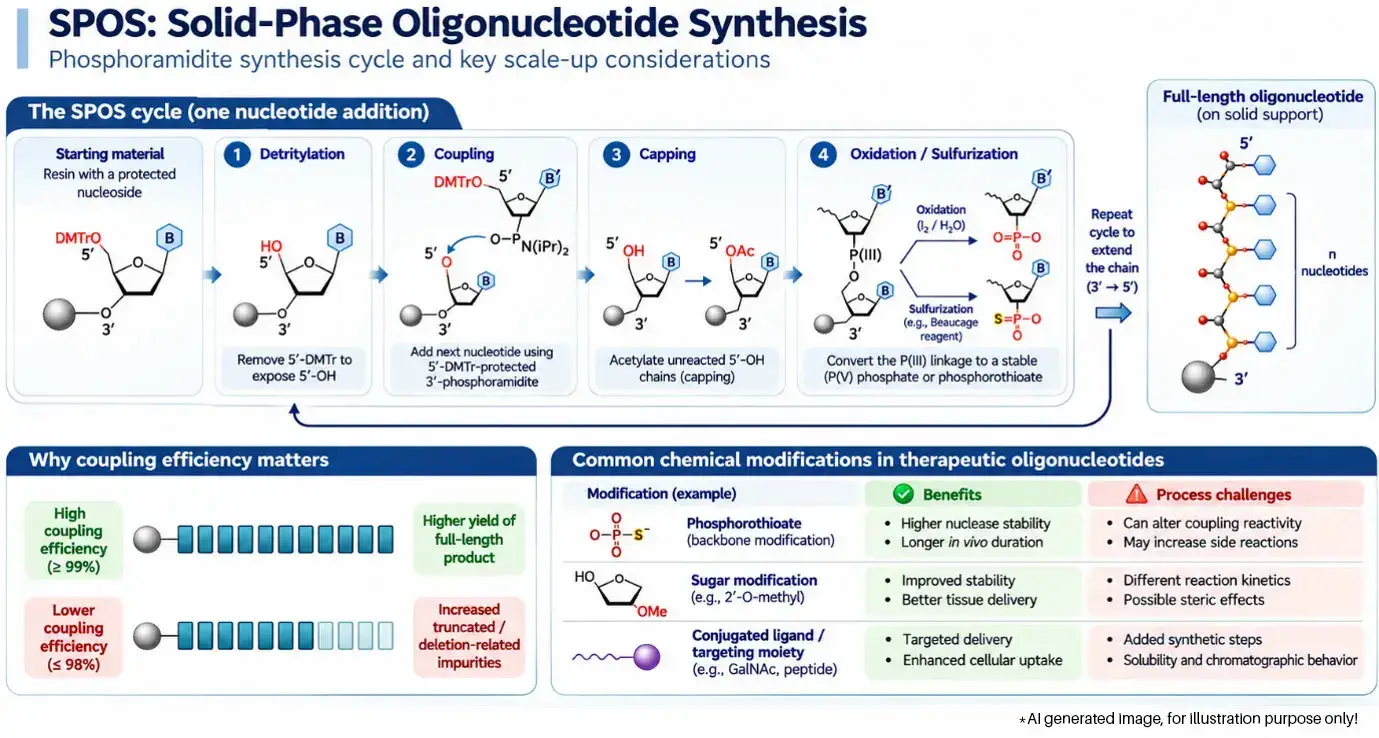
Figure 1: Solid-phase oligonucleotide synthesis of therapeutic oligonucleotides, showing the repeated synthesis cycle, the cumulative impact of coupling efficiency, and the benefits and process challenges introduced by chemical modifications (AI-generated).
Coupling efficiency and chemical modifications
The problem becomes more pronounced for chemically modified oligonucleotides. Modified sugars, phosphorothioate backbones, conjugated ligands, modified nucleobases, and terminal functional groups can improve biological stability, tissue delivery, or target binding. The same modifications can also affect reaction kinetics, steric accessibility, solubility, and chromatographic behavior.
At micromole scale, a scientist may extend the coupling time or use additional phosphoramidite to overcome a difficult step. At manufacturing scale, this increases material costs, cycle time, solvent consumption, and waste. It may also generate additional impurities. A process that works in a discovery laboratory therefore cannot simply be enlarged for large-scale oligonucleotide synthesis without detailed process development.
This is where an integrated contract research, development, and manufacturing organization (CRDMO) can bring practical value. Syngene supports oligonucleotide programs from discovery synthesis through process development, analytical development, and cGMP manufacturing. Its stated capabilities cover modified and unmodified DNA and RNA oligonucleotides, including antisense oligonucleotides, small interfering RNA, conjugated products, phosphorothioates, and other custom modifications.
Scale changes fluid flow inside the synthesis bed
During solid-phase synthesis, reagents must move through the packed support and reach every growing oligonucleotide chain. This becomes harder as the scale increases. Larger beds create longer flow paths and may show uneven wetting, channel formation, pressure differences, or poor reagent distribution.
Some areas of the bed may receive enough activated phosphoramidite, while other areas receive it more slowly or at a lower effective concentration. This can result in incomplete coupling and more deletion sequences. The effect may not be obvious from the reactor settings because the average flow rate can appear normal even when conditions inside the bed are uneven.
The properties of the solid support are equally important. Loading capacity, pore size, particle distribution, swelling behavior, and mechanical strength influence reaction performance and backpressure. A highly loaded support can increase the theoretical amount of product obtained from a reactor. However, crowding of the growing chains may reduce coupling efficiency, particularly for long sequences or molecules carrying bulky modifications.
Process development must therefore balance productivity with chemical performance. Maximum support loading is not always the most economical option. A lower loading may provide better crude purity, easier purification, higher overall recovery, and a lower risk of batch failure. For large-scale oligonucleotide synthesis, these trade-offs can matter more than simply maximizing the quantity of material loaded into the synthesizer.
Small inefficiencies become large impurity problems
Solid-phase synthesis does not purify the growing oligonucleotide after every reaction. Washing removes excess reagents and soluble by-products, but many sequence-related impurities remain attached to the support and continue through later cycles.
The crude product may contain shortened sequences, sequences with an additional nucleotide, incompletely capped products, oxidized species, products with incorrect backbone chemistry, depurinated material, and incompletely deprotected structures. Conjugated oligonucleotides can introduce another group of impurities arising from the linker, ligand, or conjugation reaction.
These impurities are often chemically very similar to the desired product. Some differ by only one nucleotide. Others have the correct sequence but contain a change in one phosphorothioate linkage, sugar modification, nucleobase, or terminal group. This makes both their separation and identification difficult.
Scale-up can also change the impurity pattern, even when the nominal synthesis recipe remains the same. Reagent preparation may take longer. Moisture exposure may increase. Transfer lines and hold vessels can affect residence time. Washing may be less uniform, and reaction heat may not dissipate in the same way. For this reason, the scale-up team must compare the nature of impurities, not only the total percentage purity.
The United States Food and Drug Administration has recognized that synthetic oligonucleotides can contain closely related product and process impurities that require suitable characterization and control. Regulators increasingly expect manufacturers to understand which impurities are present, how they arise, and how analytical methods detect and control them.
Cleavage and deprotection need their own development work
After chain assembly, the oligonucleotide must be removed from the solid support. Protecting groups on the nucleobases, phosphate groups, and other chemical functions must also be removed. At small scale, cleavage and deprotection are sometimes treated as standard finishing steps. At larger scale, they can become important sources of variability.
Temperature, reagent concentration, mixing, reaction time, and oligonucleotide concentration must be controlled. Incomplete treatment may leave partially protected material. Excessive exposure can damage sensitive bases or modified residues. The reaction may also behave differently near the center of a large vessel compared with material closer to the walls.
The process needs suitable endpoint tests rather than relying only on a fixed laboratory hold time. Sampling must be representative, and the analytical method should distinguish incomplete deprotection from other related impurities. The composition of the crude mixture after deprotection also affects later purification, so this stage cannot be optimized in isolation.
Oligonucleotide purification is often the real manufacturing bottleneck
A high crude synthesis yield does not guarantee a successful manufacturing process. The product must still be separated from a mixture of closely related oligonucleotide species. This is often where a significant amount of material can be lost during large-scale oligonucleotide synthesis.
Preparative anion-exchange chromatography and reversed-phase or ion-pair reversed-phase chromatography are commonly used. The choice depends on the oligonucleotide sequence, protecting strategy, hydrophobicity, backbone chemistry, and impurity profile. In some processes, more than one chromatographic step may be needed.
Loading, pooling, and recovery trade-offs
At manufacturing scale, column capacity, pressure, gradient control, feed concentration, peak shape, buffer preparation, and fraction collection become major practical concerns. Loading more crude material onto the column can improve throughput, but it may reduce the separation between the target product and nearby impurities.
Pooling decisions create another difficult balance. Narrow pooling may provide excellent purity but discard a considerable amount of acceptable product. Wider pooling improves recovery but can allow more impurities into the drug substance. Oligonucleotide purification therefore involves a direct balance between recovery, purity, throughput, and product quality requirements.
Purification is followed by concentration, desalting, buffer exchange, filtration, and sometimes lyophilization. Product can be lost during each operation through membrane passage, surface adsorption, transfer losses, or incomplete recovery. These losses may appear minor in individual steps but become significant when considered across the full process.
For a CRDMO such as Syngene, bringing synthesis, purification, analytical development, and manufacturing teams into the same program can reduce handover gaps. This is relevant because purification development cannot progress properly unless analytical methods can measure the impurities that the process is expected to remove.
The analytical package must scale with the oligonucleotide synthesis process
Research material may sometimes be accepted based on chromatographic purity and confirmation of molecular mass. A cGMP drug substance needs a much broader control strategy. Testing may include identity, assay, purity, sequence-related impurities, residual solvents, water content, counterion content, elemental impurities where relevant, bioburden, bacterial endotoxins, and molecule-specific process impurities.
No single method gives a complete picture of an oligonucleotide. Different liquid chromatography methods, mass spectrometry, capillary electrophoresis, ultraviolet measurement, and specific chemical assays may be used together. These methods need to provide complementary information.
Analytical methods developed at discovery scale may also fail during process scale-up. A newly formed impurity may co-elute with the main peak. A method may show a high purity value while failing to separate two chemically similar species. Sample concentration, salt content, or formulation composition can further influence method performance.
Analytical development must therefore continue alongside process development. Syngene’s analytical capabilities include support for oligonucleotides and cover method development, validation, stability testing, impurity assessment, and product characterization. Such integration becomes especially useful during technology transfer because unexpected process changes can be investigated across connected development teams.
Raw materials become a quality and supply risk
Large-scale oligonucleotide synthesis consumes substantial quantities of phosphoramidites, activators, capping reagents, sulfurization reagents, solvents, solid support, buffers, and filtration materials. Their quality can directly affect the final product.
Moisture in phosphoramidites or solvents can reduce coupling efficiency. Variation in the solid support can alter flow and pressure. Impurities in a modified nucleotide building block may continue through synthesis and become difficult to remove later. Novel monomers, linkers, and targeting ligands may also be available from only one or two suppliers.
For GMP oligonucleotide manufacturing programs, supplier qualification, suitable raw material specifications, change control, traceability, and incoming material testing become important. Supply continuity must also be examined early. A chemically successful process may still be commercially weak if a critical modified phosphoramidite has a long lead time or cannot be supplied consistently at the required quality.
Scale-up also brings a large solvent burden
Traditional solid-phase synthesis uses excess reagents and repeated solvent washes. Purification adds large volumes of aqueous buffers and organic solvents. Waste generation rises quickly as batch size increases.
This affects manufacturing cost, worker safety, facility design, solvent storage, waste treatment, and environmental performance. Acetonitrile use is a major concern, but the wider process burden also includes water consumption, buffer preparation, chromatography waste, equipment cleaning, and the disposal or recovery of process solvents.
Newer liquid-phase, membrane-assisted, and enzymatic synthesis approaches are being studied. Some may eventually reduce the reagent and waste burden. However, they are not yet universal substitutes for established phosphoramidite-based solid-phase manufacturing.
For large-scale oligonucleotide synthesis today, the practical approach is often to improve the existing process. Better coupling efficiency can reduce repeated reactions. Optimized wash volumes can lower solvent use. Improved chromatographic loading and pooling can reduce the number of purification cycles. Strong process development therefore supports both manufacturing efficiency and sustainability.
Scale-up begins before the first cGMP batch
One of the most costly mistakes is to optimize a process only for the next discovery batch. The chemistry is then transferred to manufacturing with limited information about difficult coupling steps, raw material sensitivities, support behavior, purification limits, and scale-dependent impurities.
By the time these problems appear in a cGMP campaign, changes are slower and more expensive. Some changes may require analytical method updates, comparability work, additional stability studies, or regulatory justification.
Good scale-up begins during early development. Chemistry, analytics, engineering, quality, manufacturing, and supply chain teams need to work from a shared process understanding. The objective is not to copy every laboratory detail. It is to identify the controls that are necessary to deliver consistent material within acceptable operating ranges.
Syngene’s broader oligonucleotide model is built around this laboratory-to-manufacturing connection. Its published capabilities include process development, analytical development, synthesis, purification, and cGMP manufacturing, with support extending from small discovery quantities toward larger clinical and manufacturing requirements. This does not remove the scientific difficulties of scale-up. It can, however, reduce the fragmentation that occurs when synthesis, analysis, and manufacturing are managed separately.
Moving from micromoles to cGMP production is ultimately a change in mindset. Discovery proves that the molecule can be made and tested. Large-scale oligonucleotide synthesis must show that the same molecule can be produced repeatedly, characterized properly, purified efficiently, and supplied without losing control of quality. That is the real work behind oligonucleotide scale-up routinely performed at Syngene.