



The success of glucagon-like peptide-1 (GLP-1) medicines has made peptides a major focus for drug developers and manufacturers. Obesity and type 2 diabetes have driven much of this attention. At the same time, peptide candidates are advancing in cancer, cardiovascular disease, inflammation, infection, and rare diseases. A 2025 review, “Peptides in the Clinic Today: The Leading Families and Their Applications,” catalogued 287 candidates in clinical development across areas including antimicrobial therapy, cancer treatment, and guided surgery. For CDMOs, that breadth changes the peptide manufacturing process: capacity must support high-volume metabolic APIs as well as complex clinical batches involving modified sequences, conjugation, or lower-volume supply.
How new peptide types change CDMO requirements
The next wave includes programs with distinct technical and commercial profiles. Some may need high-volume supply for chronic treatment; others are complex, low-dose products for smaller patient groups. Oral macrocycles, peptide-drug conjugates, radiolabeled peptides, and modified antimicrobial or immunology candidates bring different process, analytical, and drug product requirements. Pipeline growth will favor CDMOs that can support early clinical batches and scale programs as evidence and demand develop.
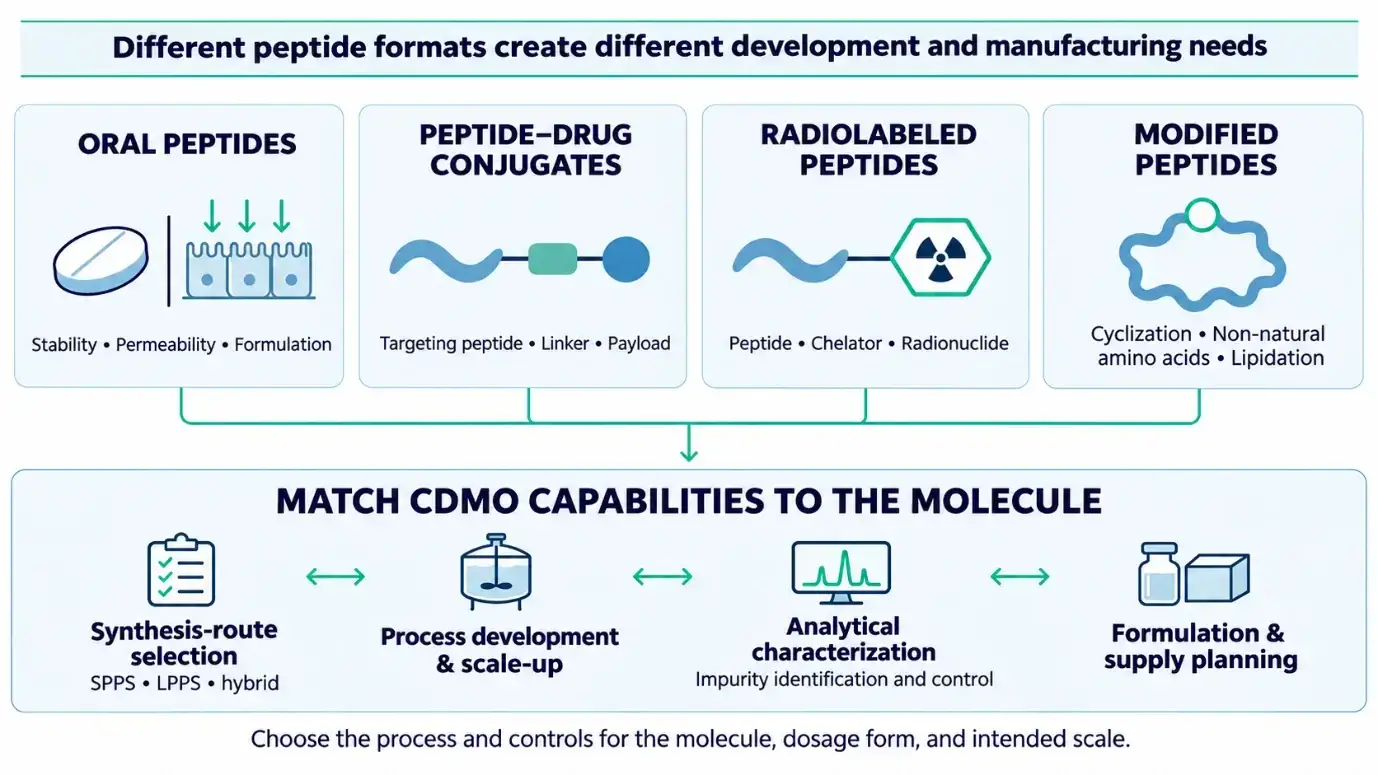
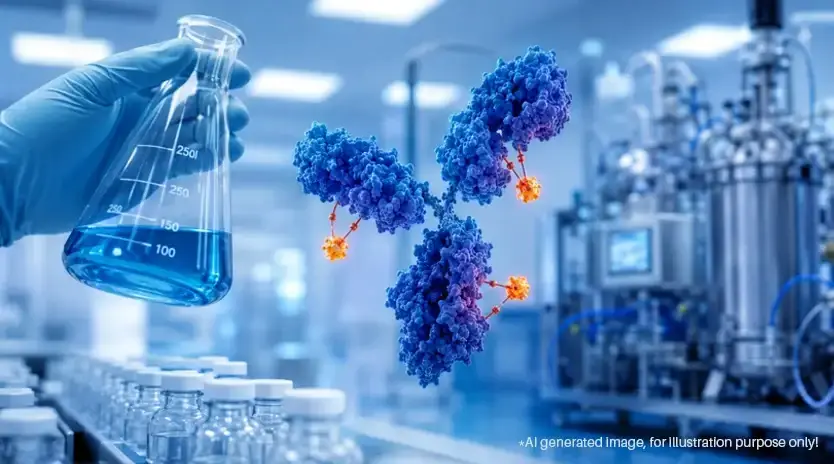
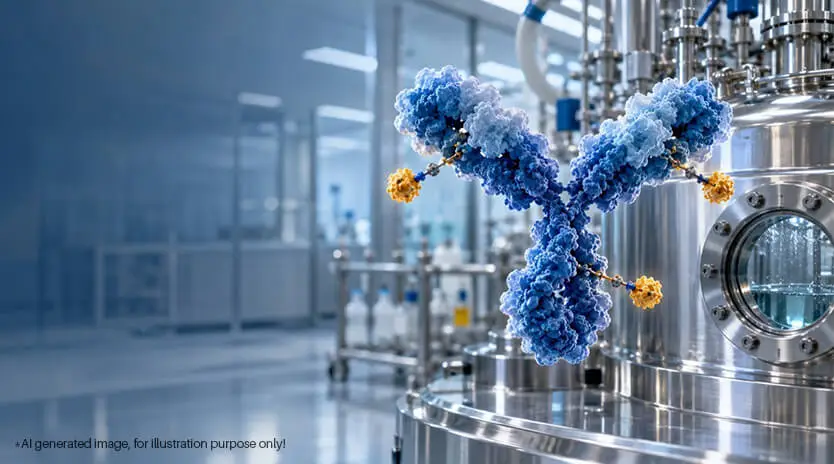
Figure 1. Different peptide formats create distinct CDMO requirements, from synthesis-route selection and analytical control to formulation and supply planning. (AI-generated Image)
Oral delivery and peptide formulation development
Oral delivery illustrates this shift. Most peptides are injected because digestive enzymes can break them down, while their size makes absorption through the gut difficult. Oral candidates may need molecular changes, protective excipients, permeation enhancers, or a combination. Enlicitide, an investigational oral macrocyclic peptide that inhibits PCSK9, has reported positive Phase 3 results. This is a notable development beyond incretin therapy, but oral delivery remains a formulation and manufacturing challenge. Peptide formulation development may involve synthesis, excipient selection, tablet development, stability testing, and assessment of product performance. The process must protect the molecule and produce a dosage form that delivers consistent exposure.
Oncology: conjugates, radioligands, and peptide API manufacturing
Oncology brings another set of needs. Peptides can bind to receptors on tumor cells and carry a payload to those sites. Lutathera, a radiolabeled somatostatin analog, is an established treatment for receptor-positive gastroenteropancreatic neuroendocrine tumors. Peptide-drug conjugates are also being investigated, though their clinical record is still developing. These products combine a targeting peptide, linker, and payload. Each part, and the conjugation step, can affect stability, binding, and release.
Radiopharmaceuticals add isotope handling, limited shelf life, time-sensitive release testing, and coordination with treatment centers. A CDMO may not perform every step, but it must understand how peptide API manufacturing connects with conjugation, radiochemistry, and drug product manufacture.
Process choice must follow the molecule
Choosing a peptide manufacturing process: SPPS, liquid-phase, or hybrid
Many new candidates are not simple linear sequences. They may contain D-amino acids, non-natural amino acids, cyclization, lipid tails, PEG groups, or other modifications to improve potency, stability, or duration of action. These changes can also affect solubility, purification, and analytical control. Long sequences may generate deletion or insertion impurities, while stereochemical errors can be hard to separate. For modified peptides, methods must confirm the expected mass and locate the modification.
Solid-phase peptide synthesis (SPPS) remains widely used, but it can consume large quantities of solvent and generate substantial waste. Liquid-phase or hybrid synthesis may suit some molecules, particularly when a sequence can be split into fragments. The peptide manufacturing process should be selected case by case, based on yield, purity, cost, safety, and supply. A 2024 industry study compiled process mass intensity data from companies and highlighted the sustainability burden of peptide synthesis. Solvent recovery, lower solvent use, improved washing, and alternative reagents are practical priorities. Biocatalysis is also being explored for complex peptides, though it requires its own development and controls. The important capability is not one preferred platform; it is the ability to compare routes and choose one that fits the molecule and its intended scale.
From gram scale to GMP peptide manufacturing
That choice affects the path to commercial supply. A peptide manufacturing process that works at a few grams may behave differently at kilogram scale. Resin, loading, mixing, heat transfer, reagent delivery, and washing can influence impurities as batches grow. Larger batches need more raw material and purification capacity, along with suitable solvent recovery and waste handling. CDMOs are investing in peptide capacity across SPPS and liquid-phase production. But reactor volume alone does not show whether a site can deliver consistent quality or respond to a rapid rise in demand. Sponsors should ask what scale has been demonstrated, how the process will move into GMP, and how capacity will be allocated if the program advances.
Build impurity testing and peptide analytical development into process development
As the route and scale change, the impurity profile can change too. Impurities may include deletion sequences, epimers, oxidation products, and residual reagents. Different manufacturing routes can produce different impurity profiles, with possible safety implications. Peptide analytical development must therefore begin alongside process development. The CDMO needs methods for identity, potency, purity, and impurity characterization, supported by LC-MS, chromatography, reference standards, and stability studies. It should link process parameters to product quality. The question is not only whether a batch meets a purity limit, but whether key impurities are understood and controlled consistently across scale, site, and time.
Plan peptide formulation development, fill-finish, and raw materials together
A peptide program may need sterile filling, lyophilization, a depot formulation, or an oral dosage form. Each option changes equipment, formulation, packaging, and stability requirements. If API, formulation, and fill-finish teams work separately, decisions can be delayed or repeated. An integrated partner can connect these activities when responsibilities and technical handoffs are clear.
Supply planning should also start early. Peptide production depends on qualified amino acids, resins, linkers, solvents, and specialist reagents. Some inputs have long lead times or few suppliers. Sponsors need qualified supply chains, realistic campaign schedules, and backup plans, not reactor capacity claims alone. The CDMO should identify materials requiring early qualification and assess where alternate sources are feasible.
What this means for CDMO selection
Sponsors should assess a partner against the molecule and its likely route to market. Can it handle the sequence and modifications, compare SPPS with liquid-phase, hybrid, or enzymatic approaches, and explain impurity risks? Can it support the intended formulation, transfer process knowledge, and plan supply as demand changes? Early programs need flexible batches and access to experienced scientists; later products need reproducibility, capacity, and continuity. The partner’s peptide manufacturing process should fit the molecule and the program’s expected scale.
At Syngene, we are expanding peptide support from synthesis and characterization through scale-up and development. Our teams support linear, cyclic, and conjugated peptides, with automated synthesis, purification, and analytical characterization. Clinical cGMP batches range from 10 g to 200 g, and our 150 L solid-phase train delivers 5–7 kg per batch. A new peptide facility, ready in April 2027, adds a 1000 L solid-phase train for batches of up to 50 kg and annual capacity of up to 500 kg. Our GLP-1 experience includes a semaglutide bioequivalence study using prefilled pens, supported by LC-MS/MS bioanalysis of semaglutide in human plasma. These capabilities connect peptide chemistry with the analytical and clinical development needs of programs as they advance.
GLP-1 medicines have shown what peptides can achieve when biology, formulation, manufacturing, and demand align. The next programs will be less uniform. CDMOs will need to match process chemistry, analytical control, formulation, and supply planning to each molecule. A high-volume platform alone will not address every need. The ability to move from a well-characterized peptide manufacturing process to reliable clinical and commercial supply will matter just as much.
To discuss a peptide development program, contact the Syngene team or visit our peptide capabilities page.