





Drug substance manufacturing is often judged by the capabilities a contract development and manufacturing organization (CDMO) can offer: fermentation, cell culture, synthesis, purification, high containment, or analytical testing. That list is useful, but it does not tell a sponsor whether the proposed process will work for its molecule, meet its quality requirements, or support its commercial plan.
The more useful question is where the hard part of the process sits, and whether it will stay there as the program advances. For a small molecule, the challenge may be controlling an impurity or producing the right crystal form. For a protein, it may be preserving a quality profile shaped by the cell culture process. For an oligonucleotide, purification can constrain throughput and recovery. For an antibody-drug conjugate (ADC), several difficult operations have to work together.
That bottleneck can move. A process that is well suited to early clinical supply may become costly at larger scale. A change that improves yield may alter a product attribute or create new comparability work. A manufacturing decision should therefore be assessed against the molecule, the intended product, the stage of development, and the expected demand.
Commercial Drug Manufacturing: Start With the Product and the Demand
Manufacturing strategy is sometimes discussed as though the main task is to select a process platform. The product and its market need to be part of that choice from the beginning.
A route designed for a small clinical study may prioritize speed, flexible batch sizes, and access to scarce starting materials. A launch process has different pressures: reliable supply, predictable cost, raw-material resilience, and enough capacity to meet demand. The formulation also matters. A process that produces an API efficiently may not produce material with the particle properties, solubility, or stability required for the intended drug product.
Commercial teams should look beyond cost per kilogram. A better comparison may be the cost of a saleable dose, or the cost of supplying one patient over a year. That comparison depends on dose, yield, formulation, administration schedule, shelf life, and losses during production. A low-cost API route can be a poor commercial choice if it produces material that is difficult to formulate or has low recovery. Conversely, a more expensive process step may reduce downstream losses or improve product performance.
The forecast also needs scrutiny. Capacity decisions based on an optimistic demand estimate can leave a sponsor paying for underused equipment. Planning too cautiously can create long lead times or supply constraints. Scenario planning should account for clinical outcomes, market uptake, batch size, manufacturing lead time, and the time needed to qualify additional capacity.
Small Molecule CDMO: The Route Is Only Part of the Decision
Small-molecule APIs are generally made through chemical synthesis. Process development determines the reaction sequence, starting materials, operating conditions, impurity controls, and final isolation steps. The best route is not necessarily the one with the fewest steps or the highest laboratory yield.
Drug substance manufacturing for a small molecule can be difficult if the route is unsafe to run at scale, depends on a scarce starting material, or requires expensive purification. A different route may reduce cost but introduce new impurities that need characterization and control. These trade-offs influence process safety, supply continuity, analytical workload, and regulatory documentation. International Council for Harmonisation (ICH) Q11 describes approaches for developing and understanding drug substance manufacturing processes, including the justification of starting materials and the information expected in regulatory submissions.
Crystallization can be as consequential as the reaction sequence. It affects purity, particle size, filtration, drying, handling, and sometimes the performance of the finished product. Some compounds can form different crystal arrangements, known as polymorphs. These forms may differ in solubility or stability. Solvent composition, cooling, mixing, and seeding affect which form is produced. Conditions that work in a small vessel may not translate directly to a larger one, where mixing and heat transfer differ. Development work needs to establish how the intended form can be produced reliably at scale.
Ask the partner for the reasoning behind the route, expected yields, known impurity risks, crystallization controls, and the evidence supporting scale-up. A quoted batch capacity does not answer those questions.
We work through these questions with sponsors before scale-up, so route selection, impurity control, and crystallization rest on data rather than assumptions. Our small-molecule commercial manufacturing plant in Bengaluru produces APIs, HPAPIs, and advanced intermediates from 100 g to 500 kg, and is approved by regulators including the U.S. Food and Drug Administration (FDA), the Pharmaceuticals and Medical Devices Agency (PMDA), and EU GMP authorities.
Sustainability is also a process-design issue. Solvent and water use, reagent efficiency, energy demand, waste treatment, and solvent recovery can all affect the process footprint and operating cost. Process mass intensity (PMI) can help compare material use across routes, but only when the calculation boundary is clear. It should include the inputs that matter to the decision, rather than omitting water, cleaning, or waste treatment. A reduction in solvent use may be beneficial, but a full assessment should also consider yield, energy, and the burden of any replacement material.
For some reactions, flow chemistry can reduce the inventory of unstable intermediates and improve heat transfer. Its fit depends on reaction kinetics, solids handling, process control, and the cost of adapting equipment. A green chemistry review can also test whether safer solvents, catalytic routes, or fewer isolation steps reduce waste without increasing process risk or cost.
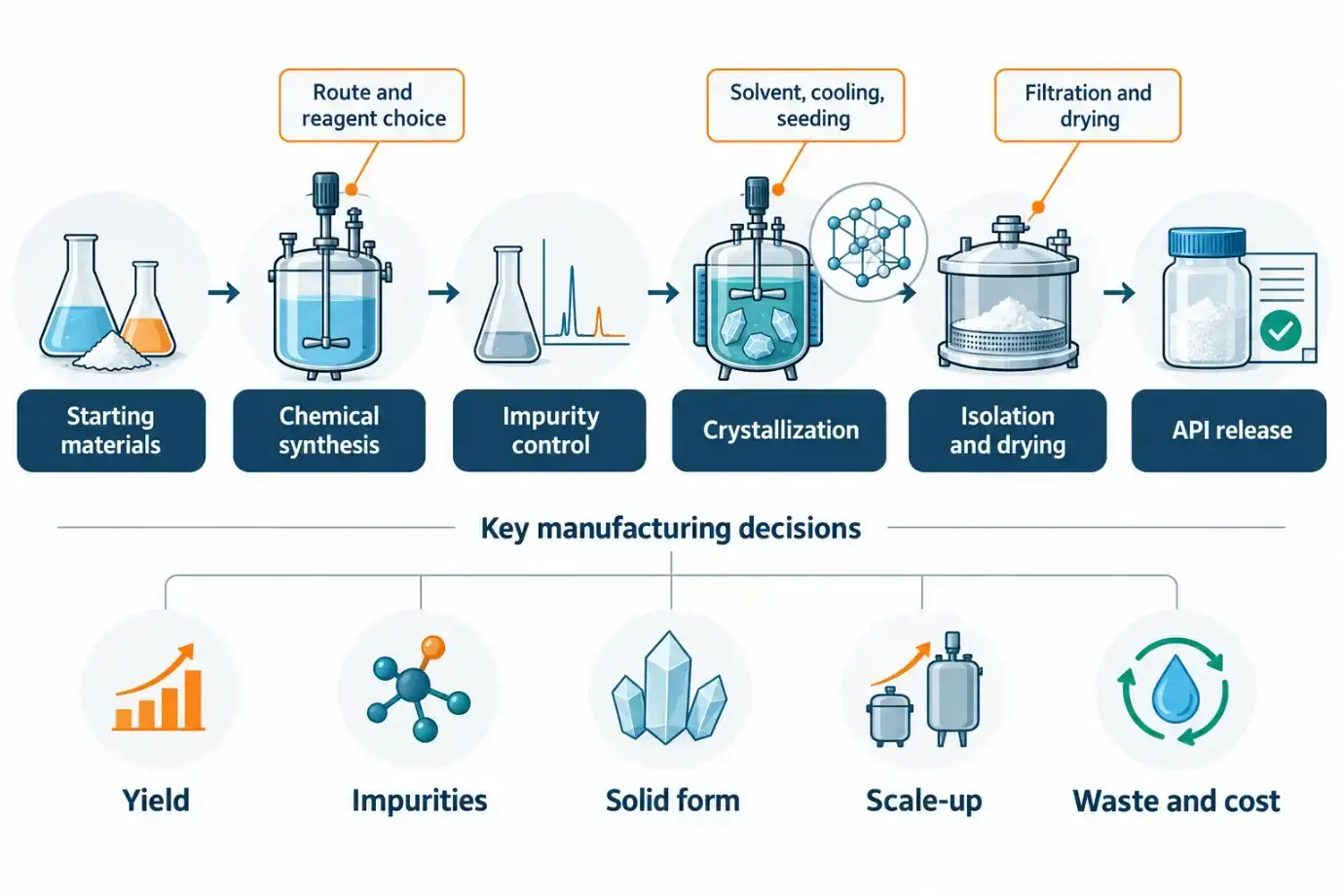
Figure 1. Small-molecule API manufacturing links route selection and impurity control with crystallization, isolation, scale-up, and waste management. Each decision can affect product quality, process cost, and supply.
High Potency Changes the Operating Model
High potency is a handling characteristic, not a distinct synthesis platform. It can apply to different molecule types. The manufacturing process must protect workers and prevent cross-contamination during weighing, transfer, sampling, processing, cleaning, and waste handling.
Containment can influence facility design, equipment, procedures, cleaning strategy, campaign planning, and the ability to share a site with other products. It can also affect cost and available capacity. Containment strategy usually starts with the compound’s occupational exposure limit (OEL) or occupational exposure band (OEB). The International Society for Pharmaceutical Engineering (ISPE) Baseline Guide on Risk-Based Manufacture of Pharmaceutical Products (Risk-MaPP) describes a science-based approach to managing cross-contamination using health-based exposure limits. The partner should be able to explain how its controls relate to the compound’s risk assessment and specific operations. A broad claim that a site handles potent compounds does not establish that its controls fit a particular program.
These requirements have to be included in project planning. If containment needs are identified only after process transfer, the program may need changes to equipment, procedures, cleaning, or qualification. Those changes can add time and cost, and may limit the site’s capacity for other work.
We handle high-potency and cytotoxic compounds up to OEB-5, which lets us build containment into the project plan from the start rather than retrofit it after transfer.
Large Molecule Manufacturing: The Host and Process Shape the Quality Profile
Many therapeutic proteins are produced in living cells. Mammalian cells, most often Chinese hamster ovary (CHO) cells, are widely used for monoclonal antibodies because they can produce complex proteins with relevant post-translational modifications. A typical process includes cell culture, harvest, purification, and formulation. Each stage can affect the material that reaches the patient.
Culture conditions can influence attributes such as glycosylation. Other quality attributes include aggregation, charge variants, and sequence-related variants. Host-cell proteins and DNA are examples of process-related impurities that also need control. The manufacturer has to understand how parameters such as pH, temperature, feed strategy, and culture duration relate to both yield and product quality. Maximizing cell productivity alone is not enough if the resulting quality profile is difficult to control.
The expression system changes the process. Microbial fermentation can be suitable for some recombinant proteins and may offer a productive route. But if the protein is expressed inside E. coli, recovery may require cell disruption. If it forms inclusion bodies, the process may also require solubilization and refolding. For some proteins, directing expression to the periplasm or secreting the protein can avoid refolding, although these approaches bring their own yield and scale-up trade-offs. The manufacturer must then show that the recovered protein has the required structure and activity, while controlling host-related and process-related impurities.
Scale-up presents its own questions. Oxygen transfer, mixing, heat removal, feed strategy, and harvest conditions can differ between development and production equipment. Those differences may affect yield, cell health, or product attributes. The key questions are which expression system fits the molecule, what evidence supports scale-up, and how purification protects quality and recovery.
A process change can have regulatory consequences. ICH Q5E, adopted by regulators including the FDA and the European Medicines Agency (EMA), sets out principles for assessing the comparability of biotechnology-derived products before and after manufacturing changes. The amount and type of evidence depend on the change and its possible effect on quality, safety, and efficacy. A change in scale or site is not automatically a product problem, but the sponsor needs data to support the conclusion.
Our biologics manufacturing network spans Bengaluru and Bayview, Maryland, with total single-use bioreactor capacity of 50,000 L. That gives sponsors options for clinical and commercial supply, and for adding a second site, with comparability planned within one network rather than across separate providers.
Peptides: Sequence and Recovery Determine What Scales
Many therapeutic peptides are manufactured using solid-phase peptide synthesis (SPPS), which adds amino acids in sequence while the growing chain remains attached to a solid support. Liquid-phase or hybrid methods may also be suitable. The choice depends on the sequence, modifications, scale, and process economics.
Each coupling step can leave deletion or truncated sequences, and side reactions such as racemization, aspartimide formation, or oxidation can generate related impurities. Longer sequences increase the number of steps at which such impurities can arise. Cyclization, non-natural amino acids, or other modifications can add process and analytical requirements. Purification has to separate the desired peptide from related sequences without sacrificing too much product.
This means the process bottleneck may not be the synthesis vessel. It may be purification capacity, isolation, testing, or the supply of a specialized building block. A process that supports early clinical batches may need substantial work before it can serve commercial volumes at an acceptable cost. Useful questions cover expected yield, batch range, purification throughput, raw-material requirements, and waste profile.
The timing of investment matters too. Building large capacity before demand is clearer can lock a program into high fixed costs. Waiting too long can create supply pressure if demand rises quickly. Flexible manufacturing and a staged capacity plan can help, but only if the process and facility support that flexibility.
We develop peptides using SPPS, with drug substance and drug product development co-located in one facility under a single quality system. Running those workflows in parallel shortens the path to clinical supply and reduces the knowledge lost in transfer. Our dedicated peptide laboratory in Bengaluru supports SPPS scale-up to 800 mmol.
Oligonucleotides: Purification Can Set the Pace
Synthetic oligonucleotides are commonly made by solid-phase phosphoramidite synthesis, followed by cleavage, deprotection, purification, and isolation. Modifications and conjugates can change the process and analytical strategy. EMA’s draft guideline on the development and manufacture of synthetic oligonucleotides addresses controls for conjugation and impurities such as truncated or deletion sequences.
Stepwise synthesis can produce full-length product alongside related sequences. Purification must remove those impurities while preserving recovery. As volumes rise, solvent and reagent use, waste handling, purification throughput, isolation, and raw-material supply can become major constraints. Published reviews, including work from the ACS Green Chemistry Institute Pharmaceutical Roundtable, identify scale and sustainability limitations in established phosphoramidite processes and describe efforts to develop alternative approaches.
For a sponsor, “can synthesize the sequence” is an incomplete assessment. The manufacturing plan should cover purification, recovery, analytical characterization, specialized raw materials, and the anticipated demand profile. If the molecule includes a ligand or other conjugate, the additional steps and controls should be part of the plan from the outset.
Oligonucleotide drug substance manufacturing needs analytical planning alongside synthesis. We support oligonucleotide programs from development through cGMP manufacturing, including modified and unmodified DNA and RNA, siRNA, and antisense sequences. In-house analytics for structural characterization and impurity profiling let us plan synthesis, purification, and testing together, so recovery and throughput constraints surface before they limit supply.
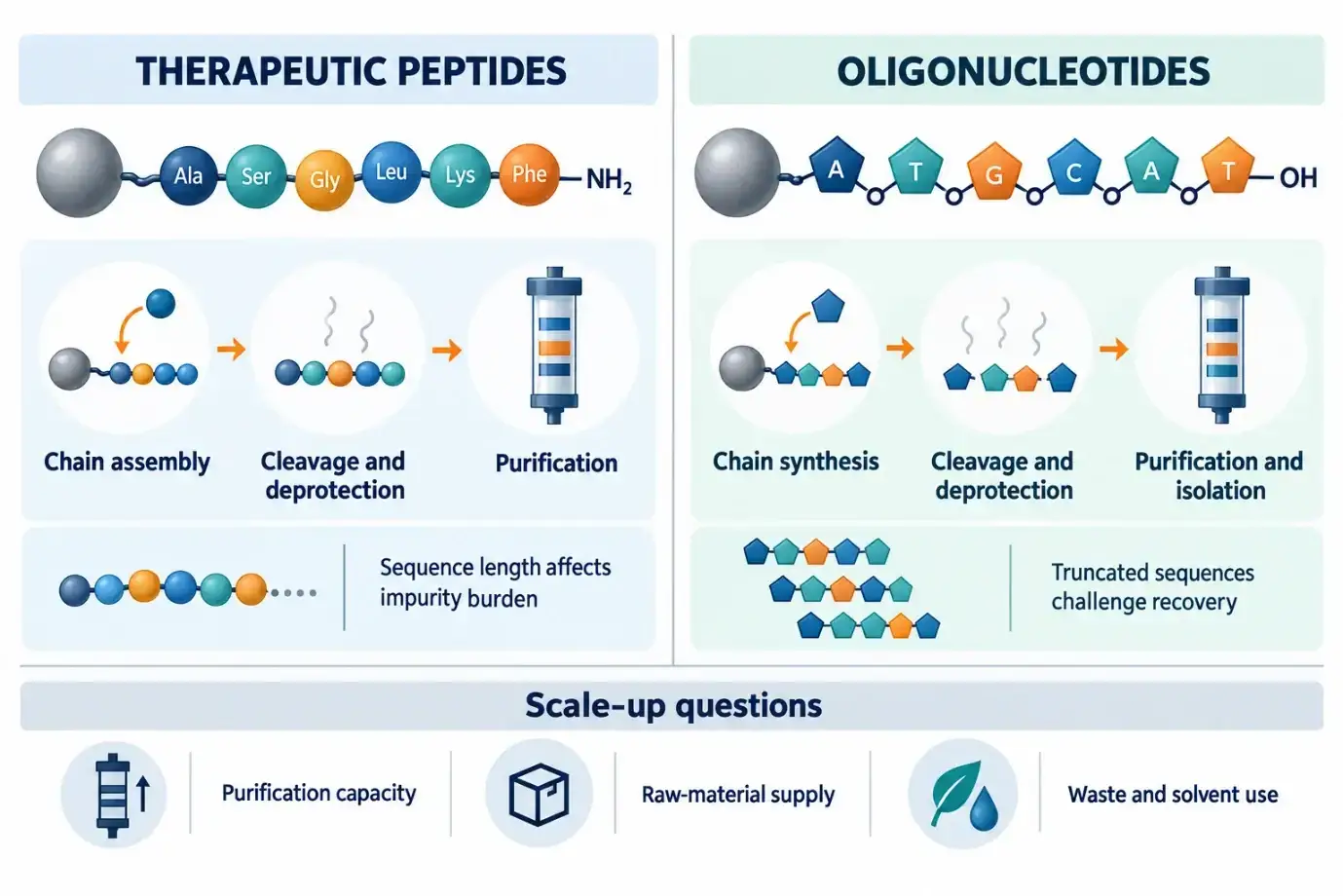
Figure 2. Peptide and oligonucleotide processes use different synthesis chemistries, but both need careful planning for purification, raw-material supply, scale-up, and solvent use.
ADC Process Development: The Linked Steps Need a Shared Control Strategy
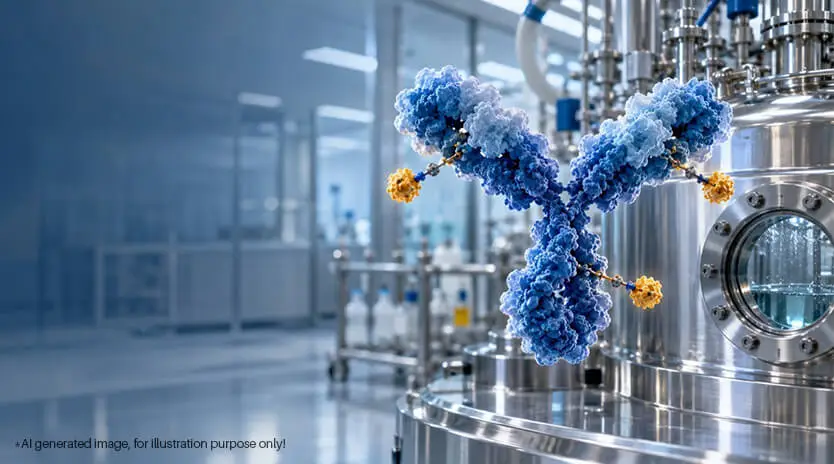
An ADC brings an antibody, linker, and potent small-molecule payload into one product. Its manufacturing strategy combines biologic production, conjugation chemistry, purification, analytical characterization, and containment.
The antibody entering conjugation has its own quality attributes. The conjugation process then has to control drug-to-antibody ratio (DAR), conjugation sites, free payload and payload-related impurities, residual solvents, aggregation, and linker stability. Site-specific conjugation can narrow the product distribution, but lysine or cysteine conjugation produces several molecular species, so analytical methods must characterize the distribution and support process control.
These operations affect one another. The properties of the antibody can affect conjugation. Reaction conditions can affect DAR distribution, aggregation, and purification yield. Payload handling brings containment and cleaning requirements. When different suppliers or sites handle antibody production, conjugation, and fill-finish, the transfer plan must account for material attributes, analytical methods, and responsibility for deviations.
Someone has to own the overall control strategy. Who decides whether a change in antibody process could affect conjugation? Which tests establish the DAR distribution and free-payload limits? How will the team manage the payload safely and demonstrate cleaning? These questions affect timelines, release strategy, and the reliability of supply.
We built our GMP bioconjugation suite inside our commercial biologics facility in Bengaluru, so antibody production and OEB-5 conjugation sit on the same site, supported by our payload and linker manufacturing and co-located analytical labs. One team and one quality system own the control strategy across antibody, linker-payload, and conjugation. For sponsors, that means fewer technology transfers and one point of accountability when a deviation occurs.
Regulatory Planning and Commercial Drug Manufacturing Economics Belong Together
Regulatory expectations vary with the process and product risks. ICH Q11 addresses development and understanding of drug substance processes. The U.S. Food and Drug Administration’s guidance, Process Validation: General Principles and Practices, describes a lifecycle approach in three stages: process design, process qualification, and continued process verification. ICH Q13 provides guidance for continuous manufacturing of drug substances and drug products, with a focus on chemical entities and therapeutic proteins. It supports appropriate continuous processes, but it does not make continuous manufacturing the right choice for every molecule or business case.
Early process knowledge has commercial value because it gives sponsors a better basis for later decisions. Changing a site, scale, raw material, or unit operation may require additional studies, documentation, or comparability evidence. If the original process is poorly understood, the sponsor may have difficulty assessing the change and defending it to regulators.
The supply plan should reflect the program’s actual constraints: demand scenarios, batch sizes, lead times, raw-material availability, testing time, and the cost of maintaining specialized capacity. A process that meets technical specifications but depends on a single fragile raw-material source may create a commercial risk. A process with high recovery but long cycle times may limit supply. These are not issues to leave until launch planning.
Sustainability claims need the same discipline. For chemical synthesis, teams can track solvent, water, material use, energy, waste, and recovery per amount of API. For cell-based production, water, energy, single-use materials, and cold-chain needs may matter. For peptides and oligonucleotides, solvent, reagent use, purification losses, and waste deserve attention. Comparisons need a consistent boundary and should account for yield. The process with the lowest input in one step may not have the lowest overall footprint.
What Sponsors Should Ask a CDMO Partner
A useful assessment goes beyond equipment lists and stated capacity. Sponsors should ask:
- Which steps are likely to limit yield, throughput, or quality for this molecule?
- What evidence supports the proposed route, expression system, purification strategy, or conjugation method?
- Which process parameters affect the product attributes that matter?
- How will the process change as batch size and demand increase?
- What changes could trigger additional comparability or regulatory work?
- Where are the supply risks in raw materials, testing, and specialized capacity?
- How will environmental performance be measured across the process?
The answers should connect science to business. If purification is the bottleneck, a larger synthesis vessel may add little value. If a route depends on a scarce reagent, an alternate-source strategy may be more valuable than a small yield improvement. If a biologic process is still changing, early agreement on comparability methods may prevent later disputes.
This is where a manufacturing partner earns its place in a development program: by identifying which decisions are hard to reverse, showing where the process is likely to constrain the product, and bringing the sponsor into those choices early. A capability list can start the discussion. Evidence, process understanding, and realistic planning determine whether the partnership can support the molecule through development and into reliable supply.
That is how we approach programs across small molecules, biologics, peptides, oligonucleotides, and ADCs: find the likely bottleneck early, build the evidence to manage it, and plan scale-up and supply around the molecule’s development and commercial path. To discuss your molecule, development stage, and manufacturing needs, explore our small- and large-molecule CDMO solutions or get in touch with our team.
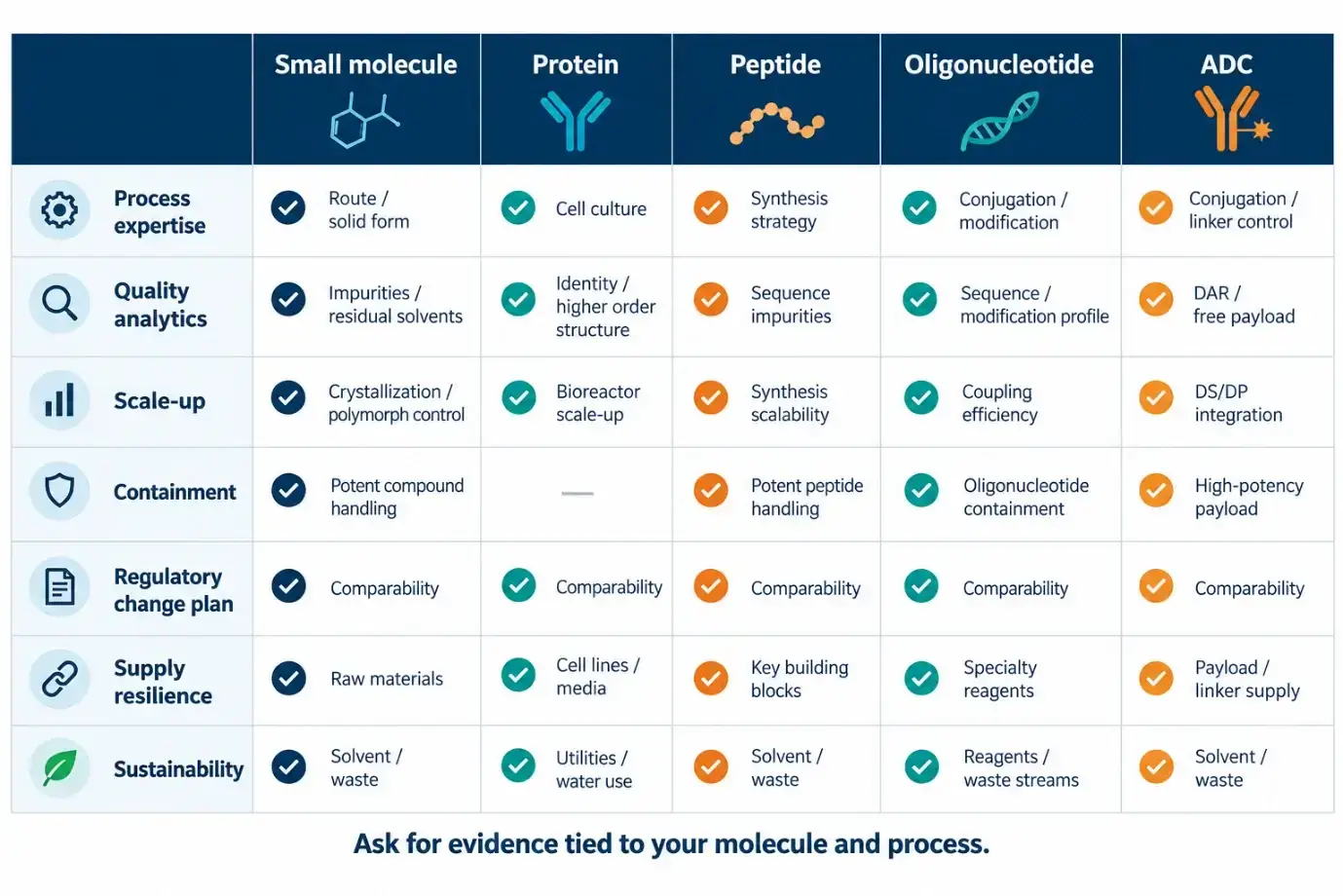
Figure 3. A sponsor’s manufacturing assessment should cover process expertise, analytics, scale-up, containment, regulatory change planning, supply resilience, and sustainability. These areas can guide discussions with a prospective manufacturing partner.