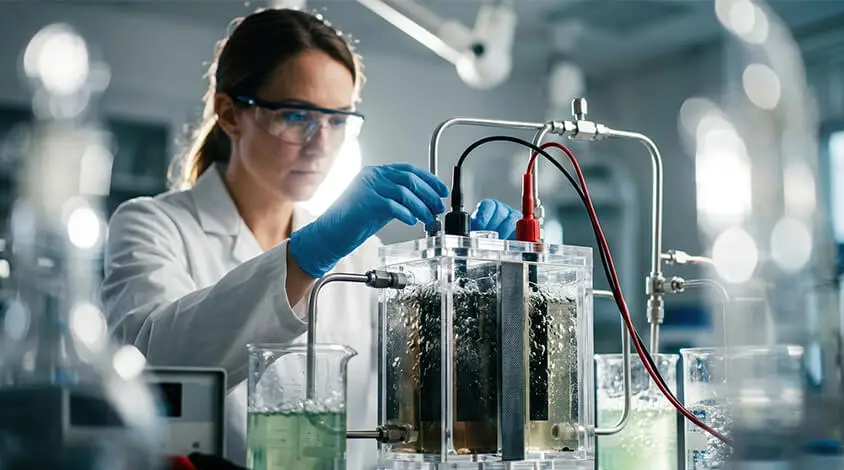







Unstable intermediates are a familiar challenge in process development. They may decompose before the next reaction step begins, generate unexpected impurities during scale-up, or create safety concerns when larger quantities are handled. In some cases, the chemistry works well at laboratory scale but becomes difficult to reproduce when reaction volumes increase. This is where flow chemistry can provide a practical advantage. By controlling how long materials remain under reaction conditions and limiting the amount of reactive material present at any moment, flow chemistry can make demanding transformations easier to develop, scale, and operate.
For process development teams, however, the important question is not how widely flow chemistry is being adopted. It is whether the technology provides a meaningful process advantage for the chemistry under development. For unstable or highly reactive intermediates, that advantage can come from precise residence-time control, rapid mixing and heat transfer, low reacting inventory, and the ability to generate a reactive species and consume it immediately in a subsequent transformation.
Why unstable intermediates create disproportionate development risk
In many small molecule programs, the greatest development challenge is not the final active pharmaceutical ingredient but the behavior of the pharmaceutical intermediates used to reach it. Some intermediates degrade within minutes, while others slowly generate impurities during processing, transfer, or isolation. A compound that appears manageable during route scouting may become problematic during process optimization when reaction times, temperatures, or scale begin to change.
The consequences extend beyond yield loss. Decomposition products can complicate impurity profiles, increase purification requirements, and reduce process robustness. In severe cases, instability may force the redesign of an otherwise attractive synthetic route.
For many drug intermediates, instability is closely linked to process conditions. Elevated temperature, prolonged exposure to reagents, residual catalysts, dissolved oxygen, moisture, or pH changes can accelerate degradation. The development challenge is therefore not only achieving conversion. It is establishing a process window in which reaction performance, impurity control, safety, and scalability remain acceptable at the same time.
This requires an early understanding of both reaction kinetics and degradation kinetics. A high-yielding reaction is not necessarily a robust process if the desired intermediate begins to decompose while addition, sampling, transfer, or quenching is still taking place. Mapping that time dependence is often the first indication of whether conventional batch processing provides enough control.
Where flow chemistry changes the equation
Short residence time and controlled exposure
One of the most important advantages of continuous flow chemistry is precise control over residence time. Reactive species can be generated and consumed within seconds or minutes, rather than remaining in a reactor for extended periods.
This becomes particularly valuable when an intermediate is inherently unstable. Instead of preparing a large batch and hoping the material remains intact until the next operation, flow chemistry allows the intermediate to move directly into the subsequent transformation. Exposure to conditions that promote degradation is reduced, and the opportunity for side reactions decreases.
For short-lived intermediates, this difference can determine whether a route is practical or not. Residence time can also become an optimization variable in its own right. By relating conversion and impurity formation to defined residence times, process teams can identify an operating window that favors the desired transformation before competing degradation pathways become significant.
Better heat transfer and reaction control
Many unstable pharmaceutical intermediates are formed in highly exothermic reactions. Thermal excursions that appear minor at laboratory scale can become significant during scale-up. Localized hot spots may trigger decomposition pathways that were not evident during early development.
Because continuous flow chemistry uses small reaction volumes and high surface-area-to-volume ratios, heat removal is generally more efficient than in conventional batch reactors. Temperature profiles remain tighter and easier to control. This improved thermal management often translates into cleaner reaction profiles and lower impurity formation. Sometimes the improvement is modest. In other cases, it completely changes the viability of a synthetic step.
Rapid mixing can be equally important. Fast reactions may be strongly affected by the rate at which two reagent streams come into contact. Poor micromixing can create local excesses of a reagent and promote undesired pathways even when the overall stoichiometry is correct. Reactor and mixer selection therefore become part of the chemistry development exercise, particularly for fast, exothermic, or selectivity-sensitive transformations.
Managing hazardous transformations
Certain unstable drug intermediates are associated with hazardous chemistry. Nitrations, azide chemistry, organometallic reactions, diazotizations, oxidations, and high-pressure hydrogenations are common examples where reactivity and safety must be considered together.
In a batch reactor, large quantities of reactive material may be present at one time. In contrast, flow chemistry limits the reacting inventory. Only a small quantity of material is exposed to reaction conditions at any moment.
The chemistry itself does not become less hazardous, but the process often becomes easier to control and assess from a safety perspective.
This distinction matters during process development. Flow should not be described as making hazardous chemistry inherently safe. Rather, reduced inventory, controlled reagent addition, efficient heat transfer, and defined reaction volumes can change how the hazard is managed. Reaction calorimetry and appropriate process safety assessment remain necessary when a transformation is taken toward scale.
Generating and consuming reactive species in situ
A common reason for intermediate instability is that the molecule was never meant to exist for long periods. It is simply a transient species on the pathway to another compound.
In conventional processing, these intermediates are sometimes isolated, stored, or transferred between vessels because of operational constraints. Each additional handling step increases the opportunity for degradation.
Flow chemistry provides an alternative approach. Reactive intermediates can be generated in one reactor segment and immediately consumed in the next. This reduces storage requirements and minimizes exposure to destabilizing conditions.
For chemistries involving highly reactive species, the ability to combine generation and consumption within a single integrated process can be a significant advantage during route development.
This type of telescoped processing is particularly useful when isolation adds little chemical value and instead creates instability, safety, or handling risk. Multiple reaction stages can be connected so that a reactive intermediate passes directly into the next transformation, with quenching, reagent addition, or condition adjustment introduced between stages where required. The process then has to be developed as an integrated sequence rather than as independent reactions.
Developing the process around the reaction kinetics
Flow chemistry gives process teams the ability to study reaction variables in a controlled and systematic way. Residence time, temperature, reagent stoichiometry, concentration, mixing, and pressure can be varied while maintaining defined processing conditions. This can be useful during early process optimization, particularly when only limited quantities of starting material are available.
The resulting data can help distinguish between a chemistry problem and an engineering problem. If degradation occurs even at very short residence time, changing the reactor configuration alone is unlikely to rescue the route. If impurity formation is driven by prolonged exposure, poor heat removal, or local reagent excess, flow processing may offer a much clearer path forward. This distinction is important before significant effort is invested in scale-up.
Analytical understanding becomes more important
Unstable intermediates cannot be managed effectively through end-point testing alone. Development teams need to understand how rapidly degradation occurs, which conditions accelerate it, and what impurities are formed.
Questions that deserve attention early in development include:
- How long does the intermediate remain stable?
- Which degradation pathways are reversible?
- Which impurities accumulate with time?
- Does decomposition accelerate at larger scale?
- Are temperature and concentration effects independent or linked?
The answers often influence reactor design, residence-time selection, quenching strategy, and workup conditions.
For a continuous process, analytical understanding also supports decisions around start-up, steady-state operation, diversion of off-specification material, and shutdown. Where appropriate, in-line or at-line analytical measurements can provide faster feedback on conversion and impurity formation. This becomes increasingly important when the intermediate cannot simply be held and retested because its composition continues to change with time.
What development teams should watch for
Development teams should be careful not to evaluate unstable intermediates only after a batch route begins to struggle. Warning signs often appear much earlier. Rapid impurity growth, poor hold-time flexibility, strong temperature sensitivity, hazardous reagent combinations, and repeated changes to quench or workup conditions are rarely isolated development inconveniences. They are signals that the route may need a different control strategy.
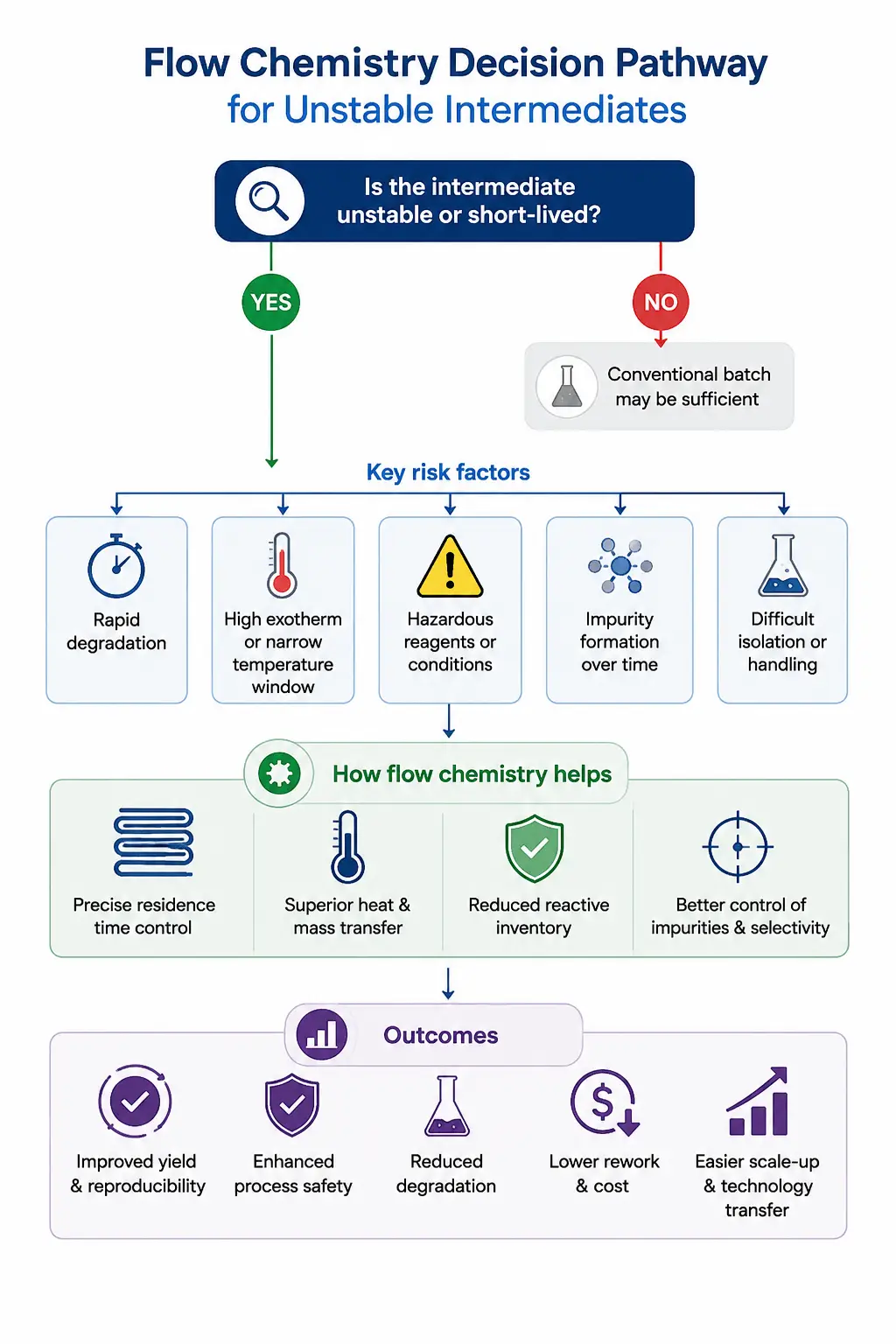
Figure 1. Key indicators for evaluating flow chemistry in unstable pharmaceutical intermediates during process development.
Continuous flow chemistry should be considered early when the process involves short-lived reactive species, narrow thermal operating windows, hazardous transformations, or unstable pharmaceutical intermediates that are difficult to isolate without degradation. The key question is not whether flow is more advanced than batch processing. The more useful question is whether batch processing provides enough control over residence time, heat transfer, reacting inventory, and impurity formation. If the answer is no, delaying flow evaluation can increase development risk and reduce confidence in the route.
The evaluation should happen before the process is locked. A route that repeatedly requires shorter holds, faster additions, immediate quenching, very tight temperature control, or special handling of a reactive intermediate is already providing evidence about the type of process control it needs.
An integrated development perspective
At Syngene, flow chemistry can be evaluated within the wider process development program, bringing together reaction optimization, reactor and mixing considerations, analytical understanding, process safety, impurity control, and scale-up. For unstable intermediates, this is important because selecting a flow reactor is only one part of the solution. The chemistry and the process have to be developed together.
For unstable drug intermediates, these decisions are often interconnected. A residence-time adjustment may affect impurity control. A safer operating window may influence downstream processing. A change in reaction concentration may alter scale-up feasibility. This is why the evaluation of continuous flow chemistry is most effective when process chemistry, analytical sciences, safety assessment, and manufacturing considerations are considered together.
Not every unstable intermediate requires a flow-based solution. However, when instability becomes a recurring obstacle during optimization, scale-up, or safety assessment, flow chemistry can offer a level of control that is difficult to achieve through conventional batch processing alone.
The practical objective is to determine early whether better kinetic, thermal, mixing, and inventory control can turn a difficult transformation into a reproducible process. When it can, developing that understanding before pilot scale provides a stronger basis for scale-up and technology transfer.