





The pharmaceutical outsourcing model is being pushed into a different shape. For a long time, drug development outsourcing was largely about getting a defined activity done well, on time, and at the right cost. A sponsor selected a partner for chemistry, process development, drug substance manufacturing, formulation, or another part of the program, and the work moved from one specialist to the next.
That model is still useful, but it is becoming harder to manage as development programs become more complex. Growth in complex modalities, including the antibody drug conjugates market, is increasing the need for specialized knowledge and connected capabilities.
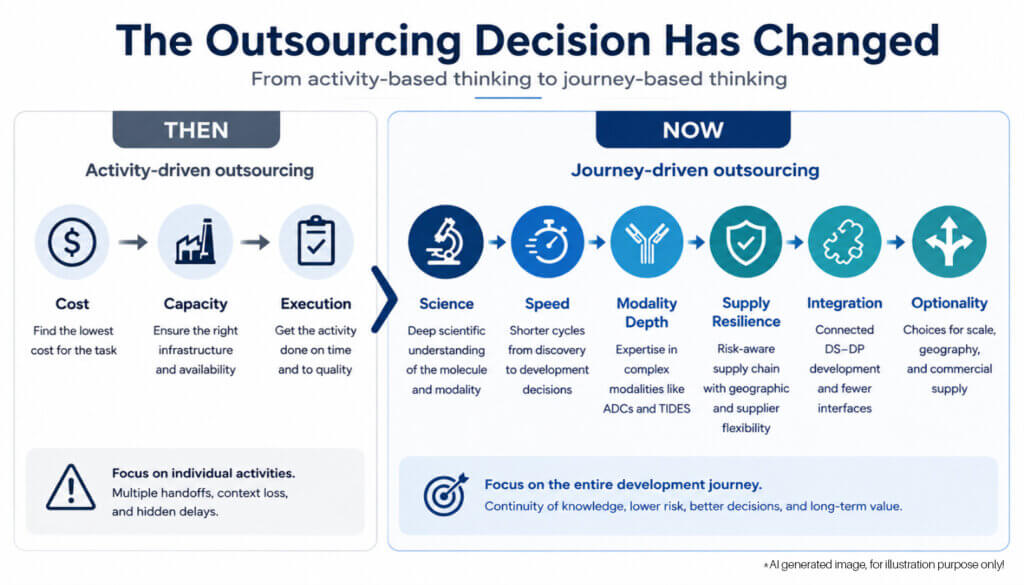
The old outsourcing question was mostly: can this partner perform the activity? The more important question now is: can this partner help the program remain scientifically, operationally, geographically, and commercially workable as it moves forward?
That is a more useful way to think about a new-age CRDMO. It is not simply a larger CDMO with more services. It is a development model built around continuity. The aim is to reduce the points at which time, knowledge, accountability, and flexibility are lost as the molecule moves from discovery toward clinical and commercial manufacture.
Drug development partnership models have evolved
A fragmented outsourcing model can work very well when the interfaces are simple, and the sponsor has enough internal capability to manage them. Problems begin when every handoff requires the next team to rebuild context.
For a new-age CRDMO, integration should therefore mean more than putting many capabilities under one corporate name. The real issue is whether knowledge can follow the molecule. The shift is from optimizing individual activities to building the resilience of the entire development journey.
Complex modalities are changing what “capability” really means
In conventional areas, sponsors can often choose from a broad supply base. With modalities such as antibody-drug conjugates, peptides, and oligonucleotides, suitable expertise and capacity can themselves become limiting factors.
ADCs are a useful example because they are not one manufacturing task. Antibody development, linker chemistry, highly potent payload synthesis, conjugation, purification, analytics, formulation, containment, and drug-product manufacturing all interact. A sponsor may be able to find individual providers for each, but the real risk sits between them.
A conjugation problem may relate to the antibody, linker-payload characteristics, process conditions, or purification strategy. Changes in drug-to-antibody ratio or heterogeneity may affect later analytics and formulation. This is why an ADC partner should not be judged only by whether it has conjugation capability or high-potency infrastructure. The more important question is whether the organization understands how the full modality behaves as a connected system.
The same issue appears in TIDES. Peptides and oligonucleotides bring their own challenges around sequence complexity, chemical modification, impurity control, purification, analytical characterization, scale-up, solvent use, conjugation, and delivery. Treating these molecules simply as another extension of standard synthetic chemistry underestimates what development can require.
The commercial outlook reflects the same shift. Published market forecasts suggest that outsourcing around complex modalities is growing faster than the broader pharmaceutical CDMO market. Grand View Research forecasts the global pharmaceutical CDMO market to grow at 7.4% CAGR, while its forecast for ADC contract manufacturing is 10.9%. The peptide and oligonucleotide CDMO market is projected by Mordor Intelligence to grow at 11.05% CAGR. The underlying market definitions and forecast periods are not identical, so these figures should not be treated as a strict like-for-like comparison. They nevertheless suggest that specialized modalities are becoming a larger and faster-growing part of the outsourcing opportunity.
For sponsors, access to specialized development, analytical, high-potency, conjugation, purification, and manufacturing capabilities can therefore become part of program planning itself. The issue is therefore not only whether a CRDMO can technically support an ADC, peptide, or oligonucleotide today. Sponsors also need to consider whether the partner has enough depth, capacity, and ability to scale with the program.

Figure 1. Selected market forecasts indicate faster growth in ADC contract manufacturing and peptide and oligonucleotide CDMO services than in the broader pharmaceutical CDMO market, reinforcing the growing strategic importance of complex-modality capabilities.
Specialized scientific depth is becoming just as important as manufacturing scale. The supply base for complex modalities is narrower, which means capability is not merely a checkbox during vendor selection. It can become a gating factor for the development plan itself.
A new-age CRDMO should therefore resist the temptation to claim equal expertise everywhere. As therapies become more specialized, CRDMOs may increasingly compete on depth in selected modalities rather than breadth alone, particularly where expertise and infrastructure are difficult to replicate.
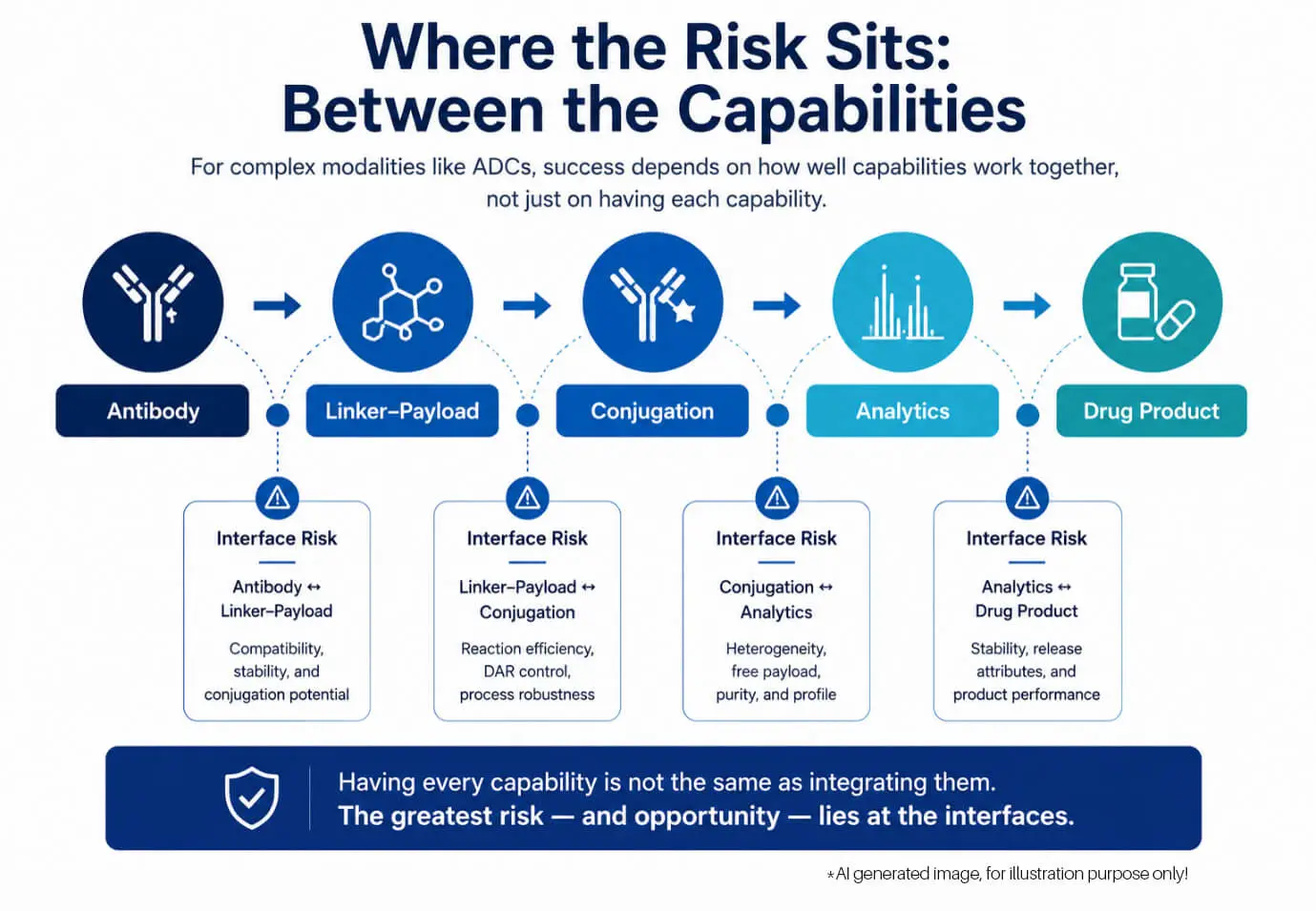
Figure 2. ADC development risk often sits at the interfaces between antibody, linker-payload, conjugation, analytics, and drug product, making integrated CRDMO capabilities critical for development continuity.
Supply-chain resilience and the US BIOSECURE Act
Cost and efficiency still matter, but they are no longer enough. Geopolitical tensions, trade restrictions, tariffs, sourcing concentration, and changing policy around biotechnology and pharmaceutical manufacturing have made supply-chain structure a strategic issue. The policy environment around the US BIOSECURE framework is part of this broader change. Where a product is developed and manufactured can no longer be treated as a secondary procurement decision.
The practical decision window can close long before a disruption happens. That makes resilience a development principle, not an emergency response. Sponsors need to understand where the real single points of failure sit.
A new-age CRDMO should therefore help build optionality early by identifying the dependencies that matter most and creating realistic alternatives before the program becomes difficult to move. Resilience is easier to build early than to retrofit later.
India + US in the global CDMO market
The same logic applies to geography. The value of an India + US footprint is often reduced to a simple cost-versus-proximity argument. India can offer scientific scale, process-development depth, chemistry expertise, biologics capability, and a competitive cost structure. A US presence can bring proximity to customers, access to an important pharmaceutical market, geographic diversification, and manufacturing options where domestic supply becomes strategically relevant.
The stronger model is not India for early work and the US for later work as two separate systems. It is one network in which work can move according to the needs of the molecule and the stage of development. The market outlook also shows why both geographies matter, although in different ways. Published Grand View Research estimates place the India pharmaceutical CDMO market at about USD 13.5 billion in 2024, rising to USD 27.9 billion by 2033, while the US market is estimated at USD 38.8 billion in 2025 and forecast to reach USD 65.3 billion by 2033. India is therefore growing from a smaller base at a faster rate, while the US remains much larger in absolute market size. In practice, the two locations can serve different purposes: India can support development scale and cost efficiency, while the US can add market proximity and another manufacturing option.

Figure 3. India and the US represent complementary CDMO growth opportunities, with India showing faster market expansion and the US maintaining greater market scale and proximity to major biopharma customers.
That distinction matters because a global footprint is only useful if processes, analytical methods, data, and scientific understanding can move with reasonable continuity. If every site change feels like starting again, the network has not created much resilience.
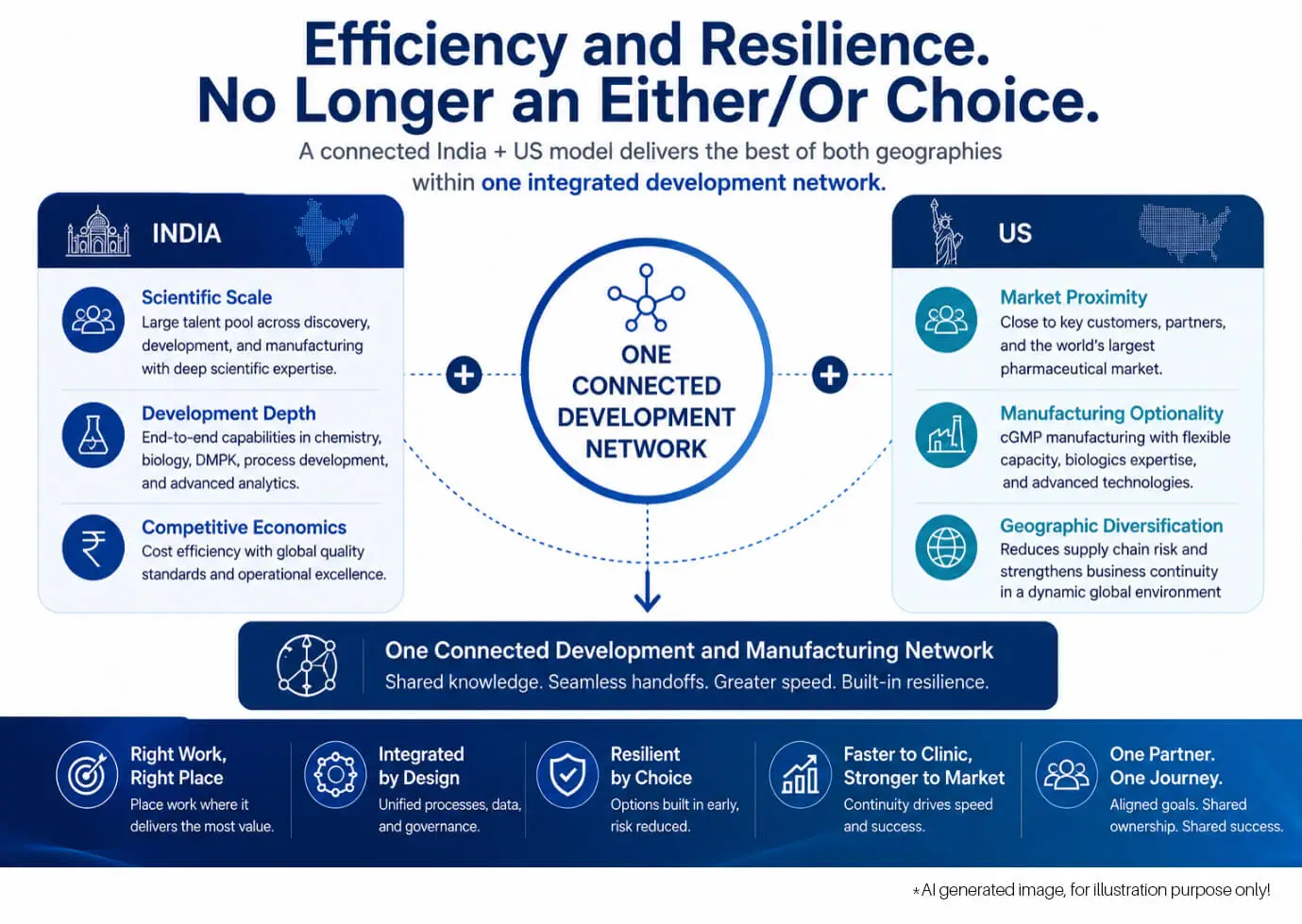
Figure 4. A connected India + US CRDMO model combines scientific scale, development depth, manufacturing flexibility, market proximity, and geographic diversification to strengthen speed, resilience, and continuity across drug development.
AI should improve decisions, not decorate the service offering
AI is now so common in pharmaceutical presentations that the important question is not whether a CRDMO has an AI platform. It is whether AI changes the quality or timing of scientific decisions.
Early drug development remains full of uncertainty and attrition. Teams have to decide which targets to pursue, which molecules to make, which compounds to stop, and which candidates are strong enough to take into more expensive development. Much of the value of AI therefore lies in prioritization.
In discovery, AI-enabled approaches can support target identification, virtual screening, molecular ranking, and property prediction. During lead optimization, they can help teams decide which compounds deserve another cycle of synthesis and testing. During candidate selection, they can help integrate pharmacology, DMPK, safety, physicochemical behavior, and developability data.
AI, however, does not remove the need for experimental validation. A software-only organization may generate a prediction. An integrated research and development organization can generate the prediction, test it, interpret the result, and feed that information into the next decision. The benefit comes when computational predictions can be tested quickly, interpreted by scientists, and used to guide the next experiment.
This is where AI fits naturally into the new-age CRDMO model. It should sit inside the scientific workflow, not beside it.
Digital maturity may increasingly become part of CRDMO selection. AI also needs the basics to be in place: reliable data, systems that can communicate with each other, clear oversight, and people who understand both the science and the technology.
AI matters because early R&D is costly and attrition is high. AI-enabled tools can support process monitoring, manufacturing optimization, predictive maintenance, quality management, and supply-chain planning. In both discovery and manufacturing, AI is most useful when it helps teams make better decisions, not just automate routine work.
The DS–DP boundary is where time quietly disappears
Drug-substance properties can influence solubility, stability, formulation, aggregation, concentration, and manufacturability. Drug-product requirements can force changes to upstream processing.
This is why integrated DS and DP capability matters. The advantage is not simply having two service lines under the same company. The value comes when process development, analytical development, formulation, stability, drug product, clinical manufacturing, and later scale-up operate as one connected development conversation.
The DS–DP interface therefore deserves more attention than it often receives. Handoffs may not cause an obvious failure, but they can still add significant time when information has to be transferred or work repeated. Early coordination across process, analytical, formulation, and manufacturing teams can help identify problems before key development decisions become difficult to change.
Integration is increasingly about continuity
For many sponsors, integration is increasingly about continuity.
Continuity also depends on governance: clear ownership, shared objectives, transparent communication, and agreed decision-making. A development program that moves through several organizations creates multiple points where knowledge can be diluted, timelines can slip, and accountability can become unclear. The same applies to data. Disconnected systems and manual transfers can leave an apparently integrated organization functioning as separate teams. Reducing unnecessary handoffs can therefore reduce development risk. The aim is to preserve more of the scientific and development history without taking away the sponsor’s technical or strategic flexibility.
A genuinely integrated CRDMO should be able to address such problems without forcing the sponsor to become the only point connecting the entire program. Integration therefore changes not only how work moves between functions, but also who takes ownership when a problem sits between them.
Total development economics matter more than the cheapest activity
The cheapest individual work package does not always produce the cheapest overall development program. A sponsor may save on one activity and later lose that saving through repeated analytical development, technology transfer, process redevelopment, late formulation changes, duplicated studies, or delays.
A new-age CRDMO creates value when it reduces work that should never have been repeated. It may shorten development timelines, preserve analytical and process knowledge, avoid unnecessary transfers, identify developability problems earlier, and reduce changes made under pressure.
When the organization functions as one connected system, the economic benefit can come from avoiding rework and delay rather than simply offering a lower unit price.
What sponsors should now look for
Sponsors increasingly need to understand how deep the organization is in the chosen modality, whether its scientific teams interact, whether knowledge can move from discovery into development, and whether the DS and DP teams start talking early enough to influence one another.
They should also look beyond the headline geography. Where do critical materials come from? How concentrated are key suppliers? Can the process move between sites? Is there an alternate manufacturing route, or only an alternate address?
In the end, sponsors need a partner that can maintain continuity while still leaving room to change course if the program requires it.
The new-age CRDMO is really about keeping the program defensible
A sponsor should ask whether the development model chosen today will still make sense several years later. Will the scientific decisions remain understandable? Will the manufacturing route remain workable? Will supply options exist if geography or policy changes?
Modality depth matters because complex programs fail at interfaces. Supply-chain resilience matters because practical alternatives have to be created before they are needed. An India + US model can provide geographic flexibility without breaking the development chain. AI matters when it improves the quality and speed of decisions. DS and DP integration matters because development problems do not respect organizational boundaries. End-to-end capability matters when it preserves continuity rather than simply adding more services.
The older outsourcing model worked well when individual activities could be managed separately. That is becoming harder as programs become more complex. A strong CRDMO today needs to keep the important parts of development connected, while still giving sponsors enough flexibility to respond when the science, supply situation, or commercial plan changes.

Figure 5. The new-age CRDMO model shifts pharma outsourcing from fragmented, activity-based execution toward integrated partnerships focused on scientific value, lower interface risk, faster development, resilient supply, and long-term outcomes.