





In biologics development, cell line development is one of the first places where time can be lost, and risk can quietly enter the programme. A clone may look useful during early clone screening, but later it may show weak expression, poor stability, difficult scale-up behaviour, or product quality drift. These problems are often linked to random integration and the integration site of the therapeutic gene. By the time they become visible, the biologics development programme may already have spent considerable time, material, and money.
That is why the question is no longer only: How fast can we develop a cell line? The better question is: Can we develop a productive, stable, and manufacturable cell line early enough to make better CMC decisions? Semi-targeted integration matters because it changes the quality of the starting point. Instead of depending heavily on chance, it improves the probability of getting more useful clones earlier in the process.
Why the integration site matters in cell line development
In cell line development, the therapeutic gene must be introduced into the host cell genome. But where that gene lands matters a lot. If the gene integrates into a genomic region that supports active transcription, expression can be strong and stable. If it integrates into a less active or transcriptionally silent region, expression may be weak, unstable, or lost over time. This is often called the position effect.
For a biologics development programme, the position effect is not a small technical detail. It affects how much protein the cell produces, how stable the clone is, how much clone screening is needed, and how much confidence the team can have before moving into process development. A poor integration site can create a clone that looks acceptable in one early screen but does not behave well later. That creates exactly the kind of late surprise that development teams want to avoid.
How random integration increases clone screening work
Traditional random integration can work, and it has supported many biologics programmes. But it also brings a clear problem: too much uncertainty. The gene can integrate in many different places. Some cells may receive incomplete or poorly positioned integration events. Some clones may express well; many others may not. Some may look productive at first but show instability later.
Because the process is less controlled, teams usually need to screen a large number of clones to find the few that are truly worth advancing. This adds time, labour, consumables, analytics, and decision complexity. Every extra clone screening step adds pressure because early biologics development programmes are already working against funding windows, board approvals, and IND-enabling timelines. Long screening funnels can slow the whole CMC path.
The biggest issue, however, is not just time. The bigger issue is that risk moves forward silently. A clone selected mainly because it produces well in an early screen may later show problems in stability, product quality, or scale-up. That is a bad trade. Fast movement with a fragile clone is not progress.
What semi-targeted integration changes in biologics development
Semi-targeted integration aims to reduce some of this randomness. Instead of allowing integration to occur completely by chance, semi-targeted approaches help place the expression cassette into more favourable genomic regions. In the Syngene webinar, SynWeave is described as using transposon-based semi-targeted integration to insert the complete expression cassette into transcriptionally permissive regions of the genome.
That matters because transcriptionally permissive regions are more likely to support better expression and more stable behaviour. The result is not just faster cell line development in a superficial sense. The real value is that the pool of clones can become more useful earlier. More clones have a chance of being productive. Fewer weak candidates need to be carried through unnecessary screening. The development team can start making decisions from a better-quality clone population.
How semi-targeted integration reduces clone screening burden
Clone screening takes time because teams must separate real candidates from noise. If random integration creates high variation, then screening has to compensate for that variation. The team has to test many clones, compare expression levels, look at product quality, check stability, and keep narrowing the funnel.
Semi-targeted integration can improve the proportion of productive and stable clones. That changes the screening problem.
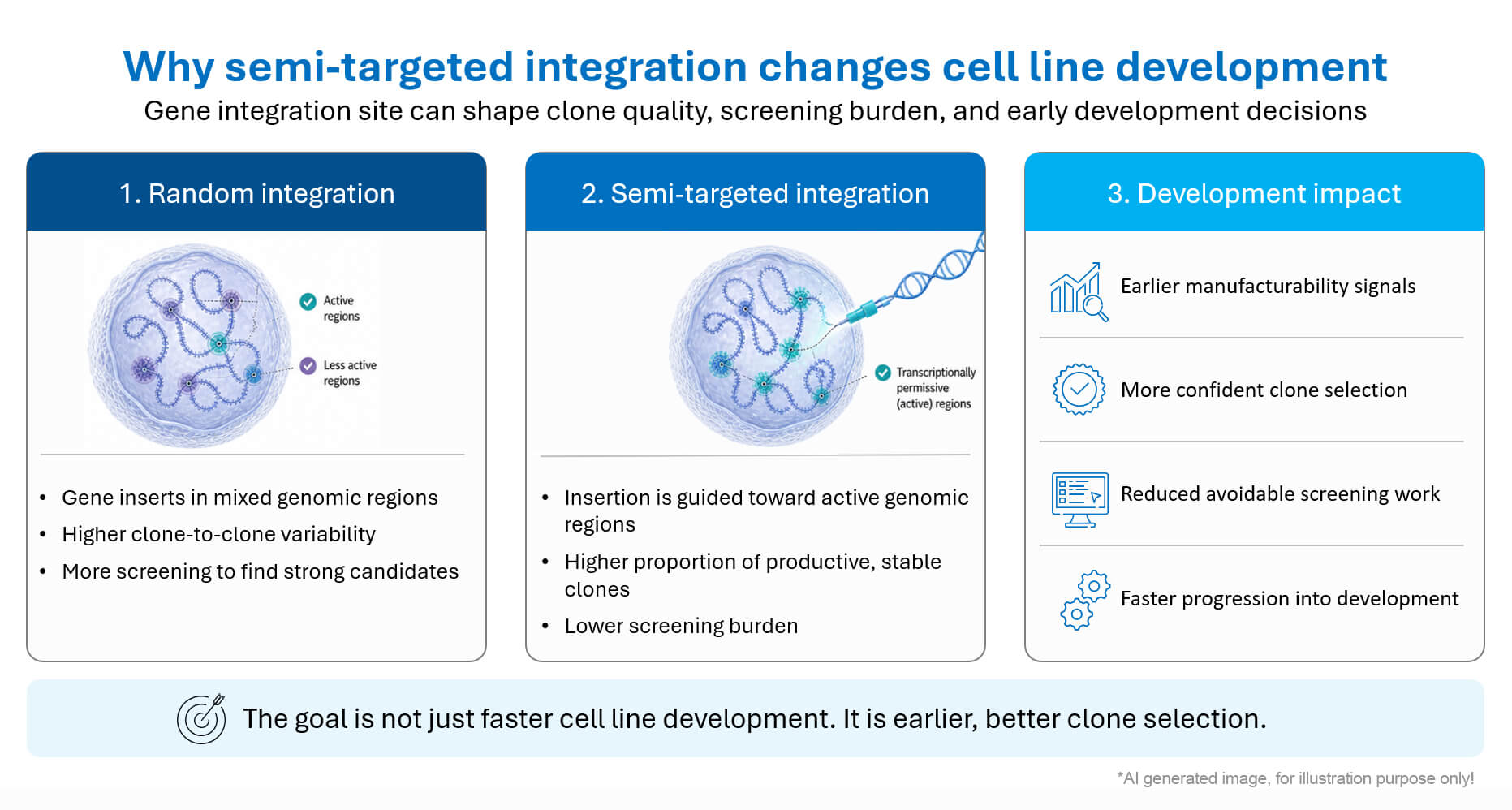
Figure 2. Semi-targeted integration can shift clone selection from broad screening towards earlier, more confident identification of productive and stable candidates.
The task becomes less about searching through a large, uneven population and more about selecting among stronger candidates. This can reduce the number of clones that need deep characterisation and can make the screening process more efficient.
This is important for cost also. Fewer unnecessary clone screens mean less material, fewer experiments, less analyst time, and less repeated work. In early biologics development, those savings matter. Many programmes do not have unlimited runway. Every month spent on avoidable screening is a month not spent moving towards toxicology material, IND-enabling work, and clinical entry.
Why faster cell line development is not enough
A short cell line development timeline sounds attractive. But a short timeline is only useful if the clone can carry the programme forward. The wrong way to talk about semi-targeted integration is to say only: “It saves time.” That is too small. The stronger point is this: semi-targeted integration can help teams save time while improving the quality of early development decisions.
A strong cell line development platform should help answer several questions early. Is the clone productive? Is the product quality acceptable? Is the clone stable? Can the clone support scale-up? Can the data support faster decisions? High titre matters because productivity affects manufacturing efficiency, cost of goods, and supply planning. But titre alone is not enough. Teams also need to look at product quality attributes such as size, charge, glycan profile, and activity. They need to know whether the clone remains stable across generations and whether small-scale behaviour can translate into larger bioreactor systems.
The real output of early cell line development is not only a clone. It is a decision package. It tells the team whether the molecule can move forward with confidence.
The link between integration site and manufacturability
Manufacturability is where this topic becomes more strategic. Many early-stage teams treat cell line development as a technical work package. That is too narrow. Cell line development shapes the downstream path of the programme. It affects process development, scale-up, toxicology material timing, IND readiness, and even investor confidence.
If semi-targeted integration helps generate better clone candidates earlier, then manufacturability signals can also be evaluated earlier. That means teams are not waiting until later to discover that a clone has hidden problems. They can make better choices before too much time and money are committed.
This is the real value for biotech companies. A platform that gives earlier clarity can reduce the risk of moving forward with a weak clone. It can also help teams generate stronger data when they need funding, internal approvals, or partner confidence.
What biologics development teams should look for
A semi-targeted integration story should not be accepted only as a technology claim. CDMO buyers should ask practical questions. How many clones typically need to be screened? What proportion of clones show useful productivity? How is product quality checked during clone selection? How is stability confirmed across generations? How does small-scale performance translate during scale-up? Can pool-derived material support earlier toxicology work?
These questions matter because the best cell line development story is not a beautiful mechanism. It is a mechanism connected to real development outcomes.
Conclusion
Semi-targeted integration changes cell line development by improving the starting population of clones. It reduces dependence on chance, lowers clone-to-clone variability, and can reduce the burden of large-scale clone screening. But its value should not be reduced to speed alone.
The bigger value is better early decision-making. When productive, stable, and manufacturable clones can be identified earlier, biologics development teams can move with more confidence. They can reduce avoidable screening, avoid fragile clone choices, and create stronger CMC data earlier in the programme.
For early biologics development, that is the real shift. Semi-targeted integration is not just a faster way to make clones. It is a better way to reduce uncertainty before the programme reaches more expensive stages.