





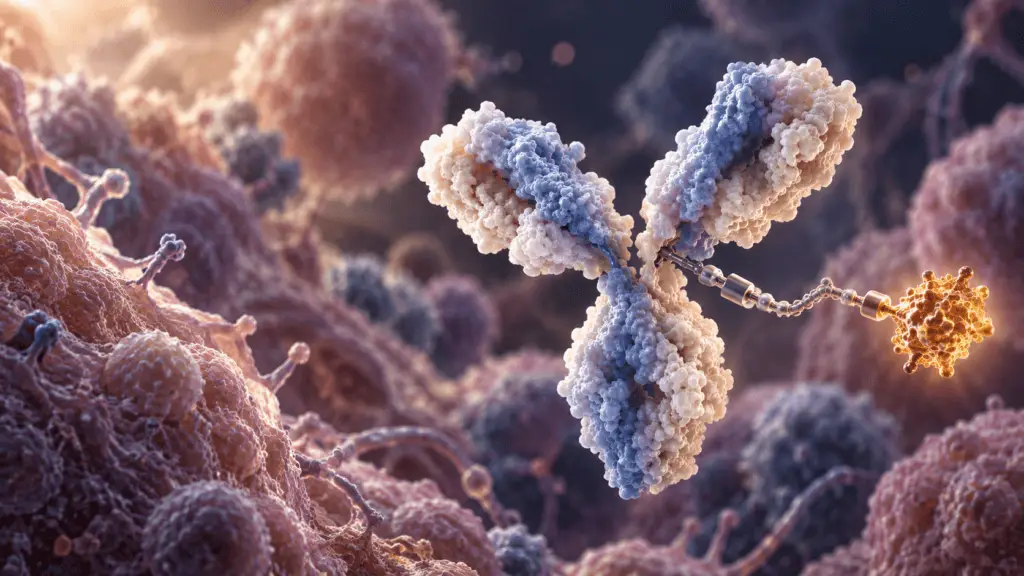
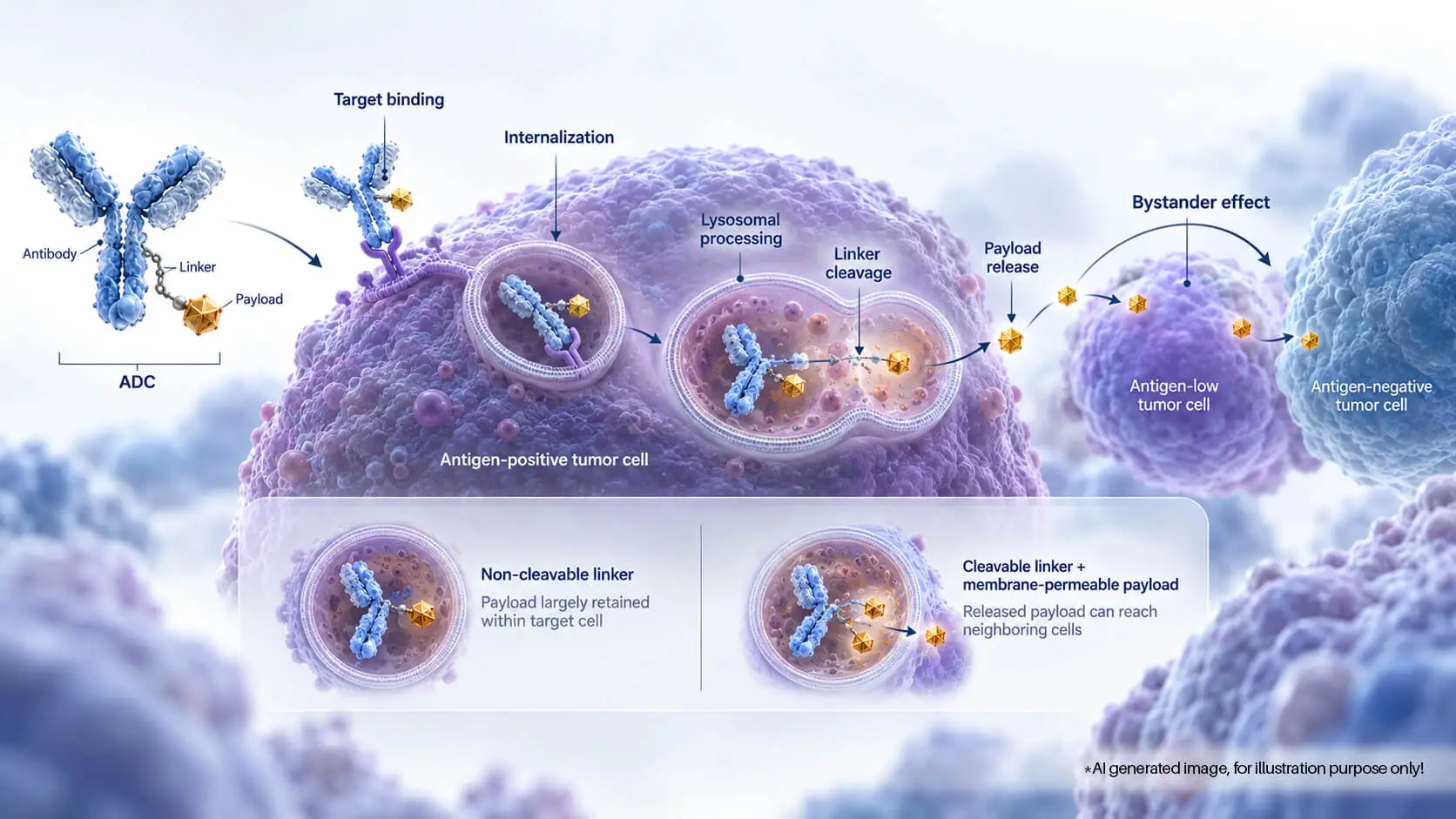
Antibody–drug conjugates (ADCs) are usually described as three-part medicines: an antibody finds the tumor, a linker holds the construct together, and a cytotoxic payload kills the cell. The antibody decides where an ADC can bind. The ADC linker payload combination largely decides what happens after binding—whether the ADC remains intact in blood, how efficiently the drug is released, whether it reaches nearby antigen-negative cells, and which toxicities limit the dose.
This does not make target selection less important. A poorly internalizing antibody against an antigen also abundant in healthy tissue will not be rescued by clever chemistry. But after a workable antibody and target have been identified, ADC linker payload design often separates an interesting molecule from a useful medicine.
Cleavable linker and non-cleavable linker choices: the bridge is not inert
The linker has two opposing jobs. It must remain stable during circulation, despite exposure to enzymes, thiols, and other reactive molecules. Then it must release the payload efficiently at the intended site. If it breaks too early, the ADC starts behaving like systemic chemotherapy. If it is too stable, the antibody may reach the tumor but much of the delivered drug remains unavailable.
Cleavable linkers respond to a chemical or biological trigger. Acid-labile linkers are designed for lower pH, disulfides for a reducing environment, and peptide linkers for proteolytic cleavage. A self-immolative spacer, often para-aminobenzyl carbamate, can then collapse and release the active payload. Non-cleavable linkers take a different route. The antibody must first be degraded in the lysosome, producing an amino acid–linker–payload catabolite.
The nature of that catabolite is important. Trastuzumab emtansine (T-DM1) uses the non-cleavable SMCC linker. Lys-MCC-DM1 released after lysosomal degradation is active inside the target cell but poorly membrane-permeable. Killing therefore remains largely confined to cells that bind and internalize the ADC. This may be acceptable when antigen expression is strong and fairly uniform. In a heterogeneous solid tumor, it becomes a limitation.
Older acid-sensitive hydrazone systems showed the opposite problem. Gemtuzumab ozogamicin had limited linker stability in circulation, allowing premature payload release. Its original withdrawal also involved dose, schedule, patient selection, and trial design. Still, the case showed that plasma stability is not just an analytical specification.
Even commonly used peptide linkers are not automatically tumor-specific. Neutrophil elastase can cleave certain valine–citrulline constructs and release membrane-permeable MMAE, a proposed mechanism behind target-independent neutropenia. Linkers therefore need testing under conditions relevant to plasma, marrow, liver, and inflammatory tissues, not only in tumor models.
Bystander effect in ADC design: the same antibody can produce a different medicine
T-DM1 and trastuzumab deruxtecan (T-DXd) use HER2-binding antibodies based on trastuzumab, yet their pharmacology is quite different. T-DM1 carries an average of about 3.5 molecules of the microtubule inhibitor DM1 through a non-cleavable linker. T-DXd uses an enzyme-cleavable tetrapeptide linker, a topoisomerase I inhibitor related to exatecan, and a drug-to-antibody ratio (DAR) close to eight.
The higher DAR gives T-DXd more drug molecules per internalization event, but that alone does not explain its performance. The conjugate is designed for good plasma stability, while released DXd is membrane-permeable and has a relatively short systemic half-life. In mixed-cell preclinical models, T-DXd killed HER2-negative cells located beside HER2-positive cells; T-DM1 did not. The effect remained local rather than affecting a separate antigen-negative tumor. This bystander activity gives the ADC a way to address patchy antigen expression and incomplete tumor penetration.
The clinical contrast is substantial. In DESTINY-Breast03, T-DXd produced markedly longer progression-free survival than T-DM1 in previously treated HER2-positive metastatic breast cancer. DESTINY-Breast04 demonstrated benefit in HER2-low disease, where expression is lower and often less uniform. These trials do not isolate a single chemical variable. The release mechanism, payload potency and permeability, loading, stability, and systemic handling work together. The target remained HER2; the medicine around it changed.
Sacituzumab govitecan illustrates a different solution. It uses a hydrolyzable CL2A linker, a DAR of roughly 7.6, and SN-38, a membrane-permeable payload less potent than auristatins or calicheamicin. Ready release can support tumor exposure and bystander killing in tumors with variable Trop-2 expression. It also creates systemic SN-38 exposure, contributing to neutropenia and diarrhea. Here, some controlled instability is part of the design.
Drug antibody ratio: more payload is not always better
DAR is often treated as a loading number, but it also changes the physical behavior of the entire conjugate. Adding hydrophobic payloads can increase aggregation, alter protein interactions, accelerate clearance, and direct more material toward the liver and other non-target tissues. Early work with MMAE ADCs showed that heavily loaded constructs could appear more potent in vitro yet clear faster and perform worse in vivo than lower-DAR versions. High DAR became more workable only when linker design, payload properties, and hydrophobicity masking improved.
Conjugation site also matters. Random lysine or reduced-cysteine conjugation produces mixtures that differ in drug loading and attachment position, with different stability and pharmacokinetics. Site-specific conjugation can generate a more homogeneous product and reduce deconjugation. But a homogeneous ADC with the wrong release rate remains the wrong ADC.
Payload selection brings its own trade-offs. Microtubule inhibitors mainly affect dividing cells and may cause neuropathy, marrow toxicity, or ocular events, depending on the molecule and its catabolites. DNA-damaging agents and topoisomerase I inhibitors can act beyond mitosis, but they bring different hematologic, gastrointestinal, and sometimes pulmonary risks. Membrane permeability helps bystander killing; it can also make prematurely released drug harder to contain.
This has become more relevant as patients receive ADCs sequentially. Changing the antibody target while retaining the same payload class may not fully overcome resistance if the tumor has altered TOP1, increased drug efflux, changed lysosomal processing, or strengthened DNA-damage repair. In some settings, changing the payload mechanism may matter more than changing the antigen named on the label.
ADC bioconjugation and linker–payload development must be integrated
There is no universal rule that cleavable is better, high DAR is better, or bystander killing is always desirable. A 2024 analysis by Tang and colleagues in Cancer and Metastasis Reviews pooled 40 clinical trials involving 7,879 patients. Grade 3 or higher composite adverse events occurred in 47% of patients receiving cleavable ADCs and 34% of those receiving non-cleavable ADCs; higher DAR was also associated with greater severe toxicity. This cross-trial analysis involved different targets, payloads, diseases, and dosing regimens, so it cannot prove that linker type alone caused the difference. It does show that features used to increase tumor killing may also raise systemic cost.
The right ADC linker–payload pair depends on antigen density and turnover, internalization, lysosomal trafficking, tumor heterogeneity, payload sensitivity, normal-tissue biology, and the proposed dose and schedule. It must also be manufacturable. Conjugation control, aggregation, DAR distribution, storage stability, potency, and the measurement of intact ADC, total antibody, conjugated drug, and free payload cannot be left until late development.
This is where an integrated ADC platform is practically useful. Syngene has expanded its discovery biology capabilities for ADCs and built a payload–linker library within chemistry, alongside support for linker–payload synthesis, bioconjugation, bioassays, pharmacokinetics, and anti-drug antibody assessment. These capabilities allow candidate linkers and payloads to be tested as complete conjugates, rather than being selected on chemical elegance alone. A promising release mechanism still has to survive plasma-stability studies, cellular assays, in vivo exposure work, and safety assessment.
The manufacturing connection also matters. Syngene has initiated a dedicated nonclinical and clinical bioconjugation facility at Unit 3 in Bengaluru, designed to bring monoclonal antibody production and GMP bioconjugation together with its payload and linker manufacturing capabilities. It has also reported developing a cytotoxic-payload ADC and progressing it toward scale-up. Fewer handoffs can reduce technology-transfer gaps and preserve analytical continuity from candidate selection into development.
Conclusion: optimizing the ADC linker payload system
The antibody gets an ADC to the right address. The ADC linker–payload system determines whether the drug remains contained on the journey, opens in the right biological compartment, reaches enough of the tumor, and leaves a tolerable level of systemic exposure. These are not secondary formulation questions. They define the therapeutic window.
The strongest ADC programs therefore do not select an antibody, attach an available toxin, and optimize the linker later. They develop the antibody and ADC linker payload combination, together with the conjugation method, DAR, and release profile as one pharmacological system. Target recognition starts the process, but linker–payload design turns binding into tumor killing. In many ADC programs, that is where success or failure is actually decided.