





As sterile injectable programmes move from laboratory development to clinical supply and commercial manufacturing, decisions made at one stage begin to affect every stage that follows. In sterile fill-finish manufacturing, an upstream decision can become a costly filling-line problem months or even years later. The first engineering batch is therefore a costly place to discover that a formulation foams during mixing, a biologic adsorbs to transfer tubing, or a sterile filter removes more product or subvisible particles/aggregation than expected. These may appear to be fill-finish problems, but most are interface problems: decisions made during drug substance or formulation development that were never tested against the conditions of sterile manufacturing.
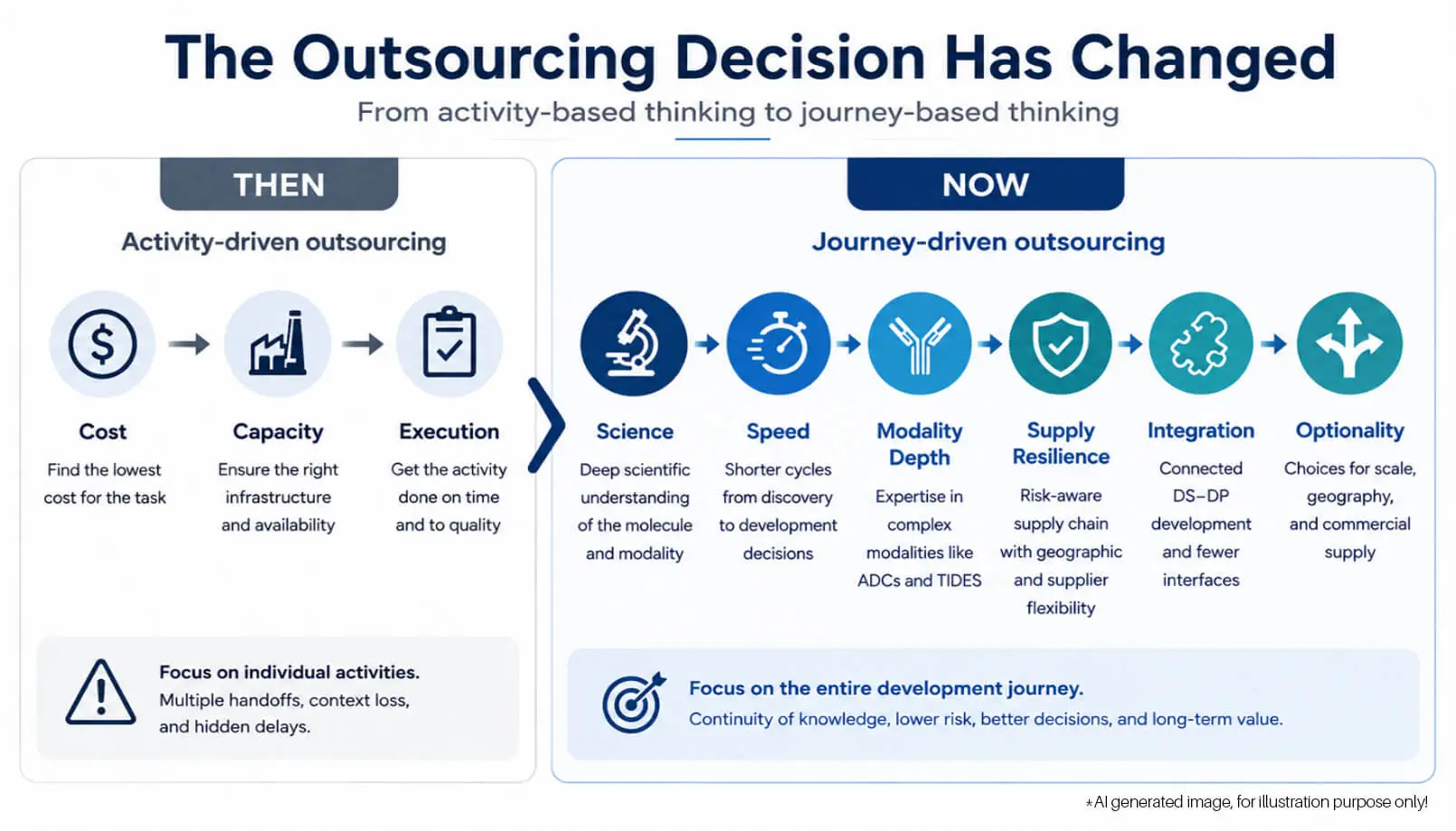
Drug substance (DS), drug product (DP) and fill-finish (FF) are usually managed as distinct workstreams. The product, however, moves through all three. Its impurity profile, concentration, viscosity, stability and sensitivity to oxygen, fill volume and vials MOC for frozen products, light, temperature and processing surfaces continue to matter at every stage. Connecting DS, DP and FF allows these dependencies to be investigated before they disrupt a clinical campaign or complicate the move to commercial manufacture. Here, scale means more than increasing batch volume. It means developing a process that remains scientifically sound as the program moves from laboratory development to clinical supply and, eventually, commercial production.
Why sterile programs become vulnerable later
Early development is shaped by speed and limited material. Sponsors need batches for toxicology studies, first-in-human trials and dose-escalation studies, so formulations and processes may be designed around the immediate clinical need. That can be appropriate, provided the limitations are understood. The problem begins when an early process is carried forward without reassessing whether it is suitable for later-stage manufacture.
By Phase II or Phase III, the formulation, analytical methods, manufacturing process, primary container, and storage conditions may already be described in regulatory submissions and supported by stability data. A late change can affect comparability, validation, regulatory documentation, and clinical supply. The US FDA’s process-validation framework reflects this lifecycle: the commercial process should be defined during process design using knowledge generated through development and scale-up. Commercial readiness therefore depends on what has been learned about the product and process, not merely on completing several successful batches.
Drug substance variability reaches sterile injectables fill finish
A drug substance can meet its release specification and still behave differently during formulation or filling. Variations in protein homogeneity, viscosity, trace impurities, oxidation, aggregation, bioburden, or endotoxin can affect solution clarity, filtration, and stability. For biologics, differences in aggregates, fragments, charge variants or higher-order structure may influence viscosity, filterability and sensitivity to agitation. At higher protein concentrations, relatively small changes can alter mixing time, pumping behaviour and fill-weight consistency.
The intended drug product should therefore influence how the drug substance is characterized and controlled. A high concentration formulation places different demands on viscosity and aggregation than a dilute product. A lyophilized presentation introduces questions about freezing behaviour, residual moisture and reconstitution that may not be evident from the drug substance specification. ICH Q11 supports this connection by requiring potential drug substance critical quality attributes to be considered in relation to their effects on drug product quality.
Syngene’s small molecules drug substance platform brings together process development, analytical development, process safety, engineering and manufacturing. Its Bangalore and Mangalore facilities include 56 reactors with approximately 135,000 litres of combined volume, ranging from 10 to 12,500 litres across GMP and non-GMP blocks. These figures describe small molecules drug substance infrastructure, not fill-finish capacity. The more relevant benefit is the ability to carry process and analytical knowledge from drug substance development into formulation and manufacturing decisions.
Sterile fill finish capabilities begin with a manufacturable formulation
Laboratory formulation studies cannot reproduce every stress introduced by manufacturing. Larger vessels, longer tubing, pumps, filters, filling needles, gas-liquid interfaces and extended processing times can all affect the product. A formulation may remain stable in a laboratory vial but behave differently when it moves through the actual manufacturing process.
Development should answer several practical questions before the GMP batch:
- Does the product adsorb to filters, bags, tubing or filling needles?
- Can it be mixed uniformly without excessive agitation?
- How long can the bulk solution be held before and after filtration?
- Does pumping increase particles or aggregates?
- Is nitrogen gassing required?
- Can the product tolerate terminal sterilization?
- Will it remain stable in the intended vial or pre-filled syringe?
Consider a biologic evaluated with short tubing and a small filter during laboratory studies. The manufacturing process may involve a longer transfer path, more product-contact surface and a longer filtration time. Protein recovery or aggregate levels may then change even though the formulation remains nominally identical. Testing a representative process train before GMP manufacture allows adsorption, filter capacity, recovery and hold time to be understood under more realistic conditions.
Syngene’s sterile drug product capabilities include solutions, suspensions, lyophilized products, nano-emulsions and long-acting formulations such as microspheres. For biologics, its capabilities cover buffer and excipient screening, biophysical characterization, formulation optimization, agitation and freeze-thaw studies, filter sizing and adsorption, tubing compatibility, mixing studies and container-closure compatibility. These activities connect formulation selection with the conditions the product will encounter during manufacturing.
The container is part of the product
Vials, stoppers and pre-filled syringes are not passive packaging. Product can adsorb to glass, elastomeric components, or silicone-treated surfaces. Leachables may affect stability, while stopper properties can influence container-closure integrity. In pre-filled syringes, plunger performance and dose delivery may also become important.
ICH quality guidance requires container-closure systems to be assessed for protection, compatibility, safety, and performance. For sterile products, their ability to prevent microbial contamination must be addressed. ICH Q1A(R2) also requires stability testing in the container-closure system proposed for marketing. Changing the presentation after substantial stability data have been generated may therefore require more than a packaging update; it can affect the evidence supporting the product.
Syngene’s clinical fill-finish facility uses ready-to-use nested vials and pre-filled syringes. Its stated fill ranges are 1–50 mL for vials and 0.1–10 mL for pre-filled syringes. The facility supports liquid and lyophilized presentations, with a lyophilizer loading capacity of 3,500 10R vials.
Aseptic fill-finish must shape development decisions
Sterility cannot be tested into a finished product. It depends on the facility, equipment, process, materials, and personnel operating as one contamination-control system. The revised EU GMP Annex 1 requires sterile manufacturing to be governed by a facility-wide contamination control strategy covering microbial, particulate and endotoxin or pyrogen risks. The intended sterile process should therefore be considered while the formulation and manufacturing approach are still being developed.
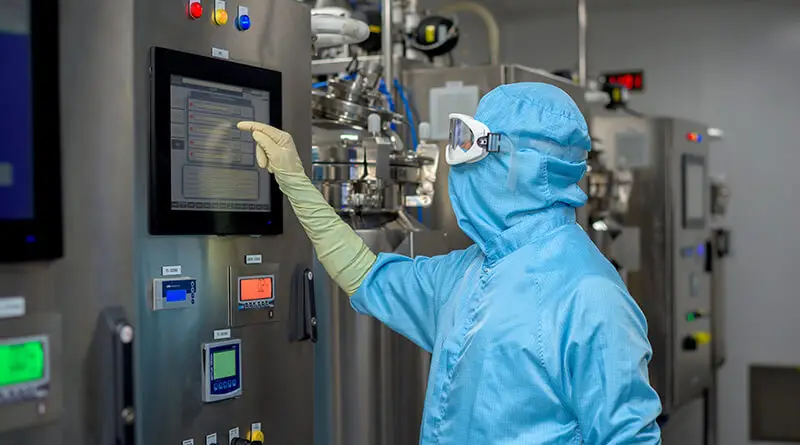
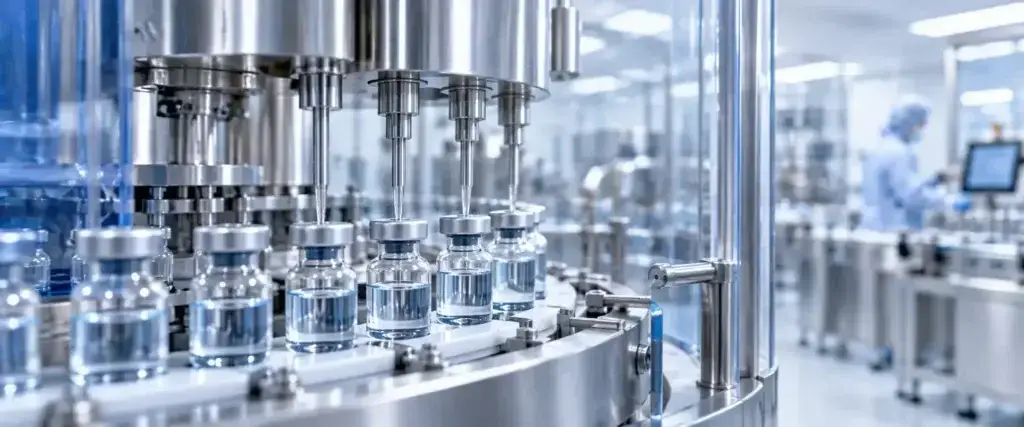
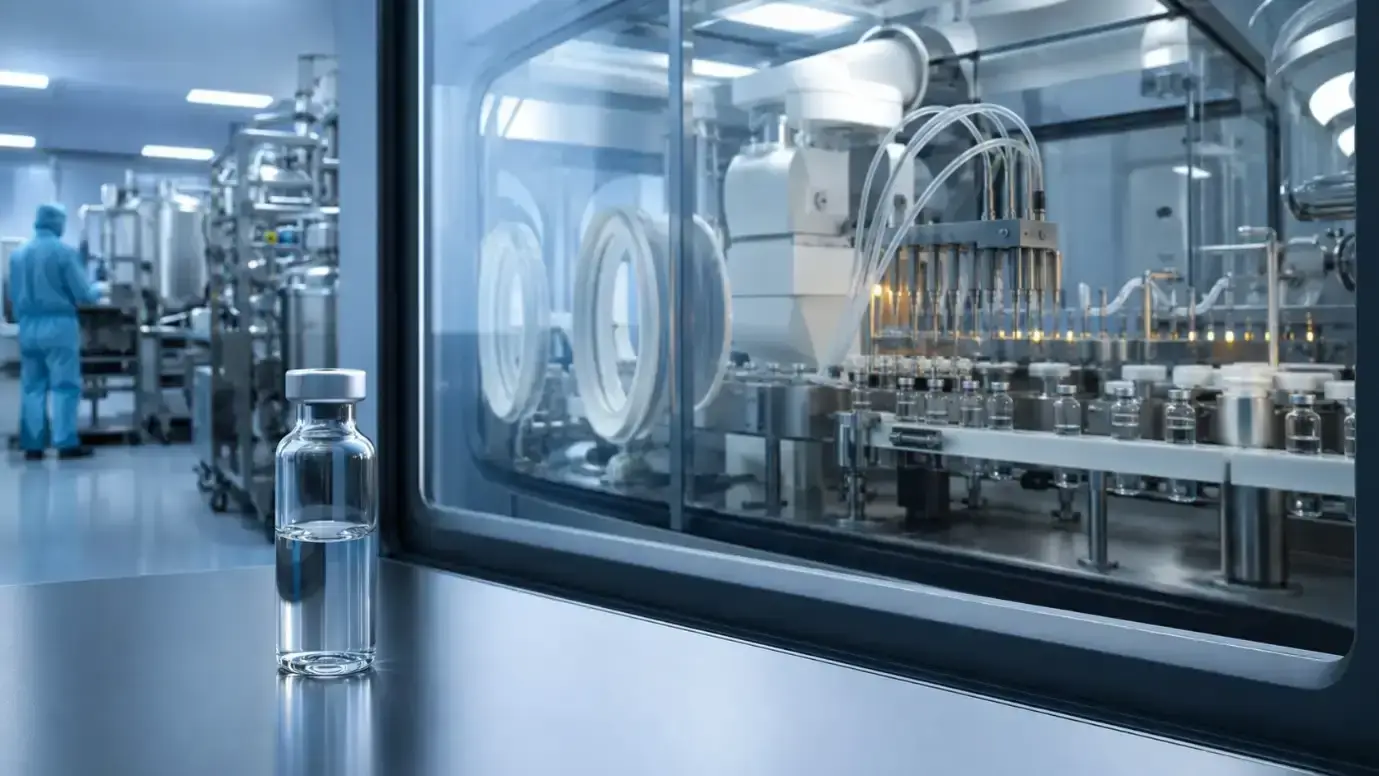
A product that requires repeated manual interventions, prolonged open handling or complicated aseptic assembly carries a different risk from one designed for a simpler, more closed process. Syngene’s sterile facility is campaign-based, with one product handled at a time. It uses single-use mixing vessels, transfer vessels, and tubing for biologic drug products, together with ready-to-use vials and stoppers. Robotic filling is available for vials and pre-filled syringes, with filling and stoppering conducted under an isolator.
The clinical batch range is 500–25,000 vials, corresponding to 5–50 L. Reported equipment outputs are 2,000 vials per hour for 10 mL vials and 1,000 pre-filled syringes per hour for 1 mL syringes. These figures describe the equipment envelope, not guaranteed throughput. Actual output depends on fill volume, formulation behaviour, in-process controls, line configuration and lyophilization requirements.
Technology transfer reveals unresolved development questions
Technology transfer is often where gaps between functions become visible. A manufacturing team may receive a formula without a justified mixing range, a filtration instruction without filter-capacity data or an analytical method that has not been demonstrated in the receiving quality-control laboratory. These are commonly labelled transfer failures. More accurately, they are development questions that were left unanswered.
ICH Q10 describes technology transfer as the movement of product and process knowledge between development and manufacturing or between manufacturing sites. That knowledge should support the manufacturing process, control strategy, validation approach, and continued improvement.
Syngene’s technology-transfer activities include developing in-process and finished-product specifications, preparing master formula documentation, reviewing batch manufacturing records, transferring analytical methods to quality control, and supporting engineering and clinical batches. They also include release testing and stability loading of clinical batches. Its drug substance capabilities cover process familiarization, engineering and safety studies, scale-down simulations, analytical-method transfer, risk assessment, and change control.
A transfer document can state what must be done. A strong transfer also explains why an operating range was selected, which risks remain, and how an unexpected result should be investigated. That scientific context becomes particularly important when the receiving site uses different equipment or when the process must be adjusted for a larger batch.
Connecting clinical sterile fill finish with commercial manufacture
The equipment used for early clinical supply may not be used for later commercial production. Vessel geometry, mixing systems, transfer paths, filter area, filling speed, and automation can all change. In addition to its 5–50 L clinical fill-finish facility, Syngene has injectable manufacturing capabilities covering 2–100 L on a small-scale commercial vial line and 200–1,300 L at its Unit 3 commercial facility. These are separate capacities, not extensions of the same filling line.
The Unit 3 facility in Bengaluru is built for commercial sterile drug product supply of both biologics and small molecules, and it runs two independent vial lines so that the two molecule types are handled separately. Compounding and holding vessels of 200 L, 1,000 L, and 1,300 L support batch sizes from 200 L to 1,300 L, with vials from 2R to 100R and fill volumes from 0.5 mL to 100 mL. The line integrates vial washing, depyrogenation, filling, and stoppering under an open restricted access barrier system, sealing and inspection in sequence, with filling speeds of up to 520 vials per minute for a 2 mL vial and an annual capacity of about 200 million vials. It supports both aseptically processed and terminally sterilized products, with online cleaning and sterilization in place, PUPSIT-compliant filtration, camera-based automated inspection of every vial, and serialization.
For a sponsor, the value of this scale is not the equipment list. It is that a small molecule or biologic drug product developed and filled for clinical supply can move to commercial manufacture within the same organisation and quality system, with the formulation, analytical and process knowledge already available to the receiving team.
Moving between them still requires product-specific assessment, technology transfer, engineering work and qualification. Integration does not make scale-up automatic. It provides the product and process knowledge needed to plan it properly.
Finding problems while they are still manageable
An integrated DS+DP+FF model cannot eliminate development risk. Molecules remain unpredictable, equipment and suppliers can change, clinical requirements can evolve, and regulators may request additional evidence. What integration can reduce is preventable uncertainty: discovering too late that the formulation is difficult to filter, the product is incompatible with the selected tubing, the analytical method cannot support release testing, or the clinical presentation creates an avoidable commercial bridging problem.
For sterile products, successful scale-up depends less on equipment size than on continuity of knowledge. Drug substance attributes must support the formulation, the formulation must tolerate the manufacturing process, the container must protect the product throughout its shelf life, and the filling operation must preserve sterility and product quality. The aim is not a program without surprises. It is to find the consequential ones early, while there is still enough time, material, and regulatory flexibility to solve them.
Building sterile fill-finish manufacturing into the process from the start
Reliable sterile manufacturing is built long before a product reaches the filling line. Connecting drug substance, drug product and fill-finish development allows formulation, process, analytical and container-related risks to be addressed while changes are still manageable. For sponsors, the practical benefit is a clearer path from clinical supply to commercial manufacture, with fewer avoidable transfers, investigations and late-stage changes.