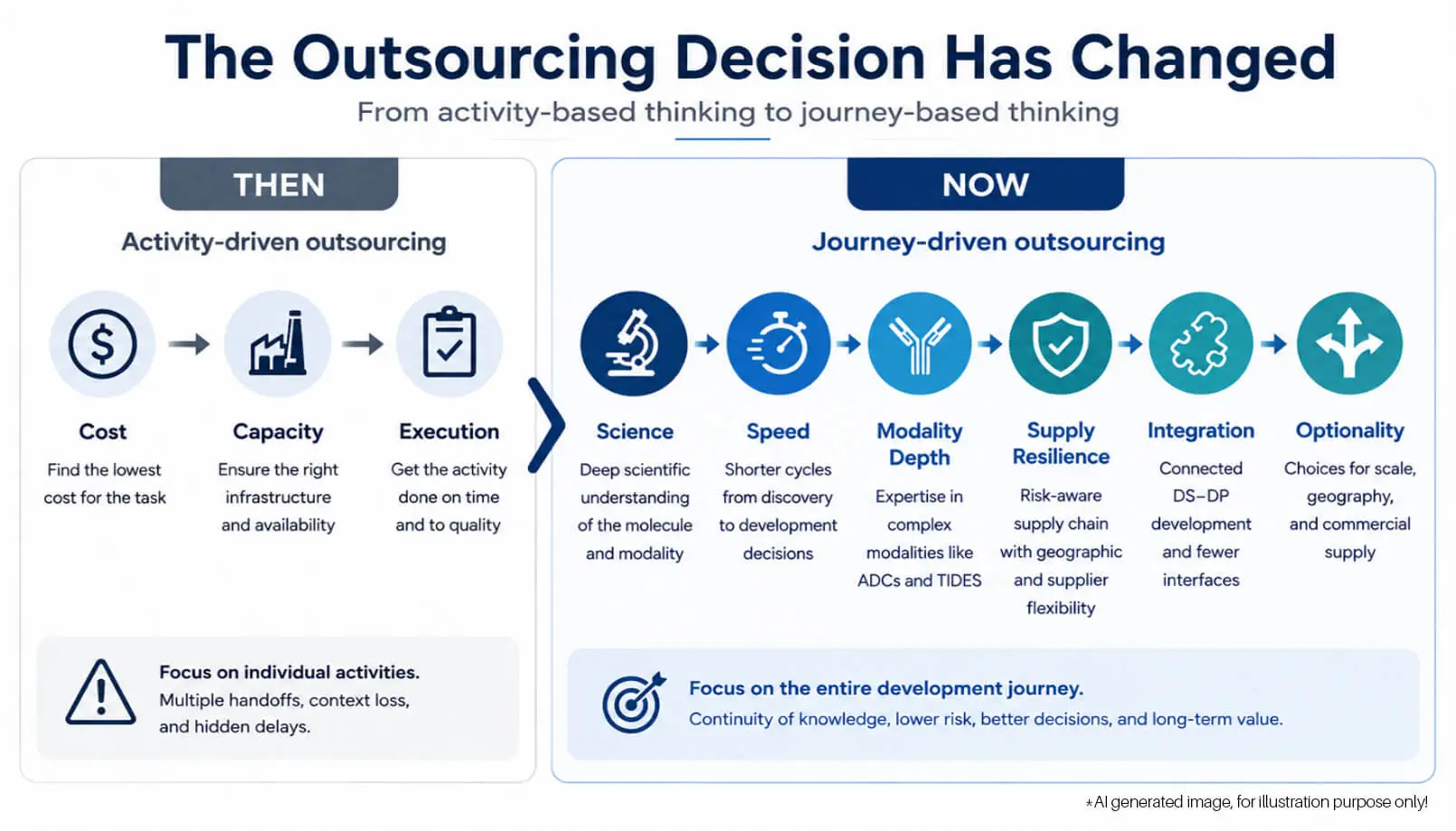






For years, many biologics companies treated CDMO outsourcing as a question that came later: Who can manufacture this material when we are ready? That question still matters, but it is no longer enough. The more difficult question now comes much earlier: Will the decisions being made today support the program when it reaches scale-up, late-stage development, or commercial supply? This is why CDMO outsourcing is moving upstream in biologics development.
That question arises because biologics development is not a simple movement from discovery to process development and then to manufacturing. The product and the process are too closely linked. A cell line choice, an upstream process condition, an analytical method, or a raw material decision made early can later affect yield, quality, comparability, regulatory readiness, and supply continuity. What looks like a small technical decision at the start can become a major constraint later.
This is why biologics companies are bringing CDMOs into the discussion earlier. The aim is not only to find someone who can manufacture clinical material. It is to reduce avoidable risk before the program reaches a stage where process changes become expensive, slow, or difficult to justify. For many sponsors, CDMO outsourcing is becoming less about outsourcing a task and more about building a development path that can move from early clinical supply toward commercialization with fewer disruptions.
Why CMC strategy is moving earlier
The need for earlier manufacturing planning has become stronger as biologics pipelines have expanded and more programs are expected to move quickly from candidate selection to IND-enabling work and early clinical supply. At the same time, the CMC expectations around manufacturing, testing, quality control, and product understanding remain demanding. FDA describes the CMC section of an IND as covering drug substance, drug product, placebo formulation where relevant, labeling information, and environmental assessment for the investigational product. In practical terms, manufacturing and testing are part of the development file from the beginning, not paperwork added near submission.
Biologics are also less forgiving than many small molecules. They depend on living systems, sensitive process conditions, and close control of product quality attributes. A process that works at small scale may not be suitable for later clinical or commercial manufacturing. A cell line that looks acceptable early may show productivity, stability, or quality problems when the program advances. Analytical methods that are enough for early characterization may not be enough when release testing, stability, or comparability expectations increase.
Early CDMO involvement helps sponsors judge whether the process is only solving the immediate need or whether it can support the next stage without major rework. This is why CMC strategy is now being discussed much earlier in many biologics programs.
Why CDMO outsourcing is not just capacity
The older outsourcing model was mostly transactional. A sponsor developed the molecule and process to a certain point, then transferred it to an external manufacturer. That approach still exists, but it can create problems when the process, analytics, and manufacturing assumptions were not designed with scale-up in mind.
Earlier engagement helps answer practical questions before they become urgent. Can the process be scaled? Are the analytical methods suitable for the next clinical stage? Are raw materials and critical reagents controlled well enough? Will technology transfer be straightforward, or will the receiving site need to rebuild parts of the process? These questions are easy to postpone, but postponement usually makes them more expensive.
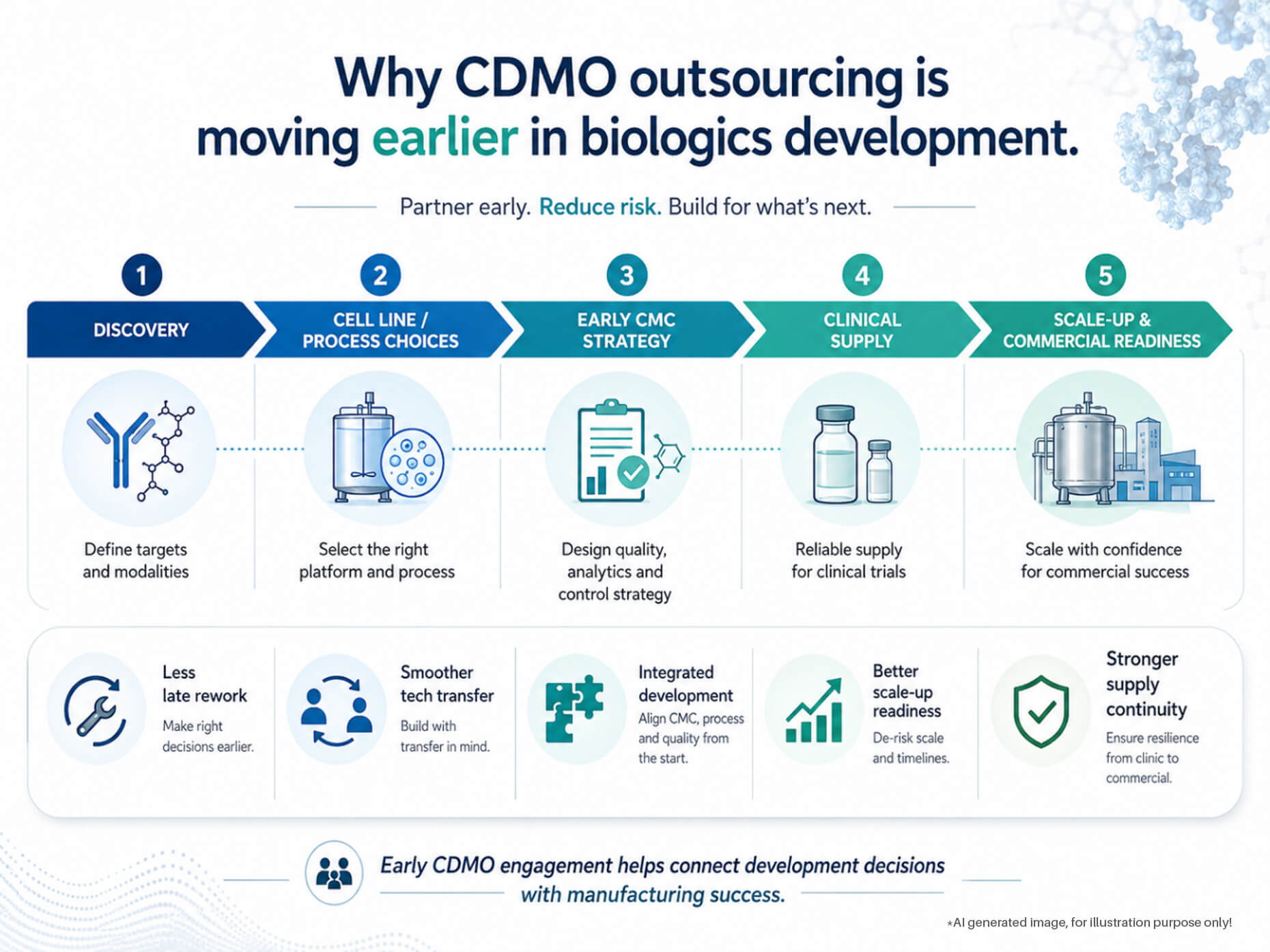
Figure 1. Early CDMO outsourcing helps biologics companies connect CMC strategy, process development, clinical supply, and scale-up planning to reduce downstream manufacturing risk.
For small and virtual biotechs, the issue is sharper. They may have a promising molecule but not the internal CMC, process development, quality, and manufacturing infrastructure needed to move the program efficiently. Building all of that in-house is expensive and often unrealistic before clinical proof of concept. A CDMO can help fill this gap, but only when it is brought in early enough to influence the development path. In that sense, CDMO outsourcing is becoming part of the development strategy, not just a procurement decision.
Development decisions can create manufacturing constraints
In biologics, manufacturing feasibility and development strategy are linked. A molecule may be scientifically promising, but it still needs a reliable route to consistent production. That route has to support yield, purity, stability, impurity clearance, and regulatory expectations.
If manufacturing is considered too late, the sponsor may need to change the process after clinical material has already been produced. That can create comparability work, additional analytical testing, stability requirements, and timeline pressure. The problem is not that process changes are impossible, but that late process changes require stronger justification and better supporting data.
This does not mean a Phase I process should be overbuilt like a commercial process. That would waste time and money. The better approach is to avoid early shortcuts that create obvious problems later. A CDMO with relevant experience can help distinguish between acceptable early flexibility and choices that may lock the program into future constraints.
Why integrated biologics development and manufacturing matter
Many sponsors are no longer looking only for a manufacturing slot. They are looking for integrated biologics development and manufacturing support. Biologics development involves cell line development, upstream and downstream process work, analytical development, formulation, drug substance manufacturing, drug product manufacturing, quality control, stability, and regulatory documentation. If these steps are fragmented across too many handoffs, information can be lost.
An integrated CDMO can help keep the development history connected. Batch results, process decisions, deviations, analytical findings, and stability data can be interpreted as part of one development story. This matters when a program accelerates, when the molecule is technically complex, or when the sponsor needs a clearer line of sight from early development to later-stage manufacturing.
This is where an integrated CDMO model becomes important. When discovery, development, analytical strategy, process development, and cGMP manufacturing are connected, sponsors can carry process knowledge forward with less handoff friction. Syngene’s biologics capabilities are relevant in this context because they support development and manufacturing across the biologics continuum, helping sponsors move from early development decisions toward clinical and commercial manufacturing with greater continuity.
Syngene is an end-to-end Biologics CDMO with integrated operations across the U.S. and India, supporting development and commercialization of large molecule therapies. Its GMP Drug Substance network includes 50,000 L of single-use bioreactor capacity across 500 L, 2,000 L, and 4,000 L scales. Its Drug Product capabilities support up to approximately 100 million vials annually, with integrated fill-finish, packaging, and labelling. The company serves mammalian and microbial platforms across modalities such as mAbs, bispecifics, recombinant proteins, biosimilars, ADCs, pDNA, mRNA, microbiome therapeutics, and peptides. For sponsors, this breadth can support seamless tech transfer and scalable manufacturing as programs move forward.
Why CDMO management still needs sponsor ownership
Early CDMO engagement is not the same as handing over control. The sponsor remains responsible for the product and for the development decisions made around it. A CDMO can provide technical depth, facilities, quality systems, documentation support, and manufacturing experience, but the sponsor still needs scientific ownership and clear governance.
This is where some companies get outsourcing wrong. They think early outsourcing will solve the CMC problem by itself. It will not. Poorly managed outsourcing creates dependency, confusion, and weak decision-making. Good CDMO management improves visibility and execution because responsibilities are clear and technical discussions happen early.
For a sponsor, the value of a CDMO partner lies not only in capacity but in the quality of the decisions made together. Early conversations around manufacturability, process robustness, analytical readiness, scale-up, and supply continuity can prevent later disruption.
What sponsors should look for in an early phase CDMO
When a CDMO is engaged early, selection should go beyond price and availability. Those factors matter, but they are not enough. The sponsor needs to know whether the CDMO has experience with the modality, expression system, analytical requirements, GMP stage, scale-up path, documentation expectations, and possible commercial direction.
A cheaper option may become expensive if the process has to be rebuilt. A fast option may become slow if the analytical package is weak. A technically capable CDMO may still underperform if communication and governance are poor. Early outsourcing decisions need a balanced view of science, execution, quality, capacity, and partnership behaviour.
The real value of early CDMO engagement is better planning. Companies that bring manufacturing thinking into development earlier are more likely to reduce late rework, protect timelines, and build a clearer path from early clinical supply to commercial readiness. For biologics, the question is no longer only, “When do we need someone to make material?” The better question is, “At what point do our development decisions begin to shape manufacturing success?”
For most biologics programs, that point comes early: during cell line selection, process design, analytical method development, raw material planning, and early CMC strategy. Engaging an early phase CDMO at this stage helps sponsors make decisions with the next milestone in mind, not just the immediate batch. It also supports a smoother path as the program moves from early clinical supply toward scale-up, transfer, and eventual commercialization.