





An ADC program depends on several teams moving related work forward at once: antibody supply, linker-payload development, conjugation process definition, analytical method readiness, and manufacturing-suite planning. Many ADC manufacturing challenges begin when these activities progress on separate schedules. Completing each workstream does not necessarily mean the outputs are compatible for a representative batch. The antibody may be available, methods may be ready, and suite time may be booked while key material attributes, process ranges, or reaction assumptions remain unresolved. That gap may become clear only as the batch approaches.
The reason is that one choice can change what the next team has to control. Antibody concentration and disulfide accessibility can influence conjugation; DAR distribution and linker-payload hydrophobicity can shape purification and analytical strategy; payload hazard and exposure limits can determine the containment and handling controls needed in the facility. If these assumptions are set independently, every function can meet its own target while the batch remains unready. The mismatch may appear as a delay, a site-to-site difference, or data that are insufficient to support the next decision.
ADC manufacturing process: molecular risks to manage
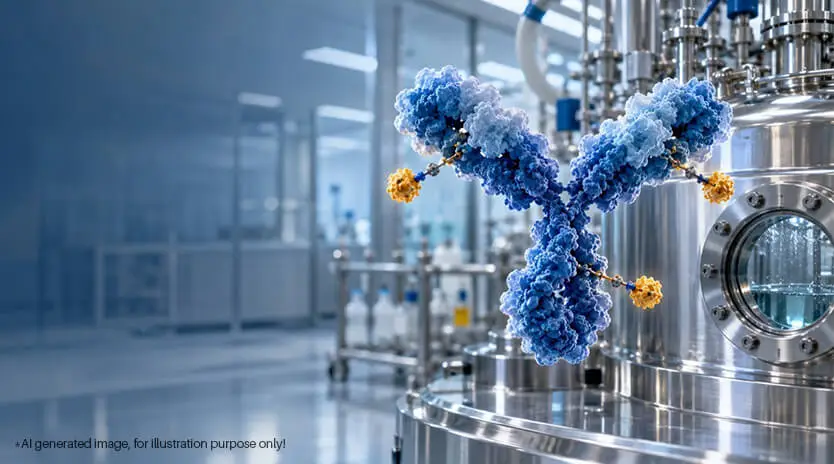
An ADC consists of an antibody, a linker, and a potent payload. The manufacturing challenge is to control how these components are combined during conjugation and how the resulting ADC behaves during purification, formulation, storage, and testing. Compared with a conventional antibody, an ADC adds chemical and product-quality attributes to control: how much drug is attached, where it attaches, whether the linker remains stable, and how the payload affects solubility, aggregation, potency, and safety handling. These features interact with the antibody’s structure and biological activity. A change in conjugation can affect purification; a change in linker or payload can affect stability, formulation, and analytical interpretation.
The antibody is a folded protein stabilized by disulfide bonds and noncovalent interactions. Conjugation must attach the payload while preserving structure, binding, and stability. The linker must be sufficiently stable before target-cell uptake and support payload release under the intended intracellular conditions. These are molecular-design questions, but they also define the practical process window.
In conventional cysteine conjugation, partial reduction of interchain disulfide bonds exposes thiol groups. The linker-payload reacts with those groups, and the extent of reduction, along with pH, temperature, and reaction time, influences the mix of loaded species. An average drug-to-antibody ratio (DAR) does not show that mix. Two batches can have the same average DAR and still differ in the proportions of unconjugated antibody and highly loaded species.
Drug-to-antibody ratio: what the average can hide
In conventional lysine conjugation, the payload can attach to multiple accessible lysine residues on the antibody, creating a heterogeneous mixture with different attachment sites and loading levels. Depending on the platform, site-specific conjugation can produce a more defined ADC. Some approaches require antibody engineering and may require cell-line development, while others use enzymatic or chemical methods on an existing antibody. Every approach still requires the team to characterize the product and control the features that affect quality. Site-specific conjugation can improve control; it does not remove the need for product understanding.
Linker design adds another set of trade-offs. A cleavable linker must remain stable before target-cell uptake, then release the payload under the intended intracellular conditions. In a common valine-citrulline design, lysosomal proteases cleave the peptide segment, and a self-immolative spacer enables payload release. Small changes in linker structure, attachment site, or local molecular environment can affect both stability and release.
The payload matters just as much. Hydrophobic payloads can make the ADC less soluble and more prone to aggregation, complicating purification and formulation. A higher DAR increases the amount of drug attached to each antibody, but it does not necessarily improve overall performance. Its effects on potency, stability, clearance, and product quality depend on the complete antibody-linker-payload construct.
Where ADC manufacturing challenges tend to break
A candidate may be chosen for its biological activity before the team knows how well it can be manufactured. Potency alone does not show how the antibody will behave during expression, conjugation, purification, or storage. Compatibility, solubility, stability, reaction kinetics, and purification behavior may still be unclear when a candidate moves forward. If those questions surface only after the clinical schedule is set, development becomes a string of urgent experiments rather than a planned sequence of decisions.
An early candidate does not need a commercial-ready process. The team should, however, identify product features that could require a different manufacturing route and test the biggest risks while there is still room to change the molecule or process. Early results can guide those decisions. If the same issue emerges after a clinical batch or technology transfer has been scheduled, it may require more studies, another manufacturing slot, and a revised timeline.
No single assay describes an ADC completely. Hydrophobic interaction chromatography can help assess DAR distribution for many ADCs; intact or subunit LC-MS can confirm molecular mass and support assessment of drug loading; and peptide mapping can identify conjugation sites. Size-exclusion methods detect aggregates and fragments, while free payload, potency, binding, and stability require additional methods. Teams should agree on which results support a batch decision and how data from methods or sites can be compared.
FDA’s 2024 ADC clinical pharmacology guidance covers clinical-development topics, including bioanalytical methods for measuring ADC-related components. It does not define manufacturing release testing, which serves a different purpose. Before a batch is made, teams still need to know which methods will assess it, who owns each method, how samples will be handled and shipped, when methods will transfer, and whether the laboratories have capacity. Otherwise, the batch may be made before the results needed to assess it are available.
A technology transfer may include the process documents but leave out why key decisions were made. ADC programs often involve several companies, sites, and specialist teams. The receiving team needs to know which process settings matter, where results have varied, what assumptions were made about the starting materials, and what questions remain open. Without this context, it may repeat work or find a problem after manufacturing begins.
The transfer package should explain the process, its rationale, material attributes, operating ranges, method limitations, deviations, hold times, and open questions. This helps the receiving team distinguish a proven control from a temporary development choice.
Scale-up is not simply a matter of increasing quantities. As batch size increases, mixing, mass transfer, addition time, hold time, and vessel geometry may affect process performance. During conjugation, antibody concentration, linker-payload-to-antibody ratio, solvent fraction, pH, temperature, and reaction time can influence reduction, coupling, and DAR distribution. Excessive reduction can disrupt disulfide architecture and affect antibody integrity.
Quenching and purification must remove unreacted linker-payload and residual reagents without excessive product loss. These variables interact: more solvent may improve linker-payload solubility but challenge protein stability; longer reaction time may improve conversion but can also increase aggregation or degradation risk. A successful small-scale run does not establish which conditions will remain comparable at the next scale. FDA’s process-validation guidance takes a lifecycle view, from process design through qualification and continued verification. Teams should agree on the evidence needed before moving up in scale.
Potent payloads also affect whether a facility and its operating procedures are suitable for the work. The required controls should be based on a formal hazard and exposure assessment. Depending on the material and process, these controls may include closed handling, containment, cleaning, waste management, sampling routes, and worker protection. If these needs are considered only after the chemistry is selected, the program may require additional qualification work or lose its planned slot. This is an execution constraint with a direct effect on timing.
Teams may review a change within their own function, even when it affects work handled by others. A new linker-payload supplier, revised antibody process, changed conjugation condition, or updated method may look local, yet affect comparability, specifications, process performance, or the meaning of earlier results. A review by one function can miss the combined impact. ICH guidance places risk and knowledge management within the pharmaceutical quality system. Reviews should identify downstream users, conclusions to revisit, and evidence that will show whether the change worked.
Antibody-drug conjugate process development: plan around scientific interfaces
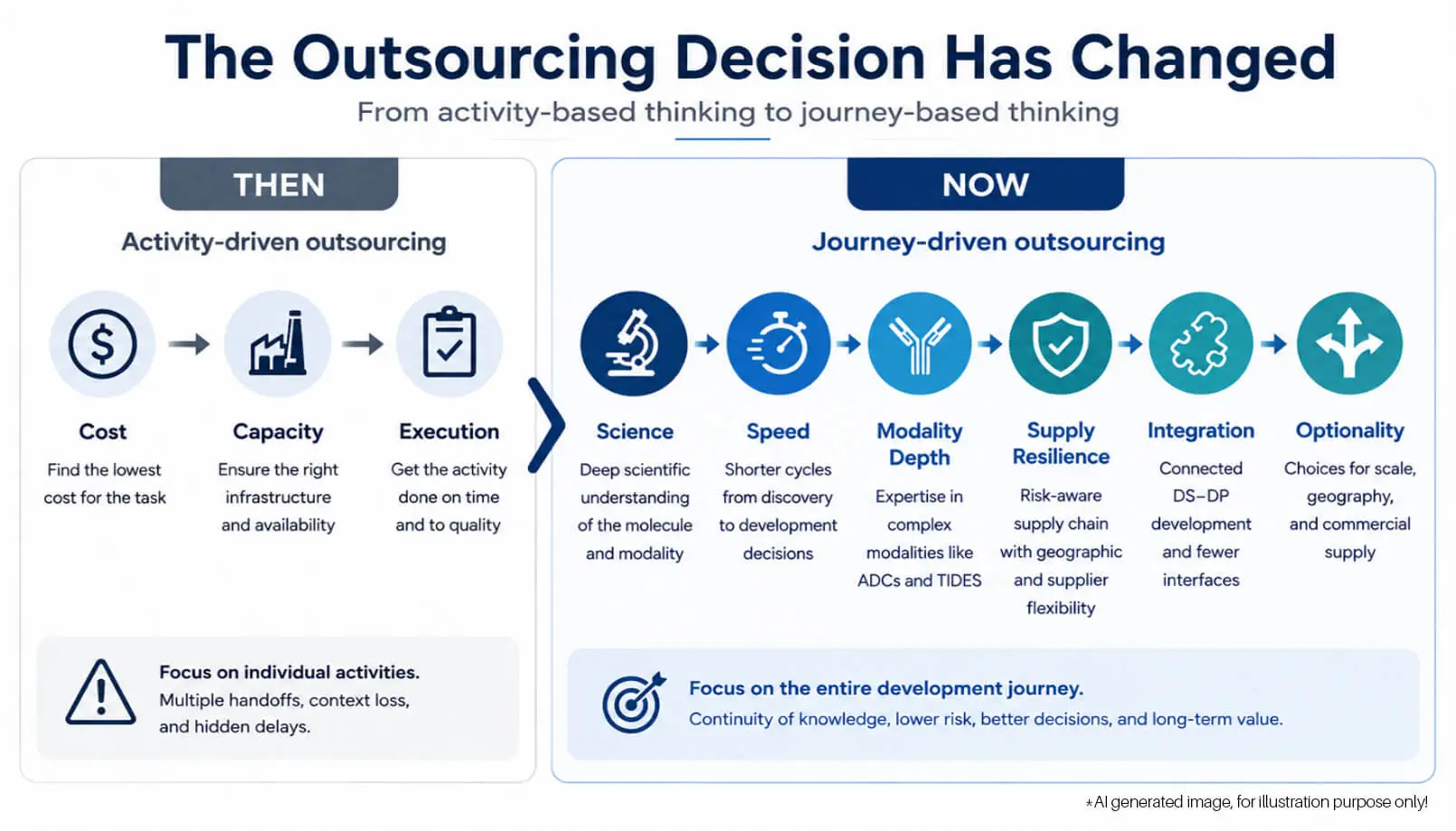
Integration does not require every activity to sit in one organization. It means the people making dependent decisions have a way to make them together. Early in a program, the sponsor and its partners should map how the molecule, process, assays, materials, facility, and schedule constrain one another. Each connection needs an owner, including when the work on either side belongs to a different company.
Decision gates keep the work manageable. Before selecting a development route, review component compatibility and manufacturing risks that could change the design. Before a representative campaign, check starting material, process ranges, methods, containment, and downstream capacity together. Before a scale transition, agree on comparability questions and the supporting evidence needed. Each review should end with a decision, an owner, and a record of open assumptions.
This shared planning helps the process evidence carry forward. At each scale transition, teams can start with the same view of material attributes, operating ranges, analytical methods, and acceptance criteria. They can then identify which conditions need further study and which have already been supported by data. This does not remove the need for scale-specific work. It makes it less likely that a new site or team will have to rebuild process understanding because the reasons behind earlier decisions were lost.
The same questions belong in CDMO selection. Sponsors need to understand how a partner manages decision rights, data exchange, assay transfer, escalation, and schedule dependencies, along with its technical capabilities. Available capacity matters, but a slot alone does not keep the program moving if method transfer or process understanding is behind. Syngene’s published development-services portfolio includes payload, linker, and conjugation work, as well as transitions toward GMP-compliant manufacturing. For a sponsor, the useful discussion is how those activities will be integrated for its molecule, stage of development, and timeline.
ADC manufacturing: the critical path is often an interface
A familiar pattern sits behind many delays: each function reports progress against its own deliverable. Antibody supply is ready when material is released. Analytics is ready when a method is qualified. The facility is ready when the suite is available. But the program needs all three to line up for the same batch, with compatible specifications and enough analytical coverage to interpret the result.
A dashboard can stay green while the next operation cannot start. Track interface readiness as well as task completion. Before a campaign, confirm that material, methods, facility, downstream capacity, and decision owners are in place for that batch. Each answer should rest on evidence, not an optimistic status label.
What may change in ADC manufacturing decisions
Manufacturability is likely to become a more important part of ADC candidate and partner decisions as constructs, payload classes, and conjugation approaches continue to diversify. Teams will need to assess whether the process route, DAR target, analytical strategy, and containment approach suit each molecule. Experience with one ADC will not answer those questions for the next. This is a reasoned outlook based on technical differences among ADCs, not a quantified forecast of when or how much decision-making will change.
Analytical readiness is also likely to matter more in partner selection. Sponsors will ask whether methods resolve meaningful product variation, whether transfer is planned, and whether capacity will be available when batches are made. This is an operational forecast; public sources do not yet quantify its market effect.
Closing
ADC programs do not usually lose momentum because one team has stopped working. More often, a decision made in one part of the program reaches another team before the assumptions behind it have been tested. That is when a material, method, process, or facility plan can become the reason a batch waits.
Sponsors can reduce avoidable delays by treating connected decisions as part of the development plan. Process, analytical, quality, facility, and supply teams should review the same upcoming milestones. Handoffs should carry the reasoning behind a decision, not only the approved document. Changes need to be assessed for their effects on later work. None of this removes scientific uncertainty. It does make it less likely that a program will discover a preventable gap only when the batch is due.