
SynVent is Syngene’s platform for fully integrated therapeutic discovery and development across large and small molecules.

Emerging biopharma work at the forefront of science, often venturing into disease areas where little or no real-world data exists to work with or regulatory frameworks to work within.
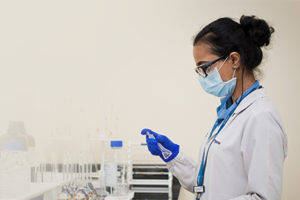
Our Dedicated Centers offer dedicated multi-disciplinary scientific teams, support personnel, and a tailormade ring-fenced and fire-walled infrastructure as per client specifications to support their R&D goals

Centre for Advanced Protein Studies [CAPS] is a state-of-the-art advanced national facility located in the Syngene campus, Bangalore.

In pharma, most attention goes to discovering new molecules and running clinical trials. The work that finally decides whether a program moves on time sits with the CRDMOs, the Contract Research, Development, and Manufacturing Organizations. These partners convert a scientific lead into a robust, compliant, and scalable product. Artificial intelligence and machine learning are now changing how CRDMOs operate. The change is practical, built step by step, and focused on reducing waste, avoiding rework, and improving predictability. Notably, from AI in drug discovery and development to process analytical technology on the shop floor and even mRNA manufacturing for complex modalities, the gains are practical and measurable. This viewpoint focuses on process analytical technology in CRDMOs and how AI models turn in-line signals into real-time control and release decisions.
The first decision, what to take on and how to plan it, shapes the entire project. AI models trained on historical programs help CRDMOs spot feasibility risks early. If a proposed route often creates stability trouble or clashes with site capabilities, the system flags it during scoping so the team can ask sharper questions. Costing and effort estimates also improve because pricing engines use past yield distributions, typical cycle times, vendor lead times, and resource calendars to suggest realistic ranges. This lowers the chance of avoidable change orders later. Document handling becomes safer and faster as language tools remove client identifiers from shared material and check compliance with data handling rules.
A useful extension here is automated risk registers. The model turns early technical notes into a living register with probability and impact bands, linking each risk to a mitigation and an owner. As new data comes in, the register updates and reorders priorities. Proposal accuracy goes up not just by better numbers but by locating the known unknowns in week one.
Where CRDMOs offer discovery services, AI works as a support system. Compound triage models combine basic potency predictions with early developability signals such as solubility, permeability, and metabolic liability, helping chemists avoid fragile directions. Image analysis adds value in phenotypic screens by capturing subtle cellular responses that manual review might miss, so hit lists become cleaner. Retrieval tools trained on internal reports and public literature surface known risks, for example, excipient interactions or photolabile motifs, so teams do not repeat old mistakes. None of this replaces scientists; it just removes avoidable loops. Positioning these capabilities as AI in pharma R&D clarifies scope, ownership, and acceptance criteria for cross-functional teams.
Discovery groups also benefit from data fusion across chemistry and biology. When assay drift, cell-line passage number, and plate effects creep in, models correct for these confounders before ranking hits. Early ADME flags are bundled with manufacturability hints, such as ability to form a pharmaceutically acceptable salt or the risk of stubborn polymorphs. The sponsor sees a shorter, more honest list that carries fewer traps into CMC (Chemistry, Manufacturing, and Controls).
CMC is the core of CRDMO work. AI supports route selection by considering site constraints, hazardous operations, waste profiles, and realistic reagent access, not only theoretical yields. In solid form selection, classification models estimate risk of hygroscopicity, form conversion under stress, and likely dissolution behavior, guiding a smaller and smarter screen. Crystallization, spray drying, and milling benefit from surrogate models trained on process and flow simulations. These models propose seeding, cooling, or atomization strategies that produce tighter particle sizes and better flow. For stability and compatibility, AI systems read prior internal studies and public safety notes to warn about peroxide formation, Maillard reactions, or moisture sensitivity with a given excipient set. The result is fewer reworks and a quicker path to a robust formulation.
Analytical development advances in steps. Peak deconvolution models speed HPLC method development when impurities overlap, while retention-time predictors suggest gradient adjustments that separate critical pairs without long scouting runs. Dissolution method selection becomes more targeted by mapping media and paddle speed to in vivo surrogates through hybrid PBPK plus ML models. Cleaning validation planning also tightens, since residue risks are predicted from process histories and surface energetics, letting teams set smarter swab locations and limits.
Projects may work at bench scale and then struggle in the plant. Transfer learning shortens this gap by taking models trained on lab and pilot data and recalibrating them with a few commercial-scale runs. Equipment mapping tools translate mixing, heat transfer, and shear behaviour between reactor families, so process parameters are not simply scaled by a rule of thumb. Digital twins of key unit operations, such as granulators, dryers, bioreactors, and chromatography skids, allow safe what-if testing when raw material grades change or ambient conditions shift. As a result, the first campaigns at a new scale face fewer surprises, and investigations become faster when deviations occur.
Another practical layer is recipe genealogy. AI links every version of a recipe to its batch outcomes and notes exactly which parameter shifts changed which critical attribute. During tech transfer, the system proposes the smallest safe set of verification runs that will cover the most uncertainty. This keeps transfer packages tight and defendable.
Process Analytical Technology generates rich data that can be hard to interpret in real time. AI models convert NIR and Raman spectra into reliable predictions of content uniformity, moisture, and polymorph in line, enabling more confident batch decisions and, in suitable cases, real-time release. Thus, AI-enhanced process analytical technology cut blend-uniformity failures and shortened investigations, with fewer partial batch holds. In coatings, spray drying, fermentation, or microencapsulation, predictive controllers adjust set points dynamically to hold critical quality attributes within tight bands even as feeds, lots, or environment vary. Computer vision systems for visual inspection and container closure checks maintain consistent sensitivity across shifts and reduce false rejects after proper tuning. Overall, this means fewer hold and test cycles and more stable output.
Process Analytical Technology programs also gain from anomaly detection. When a probe drifts silently or a line picks up subtle vibration that does not trip a hard alarm, models compare current signals to healthy baselines and raise a soft alert with likely causes. Maintenance can respond during a natural gap, and QA sees a clean explanation in the batch record.
Quality work needs traceability and careful records. Deviation narratives, change controls, and CAPAs (Corrective and Preventive Actions) are large text stores that hide repeating patterns. Language models cluster similar root causes across sites and products so teams can address systemic contributors instead of treating each event in isolation. Drafting support for batch records, certificates, and investigation summaries saves time by turning structured data into first drafts for QA review. Importantly, AI models are handled like any controlled method, versioned, locked, validated with clear acceptance criteria, and monitored for drift. When a model changes, the record shows what changed, why it changed, and how the new version was verified.
Method lifecycle management becomes more rigorous. Trending of system suitability, resolution, and tailing across products highlights methods that are drifting toward failure well before OOS (Out of Specification) events. Environmental monitoring data is mined for spatial patterns, so cleaning and air handling changes are targeted to the true hotspots. For extractables and leachables, models prioritize likely migrants from materials under actual process conditions, so studies are focused and still conservative.
Reliable supply depends on small parts as much as big ones. Demand forecasts for solvents, resins, single-use assemblies, gaskets, and filters improve when models account for the project pipeline, historical seasonality, and vendor performance. Scheduling systems balance equipment availability, cleaning cycles, operator qualifications, and QC capacity to make plans that raise utilisation without creating bottlenecks downstream. For cold chain shipments of biologics and mRNA, predictive tools select packaging and lanes based on real weather histories and variability, with early alerts if a shipment is trending toward a temperature excursion. These improvements are not glamorous, but they remove delays that quietly erode timelines.
Vendor risk scoring adds resilience. When a supplier’s on-time performance slips or a region shows transport instability, the system proposes dual sourcing or inventory buffers before shortages hit. For controlled substances or rare resins, the plan includes a regulatory view, showing lead times for variations if a second source must be activated.

Combination products and human factors
When a CRDMO supports devices such as inhalers or auto injectors, data from sensors and usability studies becomes valuable. Inhaler logs of flow rate, angle, and actuation timing feed coaching algorithms that help users correct technique. Auto injectors adapt injection speed to viscosity and tissue compliance to reduce pain while ensuring full dose delivery, even in colder conditions. Video analytics from usability sessions identify common missteps and inform small design changes that make the product easier to use safely. This is practical human-centred engineering supported by data.
Firmware and app updates can be tested against synthetic user traces before rollout. The system checks that reminders, counters, and alarms behave correctly across older phones and patchy connectivity, which reduces field complaints after launch.
Commercial manufacturing
Once a product reaches commercial supply, the goal is steady throughput with clean audits. Predictive maintenance uses vibration, temperature, and power signatures to forecast failures of pumps, motors, and bearings, allowing planned downtime instead of emergency stops. Overall Equipment Effectiveness improves when analytics highlight specific levers, such as the sequence of changeovers, shift allocation, or cleaning cycles that create small but meaningful gains. Energy optimisation across HVAC, WFI loops, and compressed air systems is easier when models learn production rhythms, cutting utilities without risking quality. These steps protect schedule adherence and margin without heavy capital spend.
Release cycle time can also drop when model-assisted review of batch records highlights likely discrepancies for human attention rather than asking QA to read every line equally. Stability programs are planned with stronger prior knowledge, so chamber capacity is used better, and pull schedules reflect real risk.
Biologics, peptides, oligonucleotides, and mRNA require careful control across many variables. In upstream cell culture, machine learning learns how feed schedules, pH shifts, and temperature ramps affect titer and glycosylation, and then suggests the next set of experiments while learning from results. Downstream, predictors connect resin choice, gradient shape, and load conditions to clearance and yield, allowing teams to compare purification trains before touching the skid. For oligos and peptides, models propose protected building blocks and cycle times that reduce deletions and branching while highlighting likely purification bottlenecks. In LNP formulation for mRNA and siRNA, multi-objective optimization balances encapsulation efficiency, particle size, polydispersity, and innate immune readouts, narrowing the search space without endless screening. For mRNA manufacturing, process analytical technology—in-line particle-size, NIR on solvent exchange, and conductivity during mixing—keeps encapsulation, PDI, and potency within limits.
Host-cell protein and residual DNA clearance can be forecast from resin age, pool volumes, and hold times, which helps set proactive column maintenance and pool limits. For viral vector and capsid engineering, pattern models connect sequence edits and process settings to tropism and aggregation risk, giving a clearer picture of which variants to test in animals. The net effect is better use of limited raw materials and lab time.
Sponsors value clarity. Secure project assistants pull raw data, documents, and derived insights from manufacturing, lab, and quality systems to answer status questions with precise, permission-controlled summaries. Document search improves as language models understand the wording used in methods, stability plans, and batch records, so sponsors can find what they need quickly. Forecast pages present expected milestone dates with confidence bands and the key drivers behind them, making discussions more objective. Trust improves when information is clear and consistent.
Secure data rooms with automatic redaction make file sharing safer. The system checks that cross-client references do not appear and that personal data is masked where required. Simple touches like change logs and side-by-side comparisons of protocol versions reduce back and forth during reviews.
CRDMOs work with many clients and must protect each client’s intellectual property. Data ring fencing is built into model design, storage, and access control. Where multiple clients agree to collective learning, federated training allows shared models to improve without moving raw data between organisations. This approach improves generalisation while maintaining confidentiality. Every query, prediction, and model version change is logged to create a complete audit trail. The idea is simple: learn faster as an organisation while keeping each client’s data secure.
Cybersecurity sits alongside governance. Model artifacts and datasets are signed and hashed, access is role-based, and monitoring watches for unusual queries. These basics keep learning systems reliable in a regulated setting.
Tools only work when teams know how to use them. Short, practical training sessions for operators and scientists, covering NIR basics, design of experiments with active learning, and the importance of complete metadata, pay off quickly. Cross-functional reviews where chemists, engineers, analysts, and data specialists examine model outputs against recent batches help the team decide the next experiments with a common view. Clear roles keep confidence high, models advise, people decide, and QA verifies. This balance reduces anxiety and speeds adoption.
New hybrid roles help. Translational data engineers sit between the plant and the modelers, making sure tags, units, and context are right. Product owners for analytics keep the backlog focused on business value and ensure models are retired or refreshed on schedule. With these roles in place, the tools stay useful after the first enthusiasm fades.
AI cannot fix missing or poor metadata. If a record does not include solvent grade, ambient humidity, or exact feed rates, the model will guess and make errors. When the mechanism is not understood, for example, difficult polymorph transitions, statistical signals do not replace proper scientific studies. Regulatory expectations do not change; methods must be validated, changes controlled, and evidence documented. Culture also matters. If people hide deviations or skip documentation, analytics may scale the problem rather than solve it. Keeping these limits in mind helps teams invest effort in the right places.
Pick one problem that creates real delay or cost, such as high coating variability, long QC release times, or recurring CAPAs around a specific unit operation. Collect the relevant data with context, including material lots and environmental conditions. Build a simple baseline model and measure success using business metrics like yield, cycle time, and OEE, not only statistical scores. Use an active learning loop to choose the next experiments or parameter sets, run them, and feed results back. Integrate outputs as decision support first, then move to closed-loop control after sustained stability. Treat each model as a controlled method with versioning, validation, monitoring, and clear SOPs. Share outcomes openly, what worked, what did not, and what changed next. This stepwise approach builds trust and compounds benefits.
Mechanism-aware models that combine first principles with data will become standard in regulated steps because they are easier to justify and maintain. Modular lines with PAT-driven control will expand for oligos, peptides, and some oral solids, supporting faster changeovers and more consistent output. Client-facing transparency will become a differentiator, with live but controlled project insights that sponsors can rely on during their own planning. For patients and the general public, the benefits will show up as fewer stockouts, quicker availability of new therapies, and steadier quality.
AI reduces repetitive work and improves memory across projects. It does not replace judgment. The strongest results still appear when experienced process engineers and scientists review model suggestions against batch history and risk, then decide the safest next step. That combination, human expertise supported by reliable data, keeps programs moving and quality intact. For CRDMOs, this is the path to faster timelines, tighter cost control, and stronger long-term partnerships.
Table 1. How AI helps CRDMOs end-to-end—cleaner discovery lists, better developability choices, faster tech transfer, tighter QC, and transparent project status.
| Stage | Find & Frame Targets | Prove the Biology | Find Matter | Shape the Leads | Preclinical Learning |
|---|---|---|---|---|---|
| What we use AI for | Blend chem/bio datasets; pull past red flags; correct drift/plate/passaging artefacts | Patient-set and pathway models to confirm mechanisms/biomarkers | Computer-vision review of cell images; quick property screens to de-noise hit lists | Rank by potency and make-ability (solubility, permeability, metabolic risk, salt-formability, polymorph risk) | Early DMPK/safety predictors; dose bands for specific groups |
| What changes on the ground | Fewer false starts; tighter shortlists | Faster yes/no on targets and readouts | Cleaner hits; less re-testing | Better choices move into CMC with fewer traps | Leaner studies; earlier view of risk |
| Stage | Build the Process | Make it Work at Scale | Sense & Control | Quality & Validation (CSV) | Run the Ops / keep sponsors in the loop |
| What we use AI for | Route options scored for hazard, waste, site limits; solid-form/crystallization predictors; ML aids for analytical set-up | Use a few plant runs to re-fit lab models; digital twins for key unit ops; link recipe history to CQAs | Inline NIR/Raman for CU, moisture, form; predictive controllers; drift/anomaly detection | Cluster deviation/CAPA roots; first-drafts for eBR/CoA/investigations; models versioned, validated, and monitored | Forecast materials/capacity; surface status data, docs, and insights with permissions; show milestone ETAs with confidence bands |
| What changes on the ground | Less rework; faster to a robust process/formulation | Fewer first-campaign surprises; quicker investigations | Fewer partial holds; faster or real-time release where justified | Strong traceability; time saved without losing compliance | Better on-time starts; fewer status calls; higher sponsor trust |
Share a few details and our team will reach out to explore how we can support your goals.