






Cell line development is a critical early step in biologics manufacturing. For monoclonal antibodies and other therapeutic proteins, the quality of the master cell bank determines not only expression levels but also long-term process stability, regulatory confidence, and downstream scalability. As biologics pipelines grow more complex and timelines tighten, cell line development has evolved from a largely laboratory-focused optimization activity into a strategic lever that shapes development speed and manufacturing readiness within biologics manufacturing programs.
In this context, cell line development must balance speed with robustness. Sponsors are looking for approaches that reduce development cycles while still delivering clonally derived, genetically stable, high-producing cell lines that can support late-stage clinical supply and eventual monoclonal antibody manufacturing and commercial manufacturing. Hence, the pressure is not only to move faster, but to move right the first time.
Why cell line development timelines matter more today
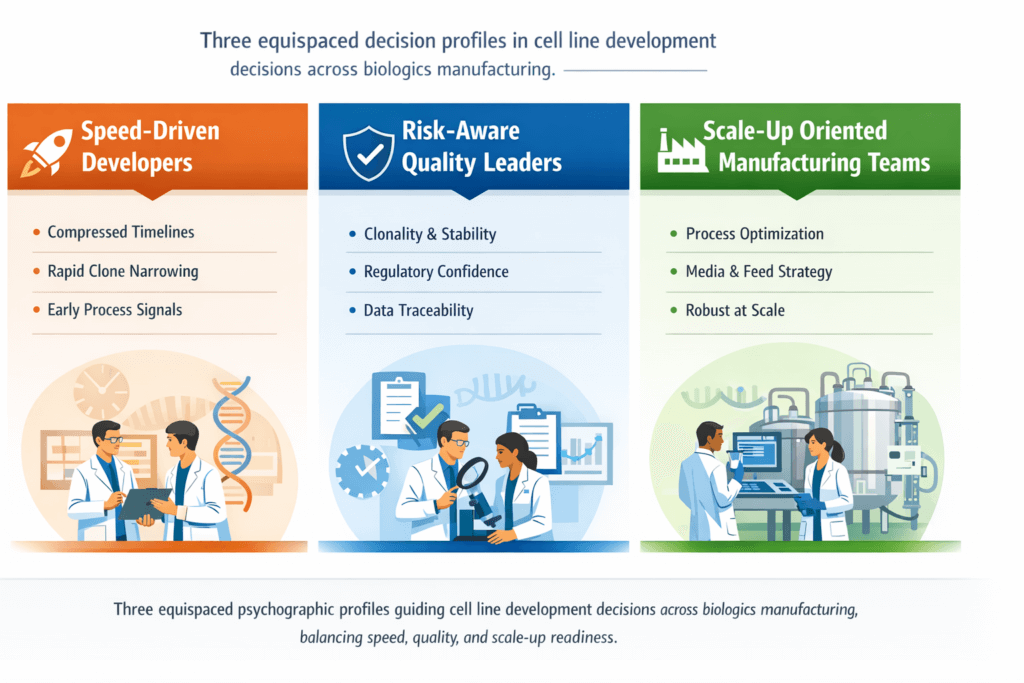
The traditional cell line development workflow prioritized reliability in clonality, stability, and repeatable expression, favoring outcome predictability rather than speed. Multiple rounds of transfection, selection, cloning, and stability testing often extended timelines to six months or more. While this approach worked for early-generation antibodies, it is increasingly misaligned with today’s development realities in biologics manufacturing.
Modern pipelines include higher-affinity antibodies, bispecifics, and engineered formats that place greater stress on host cells. At the same time, sponsors are working within compressed clinical timelines, smaller initial batches, and earlier decisions on manufacturability. Delays in cell line development can ripple across upstream process development, analytical method qualification, and tech transfer planning.
As a result, faster cell line development is no longer judged only by how much protein a clone can make. It is also judged by how early teams can understand the process, how smoothly right-first-time tech transfer supports scale-up, and how few process changes are needed once manufacturing enters a regulated setting. When development runs smoothly at this stage, it reduces downstream rework and helps programs progress with fewer late-stage surprises.
Key attributes of a robust master cell bank
A stable master cell bank is more than a high-titer clone frozen in vials. Regulatory agencies expect clear evidence of clonality, characterization, genetic stability, and consistent expression over extended culture periods. From a development perspective, the cell line must also be compatible with scalable upstream process development and predictable downstream purification, particularly in monoclonal antibody manufacturing programs.
High productivity alone is not sufficient. Clones that show rapid early expression but drift during extended passaging can introduce risk later in development. Similarly, cell lines that perform well in small-scale systems may behave differently during scale-up if culture conditions, media and feed strategy, and metabolic profiles are not well controlled. An effective cell line development strategy, therefore, integrates clone selection with early insight into growth behavior, product quality attributes, and long-term stability. This integration is where newer platforms and workflows are beginning to make a meaningful difference for cell line development services.
From transfection to clone selection: reducing variability
One of the largest sources of delay in cell line development is variability introduced during transfection and clone screening. Random integration events can lead to wide expression ranges and unstable clones, which means a larger number of clones must be screened and triaged before selecting final candidates. This increases screening effort, extending timelines and resource use across cell line development services.
Advanced expression systems and structured selection workflows aim to reduce this variability at the source. By improving transfection efficiency and introducing more consistent expression behavior across the initial clone pool, it becomes possible to generate a narrower distribution of high-performing clones. This reduces the effort required to narrow large clone pools down to a manageable number of candidates with a higher likelihood of long-term stability.
Reducing variability early also supports better comparability when programs transition into upstream process development. Clone behavior becomes easier to interpret, and process optimization efforts can begin with greater confidence.
Accelerating cell line development without compromising quality
Speed in cell line development comes from redesigning workflows so that critical data are generated earlier, and decisions are made with greater clarity. For example, clone screening can be run alongside early developability checks and small-scale upstream assessments, while early stability indicators and data-driven clone ranking help shorten timelines without weakening regulatory foundations in biologics manufacturing.
Shortened timelines also depend on alignment between cell line development and upstream process development. When these activities are designed to inform each other, cell lines can be selected with an understanding of how they will behave under production-relevant conditions. This alignment reduces the need for rework later and supports a smoother path to a stable master cell bank.
For sponsors, the value lies in earlier entry into clinical manufacturing and greater confidence that the selected cell line will remain viable through late-stage development and monoclonal antibody manufacturing.
Integrating cell line development with upstream readiness
Cell line development does not exist in isolation. Decisions made at the clone selection stage directly affect upstream process development, optimization, and media and feeding strategies. A cell line that is productive but metabolically fragile can increase process complexity and risk at scale in biologics manufacturing.
Integrating cell line development with upstream readiness allows potential issues to be identified early. Growth kinetics, nutrient utilization, and stress responses can be evaluated during clone screening rather than discovered during scale-up. This integrated approach supports more predictable timelines and reduces late-stage process changes.
From a manufacturing perspective, this integration also supports consistency across batches, which is critical for regulatory submissions and long-term supply reliability.
SynWeave™ and next-generation cell line development
Syngene’s SynWeave™ platform reflects this shift toward integrated, accelerated cell line development. SynWeave™ is designed to deliver high-producing, stable cell lines with greater predictability by combining optimized expression systems, structured clone selection based on titer and early quality indicators, and early stability assessment.
By focusing on reducing variability and selecting clones with stable growth, consistent expression, and acceptable early product quality signals, SynWeave™ shortens the path to a stable master cell bank while maintaining regulatory rigor. The platform is particularly relevant for next-generation biologics, where expression complexity and product quality requirements are higher than in traditional monoclonal antibody manufacturing.
SynWeave™ also supports smoother downstream development by enabling earlier insight into clone behavior under production-relevant conditions. This alignment helps sponsors transition more efficiently into upstream process development and clinical manufacturing.
Supporting monoclonal antibody programs through the mAb accelerator program
For monoclonal antibody developers, speed and confidence are both essential. Syngene’s mAb accelerator program is structured to help sponsors move from gene to clinic-ready cell lines with reduced development cycles and clearer decision-making across cell line development services.
By combining accelerated cell line development workflows with integrated upstream and analytical readiness, the program supports faster progression into clinical manufacturing while maintaining consistency and quality. This is particularly valuable for early-stage programs where timelines are tight, and development resources must be used efficiently.
The mAb accelerator program also aligns cell line development with broader development and manufacturing strategies, helping sponsors avoid fragmentation across partners and stages.
Building confidence from cell line to clinic
As biologics development continues to evolve, cell line development has become a defining factor in program success. Faster timelines alone are not enough. What matters is the ability to reach a stable master cell bank that can support scale-up, regulatory review, and long-term manufacturing without unexpected setbacks.
Modern cell line development strategies focus on reducing uncertainty, integrating data earlier, and aligning clone selection with downstream realities in biologics manufacturing. Platforms such as SynWeave™ and structured offerings like the mAb accelerator program reflect this direction, combining speed with robustness.
For sponsors navigating increasingly competitive and complex pipelines, a faster path to a stable master cell bank is not just an operational advantage. It is a foundation for reliable development and manufacturing outcomes.